

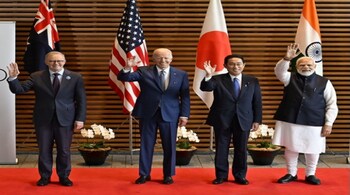
A meeting of senior officials of the Quadrilateral Security Dialogue (Quad) represented by the US, Australia and Japan hosted by India this week, has brought out interesting observations from Chinese commentators, especially on how India’s role was different from the other members.
They said Australia and Japan have tied themselves tightly to the US ‘anti-China chariot’. But India’s cooperation with the US, unlike the other two, was done without undermining its strategic independence.
This week, India held a number of meetings with its Quad partners to discuss regional and global challenges.
On September 5, India and Australia held their Leadership Dialogue, while on Monday and Tuesday Delhi hosted senior officials of the Quad, followed by a 2+2 “inter-sessional” meeting with senior US officials.
On Wednesday, Indian Defence Minister Rajnath Singh and External Affairs Minister S. Jaishankar left for Tokyo to participate in a 2+2 meeting with their Japanese counterparts.
The flurry of meetings was the first major interaction between India and the Quad member countries after the flare-up in the Indo-Pacific region when China held a number of military exercises in the Taiwan Strait to protest US House Speaker Nancy Pelosi’s visit to the island last month.
China marked its anger against Pelosi’s visit with coercive military drills involving warships, fighter aircraft and live-fire exercises by firing missiles over Taiwan.
“Senior officials from the foreign ministries of Australia, India, Japan and USA discussed regional and global developments, reaffirming their vision for a free, open and inclusive Indo-Pacific,” Indian foreign ministry spokesman Arindam Bagchi said.
He added the senior officials also reviewed the ongoing cooperation and progress of initiatives announced under the Quad framework.
The Quad has widely been seen as an anti-China platform encouraged by the US to deal with Beijing’s rise in the Indo-Pacific region.
In a departure from its earlier position, China’s English daily Global Times, which often took strident positions against Indian policies, came out with comments from a number of Chinese commentators in a recent article praising India’s strategic independence.
It said, unlike Japan and Australia, which have tied themselves tightly to the US’ anti-China chariot, India’s cooperation with the US is based on “not undermining India’s strategic independence”.
The paper noted that with India moving towards becoming a developed country as Prime Minister Narendra Modi pledged recently, it will value its strategic independence rather than blindly following the US.
The Indian Commerce Minister Piyush Goyal will travel to the US for bilateral trade talks and the third Indo-Pacific Economic Forum ministerial meeting (IPEF) in Los Angeles.
The Global Times said Chinese analysts acknowledge India’s increasingly important role amid the bloc confrontation, as the West strengthened its cozying up to India in order to contain China, while Russia maintained positive relations with India.
It observed that India sees the big powers’ game as an opportunity for its strategic rise.
The Chinese paper said India’s cooperation with the US has not turned it against Russia. India is the only member of the Quad that has not joined the US in imposing sanctions on Russia or blaming it for the conflict in Ukraine.
It said the Russian Ambassador to India, Denis Alipov recently criticised the US-led Indo-Pacific policy as a “containment policy.” But he appreciated India’s position at the Quad for refusing to endorse its “divisive” statements.
It quoted Chinese analysts as saying that what makes India a fundamentally different member of the Quad is that it prioritises its strategic independence rather than serving as a pawn of the US at the cost of giving up independence like Japan and Australia.
The Chinese analysts stressed that India will never cooperate with the US, and this is not just a strategic choice. India will cooperate with the US only when it is in its best interest to do so.
To maintain its strategic independence, India has also sent a military contingent to Russia to participate in the Vostok military exercise. But it has decided to participate only in the land exercise and will stay away from the maritime ones to avoid being part of the belligerent naval drills around Japan, a close strategic partner.
Some observers see the series of meetings and engagements of India this week with the Quad members as an attempt to maintain a balance in view of its participation in the Shanghai Cooperation Organisation (SCO) ― a joint initiative of China and Russia.
The Indian Prime Minister Narendra Modi who is likely to participate in the SCO Summit in Uzbekistan on September 15 and 16, will share the platform with Chinese President Xi Jinping and his Russian counterpart Vladimir Putin. Modi will also meet the Iranian President and other leaders of Central Asia and Pakistan.
The hectic diplomatic calendar of India this month and its engagement with a range of diverse groups of countries and blocs is a reaffirmation of the desire to expand its options and maintain its strategic independence.
Discover the latest Business News, Sensex, and Nifty updates. Obtain Personal Finance insights, tax queries, and expert opinions on Moneycontrol or download the Moneycontrol App to stay updated!





