

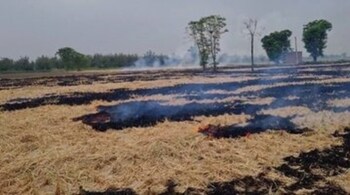
Haryana is on track to become a zero stubble-burning state within two years, Chief Secretary Anurag Rastogi said on Friday, citing significant progress in curbing crop residue fires.
The state recorded a 77 per cent reduction in farm fire incidents this season, with only 171 cases reported as of November 6, compared to 888 during the same period last year, Rastogi said after a high-level review chaired by Rajesh Verma, Chairperson of the Commission for Air Quality Management (CAQM). Verma appreciated the joint efforts of Haryana officials and farmers, particularly in Karnal and Kurukshetra districts, for their success in reducing paddy residue burning.
He stressed that the next ten days are critical and directed district administrations to maintain strict vigilance. Rastogi said Haryana’s three-pronged strategy, in-situ management, ex-situ utilisation, and fodder use, has yielded strong results across the state’s 39.31 lakh acres of paddy area. Of this, 44.40 lakh tonnes of residue are being managed in-situ, 19.10 lakh tonnes through ex-situ methods, and 22 lakh tonnes are used as fodder.
The government has promoted sustainable practices by diversifying 19,670 acres from paddy cultivation and encouraging 1.74 lakh farmers to adopt Direct Seeding of Rice (DSR). Financial incentives include Rs 1,200 per acre for residue management, Rs 8,000 for crop diversification, and Rs 4,500 for DSR, with a total outlay of Rs 471 crore.
Free bio-decomposer powder is being applied on 2 lakh acres under the supervision of the Haryana Agricultural University. Under the Crop Residue Management scheme 2025-26, 7,781 machines worth Rs 94 crore have been sanctioned, with a total funding of Rs 250.75 crore shared by the Centre and state. Haryana has expanded industrial use of paddy straw, including 31 pelletization and briquetting plants, 11 biomass power plants generating 111.9 MW, one 2G ethanol plant, two Compressed Biogas plants, and five thermal power plants using 16.64 lakh tonnes of straw. Brick kilns in non-NCR districts have been instructed to use 20 per cent straw-based pellets by 2025, rising to 50 per cent by 2028.
The state has deployed 10,028 nodal officers and uses satellite monitoring from Haryana Space Applications Centre for real-time fire detection. FIRs and environmental compensation are being imposed for verified cases. As of November 6, Rs 4.60 lakh has been levied in 87 cases, with Rs 3.35 lakh recovered, and corresponding red entries made in farm records. On waste management, 169 waste-burning incidents identified this year have been resolved through awareness and enforcement, with 86 CCTV cameras installed in Gurugram and Faridabad to monitor dumpsites.
Discover the latest Business News, Sensex, and Nifty updates. Obtain Personal Finance insights, tax queries, and expert opinions on Moneycontrol or download the Moneycontrol App to stay updated!





