

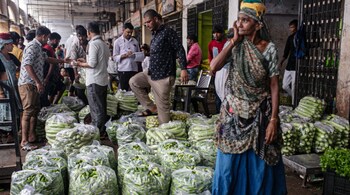
“Food price inflation continued to impart considerable volatility to the inflation trajectory,” RBI Governor and MPC Chair Shaktikanta Das had said while announcing the monetary policy decisions on February 8. The Monetary Policy Committee (MPC) left the inflation forecast unchanged at 5.4 percent for the current fiscal year and at 4.5 percent for FY25.
The CPI inflation data for January reaffirms what the RBI has been rightly worried about. The sticky components of food inflation — higher prices of spices, vegetables, and pulses — have persisted, and in some categories, prices in rural areas have edged higher than in urban areas. In an election year, this could present a worrying situation for the government.
For January, CPI at 5.1 percent was pretty much in line with market expectations. It stood at 5.69 percent in December. One of the major contributors to inflation was the high prices of food — vegetables and pulses. Inflation in vegetables was at 27.03 percent, pulses at 19.54 percent, and in spices at 16.36 percent. Interestingly, prices of edible oil have been on a slide, falling 14.96 percent. Inflation for meat and fish at 1.19 percent, fuel at 0.60 percent, and cereal and (related) products at 7.83 percent.
ALSO READ: Inflation posing the 'last mile' challenge
In rural areas, inflation across some of these categories continued to be higher than in urban areas. In spices, inflation in rural areas was 16.86 percent compared to 15.27 percent in urban areas, in transport and communication it was 2.26 percent versus 1.63 percent in urban areas, sugar and confectionary 7.81 percent versus 6.85 percent, and for eggs 6.22 percent versus 4.62 percent.
The good news is that prices of cereals have come down from double digits since September 2022, but prices of vegetables, pulses, and spices continue to be volatile and high. For pulses, inflation has continued to be painfully sticky and in double digits for several months. This is despite the government extending the free import policy for tur and urad dal until March 2025.
Why is high rural inflation a concern?
“Going forward, the inflation trajectory would be shaped by the evolving food inflation outlook. Rabi sowing has surpassed last year’s level. The usual seasonal correction in vegetable prices is continuing, though unevenly. Yet considerable uncertainty prevails on the food price outlook from the possibility of adverse weather events,” Governor Das said in his MPC statement.
Rural demand has continued to trail urban demand, and while several have dismissed the K-shaped recovery theory, the RBI said in its November bulletin that rural consumers are becoming increasingly price-sensitive and switching to cheaper alternatives. According to the bulletin, overall volume growth in rural areas was 6.4 percent compared to 10.25 percent in urban areas. The uncertainty on the food price outlook only aggravates concerns about high rural inflation. For vegetable prices, inflation in rural areas is at 25.82 percent compared to 28.92 percent in urban areas.
High rural inflation will have a direct impact on rural incomes and demand, which will have a spillover effect on a slew of industries, from FMCG to auto to housing. It also impacts economic activities and job creation.
In an election year, the ‘All is well’ messaging can only work when the price of the basic Indian thaali comes down. According to an analysis by Crisil, the price of the veg thaali was Rs 28 in January, compared with Rs 29.7 in December and Rs 26.6 in January 2023. The price of the thaali increased due to a 35 percent surge in onion prices year-on-year (YoY) and 20 percent in tomato prices.
Meanwhile, the government has taken aggressive measures to bring down inflation in pulses in the last few months, including supply-side measures such as managing exports and imports of pulses, releasing substantial cereal stocks, and restricting exports of rice and sugar. It has also launched a slew of Bharat brands across categories such as atta, rice, dal, etc.
“Food inflation moderated to 8.3 percent from 9.5 percent. Vegetable inflation eased slightly but remained elevated at 27 percent. Foodgrain inflation (cereals plus pulses) softened by 200 basis points (bps). That said, the prices of some key food items remain high and will need to be monitored. On the plus side, rabi sowing has picked up and exceeded last year’s level, which augurs well for food inflation going forward,” DK Joshi, Chief Economist, Crisil, wrote in a note.
The political implications of the dal-roti economics are significant enough for the government to step up on interventions.
Discover the latest Business News, Sensex, and Nifty updates. Obtain Personal Finance insights, tax queries, and expert opinions on Moneycontrol or download the Moneycontrol App to stay updated!





