

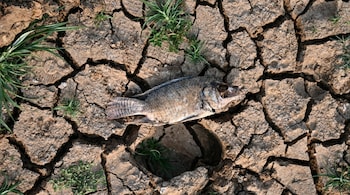
India’s water shortage could be detrimental to the credit health of sovereign, water-dependent entities like coal power generators and steel-makers, global rating agency Moody’s Ratings alerted on June 25.
The ratings agency pointed out that growing water crisis may exacerbate volatility in growth and undermine country's ability to withstand shocks. “India's fast economic growth, accompanied by rapid industrialisation and urbanisation, is reducing water availability in the world's most populous country,” it noted in a report.
The global rating agency highlighted that a drying water supply may affect farming, leading to higher food inflation and a decline in income for certain businesses.
“India has the poorest access to basic services, including water, among G-20 economies, a key component for an assessment of the credit impact of ESG factors,” Moody’s said. ESG stands for environment, social and governance.
Moody's sovereign rating for India is Baa3 with a stable outlook. The rating agency expects India to be fastest growing major economy with 6.5 percent growth in 2024.
India’s food inflation has been sticky at over 8 percent despite overall inflation declining below 5 percent. In May, food inflation had remained unchanged at 8.7 percent and is likely to stay elevated for the coming months, according to experts.
Moody’s pointed out that investments in water infrastructure and renewable energy could mitigate risks in the long term. “India's burgeoning sustainable finance market can help companies finance water investment,” the rating agency noted.
In February 2024, Vadodara Municipal Corporation issued $12 million of green bonds to enhance liquid wastewater management infrastructure. In 2021, Ghaziabad had raised $18 million for water treatment plants.
The Centre had allocated $2.52 billion for Ganga Rejuvenation in the interim budget.
“India's average annual water availability per capita is likely to drop to 1,367 cubic metres by 2031 from an already low 1,486 cubic metres in 2021, according to the Ministry of Water Resources,” Moody’s pointed out.
India considers a level below 1,700 as a sign of water stress and 1,000 cubic metres as a threshold for water scarcity.
The industry’s demand for water is expected to double from 2.1 percent in 2025 to 4.4 percent by 2050, whereas energy demand for water will grow six-fold to 9 percent during this period.
Discover the latest Business News, Sensex, and Nifty updates. Obtain Personal Finance insights, tax queries, and expert opinions on Moneycontrol or download the Moneycontrol App to stay updated!





