

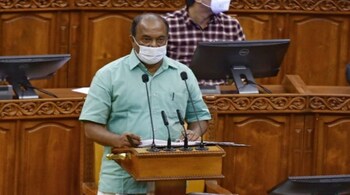
Kerala is facing a serious financial crunch due to decreasing share of taxes for states in the Centre’s divisible pool, conditional limit on borrowing and a cut in grants owing to which it decided to raise funds via cess on fuel, state finance minister KN Balagopal said.
“The Union government is decreasing our share from the Centre's taxes, which is the divisible pool. Also, there is the issue that for borrowing there are some stipulations and conditions. The loan of our major infrastructure development firm - Kerala infrastructure fund board - is also coming into state borrowing. Then some other special grants have been cut. So we are facing a very serious (financial) threat. That is why we said there should be a Rs 2 cess on fuel,” Balagopal told Moneycontrol in a video interview.
Kerala has imposed a social security cess of Rs 2 per litre on petrol and diesel. A social security cess of Rs 20 will be levied on liquor costing up to Rs 1,000, and a Rs 40 cess on liquor costing above Rs 1,000. There is also a 2 percent tax increase on new two-wheelers costing above Rs 2 lakh in the 2023 budget.
“The cess is for a specific purpose of social security. We are giving Rs 1,600 per month to 62 lakh persons. We are openly telling the people that this is the situation in Kerala that is why we are doing this. We are not getting proper support from the Union government. States need a legitimate share of the taxes,” he said.
As far as the borrowing limit is concerned, the Union budget has set a limit of 3.5 percent, with 0.5 percent conditional on reforms in the power sector. Also, if the borrowing is to be serviced from the consolidated fund of the state, then regardless if it is taken by the state or an organisation of the state, it is counted within the permissible borrowing ceiling of the state. This is being enforced from 2022-23.
“We are actually doing a lot of reforms in the power sector. We will utilise the 0.5 percent conditional borrowing as well by fulfilling the criteria. The state governments are compelled to curtail all the expenses. However, we will not surpass the stipulated percentage of borrowing limit,” he said.
The Goods and Services Tax (GST) compensation to states, which was a protected revenue at the rate of 14 percent, for a five-year period has also come to an end which is causing the shortage of funds for the states.
“In GST, we hope that the Union government will reconsider their stand on the compensation issue. In 2017, when GST was introduced, there was an apprehension among the states that there will be a sharp decline in taxes and there was a formula for compensation at the rate of 14 percent as it was the year-to-year growth at that time. So, the basis was that the taxation system will mature over time. Every year Kerala was getting that protected income. Due to COVID, the economy of every state is facing problems,” the minister said.
Secondly, he said that the GST rates are much below the revenue-neutral rates, which is leading to lower revenue for the states.
“The revenue-neutral rate was 16 percent. On many luxury items, around 250 items, the tax was reduced by the Council from 28 percent to either 12 percent or 18 percent. According to a study by our department on about 25 items, the tax was reduced, but actual benefit was not given to the customers. The tax reduction went to the kitty of the manufacturers. The revenue-neutral rate dropped by around 5 percent to only 11 percent. So there is a sharp fall in taxes and this is affecting the income. Kerala would have got Rs 12,000-14,000 crore more than what we are getting now from GST. So due to natural calamities and COVID and the tax reduction our funds have gone down. So states requested for extension of the compensation period by further five years. But the union government is not taking any stand,” he said.
Petrol, diesel and liquor continue to be out of the purview of GST on which states’ consensus is needed to bring it under the GST. “Central government is also collecting cess on petrol and diesel. It is encroaching upon the taxation rights of the states using Article 271. The cess is not divisible. The fiscal federalism of the states is under question. This is a very serious issue,” Balagopal said.
Discover the latest Business News, Sensex, and Nifty updates. Obtain Personal Finance insights, tax queries, and expert opinions on Moneycontrol or download the Moneycontrol App to stay updated!





