« back to moneycontrol
CURRENCIES WITH MECKLAI FINANCIAL.
- Trade currencies on recommendations from the best foreign exchange consultants in the country.
- Get real time SMS and a Weekly Report with detailed global insights and technical levels to enter and exit trades.

23 March 2026
Monday
Global Stagflation Alert, Major Economies Faces Heat.
Global markets faced heightened volatility last week as surging crude prices and geopolitical tensions weighed on currencies and equities. The Indian rupee depreciated sharply to a record low of 93.73 levels, pressured by rising oil import costs and capital outflows. Forex reserves fell by $12 billion in March, underscoring the strain of defending the rupee. Imported inflation risks remain elevated, with fuel and gold prices expected to rise further.
On International front, inflation concerns resurfaced as energy disruptions pushed producer prices higher. The Federal Reserve held rates steady but signaled caution, revising inflation projections upward and leaving open the possibility of further tightening. Treasury yields climbed to 4.38%, reflecting repricing of inflation risks, while housing indicators weakened under the weight of high mortgage rates. The outlook points to slowing growth alongside sticky inflation, raising stagflation concerns.
The Eurozone economy showed fragile stabilization, with modest GDP growth of 0.2% and improving PMI data. However, rising energy costs threaten to stall disinflation, keeping inflation expectations elevated. The European Central Bank adopted a cautious stance, leaning slightly hawkish as markets scaled back rate-cut expectations. The euro traded within a 1.14–1.18 range against the dollar, reflecting mixed fundamentals of weak growth but tighter policy prospects.
In the UK, the pound slipped below $1.34 as inflation risks resurfaced. The Bank of England held rates at 3.75% but warned of renewed commodity-driven inflation. Labour market conditions weakened, with unemployment rising to 5.2% and wage growth slowing. Fiscal pressures also mounted, with borrowing hitting £14.3 billion in February. Markets now anticipate multiple rate hikes in 2026, complicating the policy outlook amid slowing employment momentum.
Japan’s economy continued a moderate recovery, supported by strong business sentiment and wage growth. The Bank of Japan kept rates at 0.75%, though internal divisions emerged over tightening. Inflation neared the 2% target, but policymakers stressed the need for wage-driven stability. Risks from China’s weak demand and rising energy costs persist. Meanwhile, Brent crude surged above $110 per barrel, driven by Gulf supply disruptions, reinforcing energy-driven volatility across global markets.
Product offering
Trading currency involves the right combination of awareness, preparation and action. Over the last thirty years, Mecklai Financial has equipped corporate treasury managers and CFO’s in India’s with actionable advice to optimally manage their market risk .Mecklai will give you the right information, analysis, and updates for traded currency future pairs.
top Trading Opportunities
The service will highlight potential trades in currencies with the trading calls rendered through SMS for timely execution. The SMS will mention entry price range, stop loss levels and the expected target zones.
SAMPLE SMS
- Buy USD/INR Dec at 62.05 for target 62.20. Stop loss of 61.95
- Sell EUR/INR Nov at 77.10 for target 76.90. Stop loss 77.25
- Buy GBP/INR Nov at 97.85 for target 98.10. Stop loss 97.70
- Sell JPY/INR 52.85 for target 52.52. Stop loss 53.03
Recommendations are provided for short term and positional trading with entry level and stop loss.
WEEKLY ROUNDUP REPORT
The weekly roundup report will provide detailed insights on the current and future trends in currencies and related commodities like gold and oil. Additionally, it will outline the trend and trading opportunities in the week ahead.
Newsletter Sections-content Snapshot
The weekly mailer gives you a smart perspective on how global and domestic events will impact your currency trading with snippets on gold and oil. In addition the charts and the technical levels for each of the four currency pairs (USD/INR, EUR/INR, GBP/INR, JPY/INR) give you firm levels to enter and exit positional trades with optimum risk.
Why Subscribe ?
- Forewarned is forearmed: MECKLAI FINANCIAL will help you navigate the complex world of currencies and profit from it. You can count on Mecklai’s expertise, to identify opportunities that can translate into windfall gains and even exploit arbitrage opportunities as and when they arise. Starting April 2013, to the current time, 70% of the calls given by the futures desk have been profitable.
As a new investor in this market you may find Currency trading appear intimidating, but Mecklai will help you break through the layers of jargon and simplify things the various terms for you.
All trades recommended are tracked on a weekly basis so you can see the impact directly on your balance sheets.
ABOUT MECKLAI FINANCIAL

Mecklai Financial Services Private Ltd. is a consulting company exclusively focused on treasury risk management. With offices at five locations across India, they deliver customized solutions, backed by their proprietary risk management approach, high quality market research and robust technology processes. They draw their heritage from the Mecklai group, one of the leading brands in financial markets in India for over 85 years.
Their CEO, Jamal Mecklai, is an authority on all matters market and has been appointed to RBI committees to recommend measures on the local foreign exchange markets and managing commodity risk. He is also consultant to the World Gold Council and the Forwards Markets Commission and a frequent contributor to the media, both print and electronic.
Vision:
To provide clients with unparalleled knowledge of markets and use Mecklai’s experience to enable companies and individuals make optimal use of markets.
FULL REFUND TRIAL PERIOD
Annual
Subscription Offer
12,000

3 Months
Subscription Offer
5,000

Rupee on a down trend on emerging market sentiment : US Equities lead the way.
12.58 PM
FX MARKETS
RBI rate cut rumors vanished at the start of the week with the continued depreciation of the rupee being the key story. Experts opined that a rate cut at the time of sharp depreciation across emerging currencies in Asia a rate cut would not work well. The RBI chief, speaking at a banking conclave, was upbeat on growth citing a good monsoon was likely to see a tick up in rural demand and reiterated there was a room for rate cuts going ahead, provided there was further transmission of rates by banks. However the MOF is probably likely to continue to apply pressure for early rate cuts as growth momentum remains muted. .Stock markets were pressured by the risk off sentiment across markets as outflows from emerging markets continued to tick up. Domestic yields climbed at the end of the week, with the ten year benchmark yield at 7.77% against 7.75% at the start of the week. Today it has opened at 7.83%. Meanwhile IMF has downgraded India growth forecast this year to 7% against the earlier 7.5%.
DXY slipped below its range over the last two weeks, as experts raised concerns on troubles in emerging market economies likely to raise the scepter of global deflation if it continued for longer. In the light of that, it would be difficult for the FED to effect, the token increase in US interest rates this year which was largely expected. This realization seems to have turned the market on its head with investors moving into a risk off mode with equities across the globe at record low levels. The S&P 500, has, for instance, given up all its gains in this year. This is despite the fact that the US data remains close to expectation or better. Housing data was mostly better than expected with US Housing starts at an 8 year high. However jobless claims ticked up by 5000 to 277K and CB leading index fell to -0.2% against the earlier reading of 0.6%. Flash manufacturing PMI was at 52.9 versus 53.8.
The Euro climbed higher, moving above 1.12 at the end of the week and opened at 1.45 at the start of the week, as it appreciated against the dollar as did the Yen and CHF on possible unwinding of carry trades. Data from the Eurozone remained close or better than expectations this week, but was ignored in light of the lack of movement in GDP and CPI data. Eurozone current account surplus improved to $25.4 billion even as the Greek PM Tspiras resigned at the weekend, with hopes of coming back stronger in a snap election to be held on Sep 20. He faces strong opposition from the members of his own party, despite the fact that Greece has received parliamentary approval for its third bail out plan. The PMI numbers across the Eurozone weres better except for French manufacturing PMI which stayed below the expansion point of 50 at 48.6.
The Yen stayed higher, moving down only at the end of the week on safe haven buying on account of troubles in China as the Caixin Manufacturing PMI came in at 47.8 versus an expectation of 48.2. Chinese equity markets continue to fall even though the Yuan depreciation of the previous week has stabilized, with higher fixings for Yuan through the latter half of last week. However the risk off sentiment it has set off seems to have a mind of its own and there does not seem any let up in capital outflows from China and other emerging markets, despite the fact the dollar has actually become weaker this week.
The outlook on oil and commodities continues to hinge on China as commodity currencies come under increasing pressure. A small window on US exports of oil creaked open with the government allowing US oil companies to do a 1:1 swap of light sweet crude with Mexican oil companies doing refinery operations. However the protectionist lobby on oil remains strong and it is unlikely that much other leeway will happen in a hurry. The Middle East continues to pump output at record levels and with Iran coming on stream, investors worry about a supply glut at a time of falling demand. Inventories in the US are continuing to climb as the driving season in the US comes to an end. Currently Crude quotes at $ 40.89 and Brent is close to $44.70.
Gold moved higher on safe haven buying as global equities tanked with Dow falling to 10% over the week accompanied by falling yields across emerging markets. Gold moved up sharply to trade at $1158 and is likely to keep climbing as VIX Index’s move higher across the globe.
MARKETS LAST WEEK (Aug 17-21)
PAIR
EXPIRY
OPEN
HIGH
LOW
CLOSE
% CHG
USD/INR
27th Aug 15
65.27
66.01
65.21
65.94
1.24
EUR/INR
27th Aug 15
72.35
74.47
71.90
74.34
2.09
GBP/INR
27th Aug 15
101.99
103.67
101.99
103.32
1.44
JPY/INR
27th Aug 15
52.46
53.86
52.43
53.78
1.72
FUTURES
RBI REF RATE 21/08/2015
OPEN INTEREST Aug 2015)
VOLUME
(ALL CONTRACTS )
VOLUME
(RS. CRORE)
USD/INR
65.94
65.8298
24,34,412
74,19,600
48,692.98
EUR/INR
74.34
74.2692
89,346
299,834
21914.08
GBP/INR
103.32
103.3897
65,761
208,845
2083.08
JPY/INR
53.78
53.5500
12,757
67,510
358.08
USD/INR ARBITRAGE on Aug 21, 2015
SPOT
1 MONTH
2 MONTH
3 MONTH
NDF
65.86
66.28
66.56
66.90
FORWARDS
65.80
65.89
66.26
66.64
FUTURES
65.94
66.30
66.65
TECHNICAL SUPPORTS AND RESISTANCES (AUG 24–28)
PIVOT
S2
S1
R1
R2
Outlook
USD/INR
64.85
64.92
65.43
66.23
66.52
UP
EUR/INR
71.94
71.00
72.67
75.24
76.14
UP
GBP/INR
100.98
101.31
102.32
104.00
104.67
Up
JPY/INR
52.02
51.93
52.85
54.28
54.79
UP
USD/INR TECHNICALS
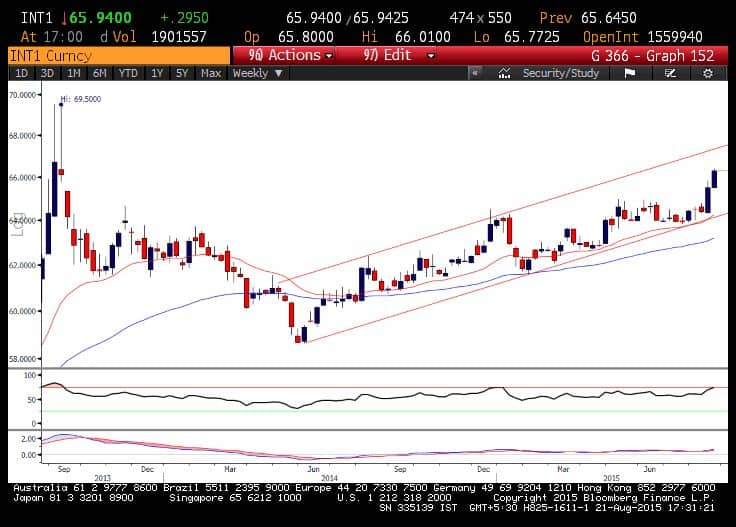
In our previous comment we had mentioned that, USD/INR continues to move in a positive formation and it is moving with an upward bias. As far as prices are moving crossing its previous highs the probability for the pair to test the level of 66 is likely with support placed at 64.80 levels.
Prices made a high of 66.01 last week thus achieving our mentioned level. The bias still is positive and can move higher till 66.50 levels in the current week. The support now will be at 65.40 on the downside.
EUR/INR TECHNICALS
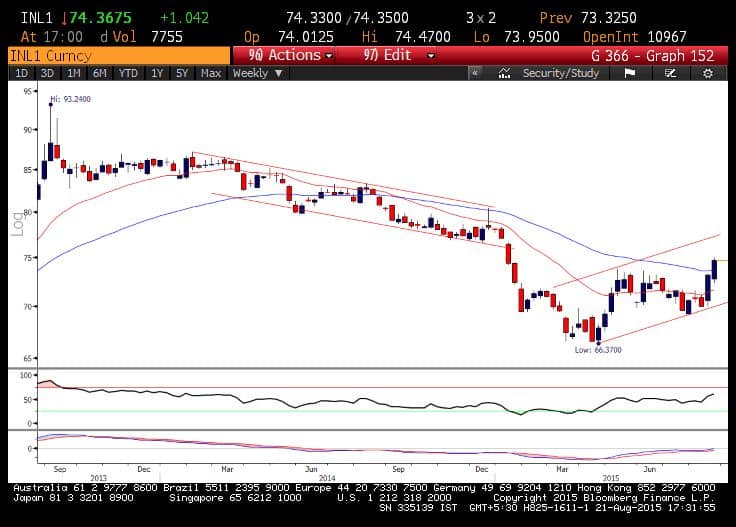
In our previous comment we had mentioned that, prices are on the brink to cross its previous high which will open positive possibilities which will push prices higher till 74 levels going ahead. The pair has protected its previous low and will probably make ne immediate high. RSI is above 50 which gives positive signal.
Prices crossed its previous high thus achieving our mentioned level of 74. Prices closed above the 50 SMA which opens further positive possibility. The revised target will be 75 for next week with support placed at 73.80 levels.
GBP/INR TECHNICALS
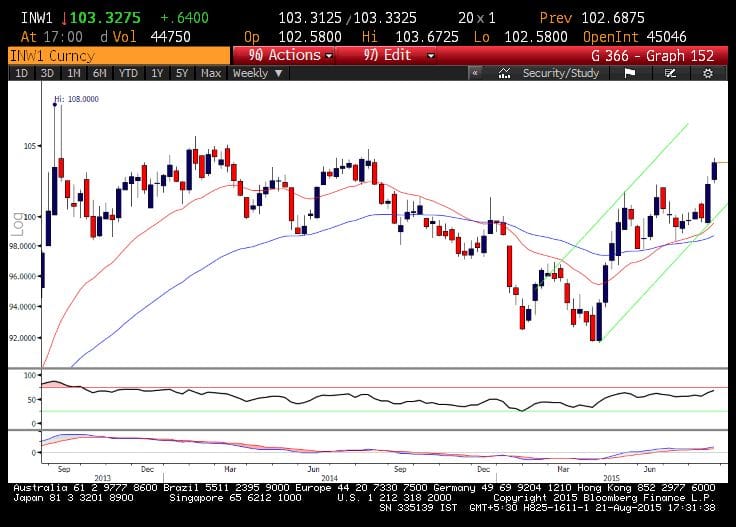
In our previous comment we had mentioned that GBP /INR bounced from the support of the moving average and it shows a perfect example of a bullish moving average crossover which is a positive sign. Prices are making a higher highs and higher lows which is a positive formation. It can test the level of 102.50 in near term with support at 101 levels.
It made a high of 103.67 levels thus achieving our level of 102.50. The overall outlook continues to be positive with the target of 105 in coming week. The support will be at 102.50 levels on downside.
JPY/INR TECHNICALS
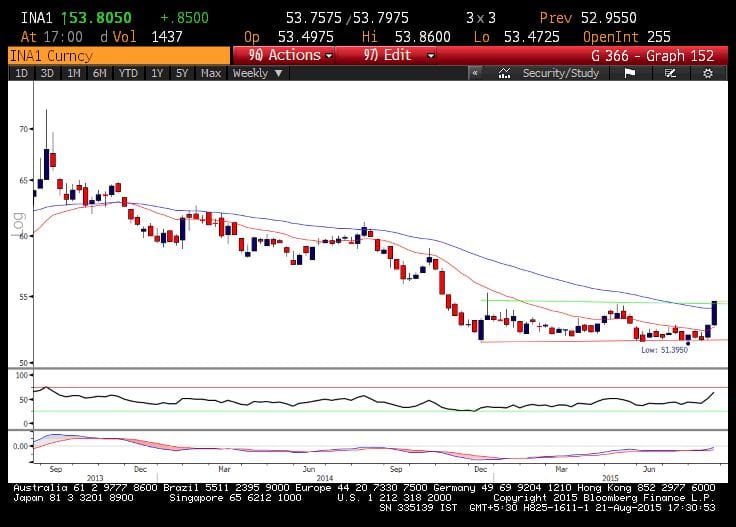
Prices broke the rectangle pattern which opens positive possibility. The over all outlook continues to be positive as the pair can move to 55 levels in the near term. The support will be at 52 levels on the down side. However, RSI is inching towards 70 but MACD has given a fresh buy signal.
GLOBAL OUTLOOK (AUG 24–28)
SPOT
PR. CLOSE
% CHANGE
S2
S1
R1
R2
EURUSD
1.1278
1.1173
0.94
1.0800
1.1000
1.1400
1.1500
GBPUSD
1.5677
1.5636
0.26
1.5250
1.5410
1.5710
1.5900
USDJPY
122.72
124.08
-1.10
120.00
121.00
123.50
125.00
Gold
1153
1119
3.04
1070
1130
1170
1200
Silver
15.4
15.47
-0.45
13.90
14.50
15.50
15.80
WTI
41.14
42.28
-2.70
38.00
40.00
45.50
47.00
ECONOMIC DATA RELEASES (AUG 24–28)
DATA RELEASES
FORECAST
PREVIOUS
IMPACT
August 25 , Tuesday
German Final GDP q/q
0.4%
0.4%
Medium
France Employment Level
4.24M
4.23M
Medium
German Ifo Business Climate
107.6
108
Medium
U.S HPI m/m
0.4%
0.4%
Medium
U.S S&P/CS Composite-20 HPI y/y
5.1%
4.9%
Medium
U.S Flash Services PMI
54.1
55.7
Medium
CB Consumer Confidence
92.8
90.9
Medium
U.S New Home Sales
512K
482K
Medium
U.S Richmond Manufacturing Index
9
13
Medium
August 26 , Wednesday
Aus Construction Work Done q/q
-1.50%
-2.40%
Medium
RBA Gov Stevens Speaks
Medium
France UBS Consumption Indicator
1.68
Medium
U.K BBA Mortgage Approvals
46.0K
44.5K
Medium
U.K CBI Realized Sales
19
21
Medium
U.S Core Durable Goods Orders m/m
0.30%
0.60%
Medium
U.S Durable Goods Orders m/m
-0.50%
3.40%
Medium
FOMC Member Dudley Speaks
Medium
U.s Crude Oil Inventories
2.6M
Medium
August 27 , Thursday
Aus Private Capital Expenditure q/q
-2.50%
-4.40%
Medium
German Import Prices m/m
-0.30%
-0.50%
Medium
U.K Nationwide HPI m/m
0.40%
0.40%
Medium
Euro M3 Money Supply y/y
4.90%
5.00%
Medium
Euro Private Loans y/y
0.70%
0.60%
Medium
U.S Prelim GDP q/q
3.20%
2.30%
High
U.S Unemployment Claims
275K
277K
Medium
U.S Prelim GDP Price Index q/q
2.00%
2.00%
Medium
U.S Pending Home Sales m/m
1.30%
-1.80%
High
U.S Natural Gas Storage
53B
Medium
August 28 , Friday
U.K GfK Consumer Confidence
4
4
Medium
Japan Household Spending y/y
0.90%
-2.00%
Medium
Japan Tokyo Core CPI y/y
-0.10%
-0.10%
Medium
Japan National Core CPI y/y
-0.20%
0.10%
Medium
Japan Unemployment Rate
3.40%
3.40%
Medium
Japan Retail Sales y/y
1.10%
1.00%
Medium
France GDP q/q
-0.10%
-0.20%
Medium
German Prelim CPI m/m
-0.10%
0.20%
Medium
Spanish Flash CPI y/y
-0.10%
0.10%
Medium
U.K Second Estimate GDP q/q
0.70%
0.70%
Medium
U.K Prelim Business Investment q/q
1.60%
2.00%
Medium
U.K Index of Services 3m/3m
0.40%
Medium
Italian 10-y Bond Auction
Medium
U.S Goods Trade Balance
-62.3B
Medium
U.S Core PCE Price Index m/m
0.10%
0.10%
Medium
U.S Personal Spending m/m
0.40%
0.20%
Medium
U.S Personal Income m/m
0.40%
0.40%
Medium
U.S Revised UoM Consumer Sentiment
93.2
92.9
Medium
U.S Revised UoM Inflation Expectations
2.80%
Medium
Standard Disclosure:
Mecklai Financial Services Private Ltd (MECKLAI) does not warrant the accuracy, adequacy or completeness of this information and material and expressly disclaims liability for errors or omissions in this information and material. No warranty of any kind, implied, express or statutory, including but not limited to the warranties of non-infringement of third party rights, title, merchantability, fitness for a particular purpose and freedom from computer virus, is given in conjunction with the information and materials.
In no event will MECKLAI be liable for any damages, including without limitation direct or indirect, special, incidental, or consequential damages, losses or expenses arising in connection with this website or use thereof or inability to use by any party, or in connection with any failure of performance, error, omission, interruption, defect, delay in operation or transmission, computer virus or line or system failure, even if MECKLAI, or representatives thereof, are advised of the possibility of such damages, losses or expenses.
Hyperlinks from and to other websites are at your own risk; the content, accuracy, opinions expressed, and other links provided by these resources are not investigated, verified, monitored, or endorsed by MECKLAI.