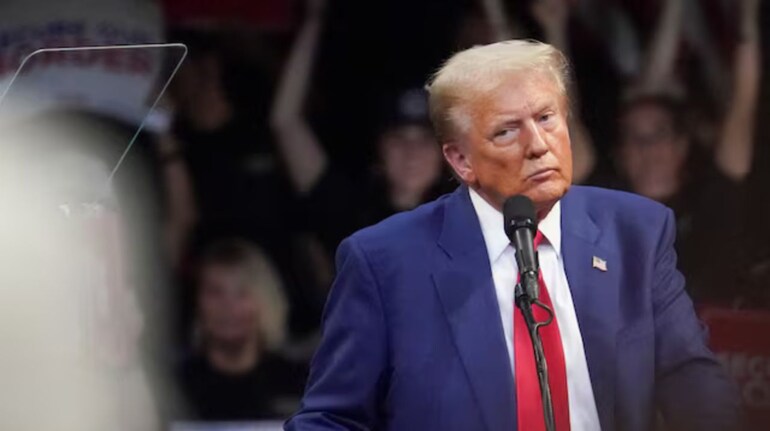
With Republican Donald Trump claiming victory in the 2024 US presidential election against Democrat Kamala Harris, China is preparing for four more years of fierce rivalry on issues of trade, technology, and security.
So what does Trump’s second term could likely mean for China?
A recent report by Barclays suggested that should Donald Trump return to the White House, it could lead to a "full-blown trade war," and that may lead to China contemplating a larger stimulus package.
The report points that Chinese leaders are likely to monitor the US election results closely, given the potential implications for trade policies, especially tariffs.
Trump has proposed implementing tariffs above 60 per cent on imports from China and ending the country's most-favoured-nation trading status. China reportedly exports over $400 billion worth of goods to the US each year, along with additional hundreds of billions in components for products purchased by Americans from other countries.
In his second term, Trump could pursue the removal of pharmaceutical manufacturing in China for the US market, as per The Diplomat. He may attempt to acquire and protect key minerals required for high-tech manufacturing, and will certainly continue to strengthen his goal of bringing manufacturing back to the US, the report added.
At a rally in Pennsylvania, Trump stated he would levy a 25 per cent tariff on goods from Mexico and would do the "same thing to China" for exporting fentanyl to Mexico.
"Every damn thing that they sell into the United States is going to have like a 25 per cent (tariff) until they stop drugs from coming in. And let me tell you something, those drugs will stop so damn fast that your head will spin," he said.
Trump would also likely introduce a ‘witch hunt’ against anyone he considers a ‘Chinese spy.’ Such actions may not only move both economies closer to a potential decoupling but also interfere with significant scientific research efforts, according to a report by Brandeis University, a research university in Massachusetts, US.
Beijing is particularly wary of a potential revival of the trade war under Trump, especially as China currently faces significant internal economic challenges, Tong Zhao, senior fellow at the Carnegie Endowment for International Peace, was quoted as saying by Reuters.
"China also expects Trump to accelerate the decoupling of technologies and supply chains, a move that could threaten China's economic growth and indirectly impact its social and political stability."
He noted that China is likely to amplify its push for technological and economic self-reliance, while feeling more compelled to enhance economic partnerships with countries like Russia.
A Trump presidency would also mean more push back against Beijing’s Belt and Road Initiative (BRI), which is already facing stagnancy in many countries.
What are Chinese leaders considering now?
A Trump presidency could drive China to consider drastic actions, Barclays suggests. The report points out that China is expected to announce a significant economic stimulus package during the National People’s Congress (NPC) Standing Committee meeting, which wraps up on November 8.
The Economic Intelligence Unit (EUI) anticipates the issuance of about 6 trillion yuan (US$844 billion) in special sovereign bonds for debt restructuring and large bank recapitalisation, alongside 4 trillion yuan in special local government bonds aimed at purchasing idle land and unsold housing inventory, with the goal of easing liquidity constraints for developers.
China is likely to shore up ties with the Global South, Europe and Northeast Asian countries in the event of a Trump win, given his "transactional, isolationist, anti-globalist and anti-multilateral foreign policy", Brian Wong, assistant professor at the University of Hong Kong who studies grand strategy, told Reuters.
Chinese President Xi Jinping and Indian Prime Minister Narendra Modi found common ground last month, marking a rare thaw in relations, while Beijing has cautiously engaged with Japan’s new administration this fall, following years of tension.
"China expects the second Trump administration to further disengage from international agreements and commitments, creating opportunities for China to expand its influence in emerging power vacuums," Zhao added.
China's yuan weakened and stock markets on the mainland and Hong Kong fell on Wednesday, as investors leaned toward Donald Trump to win the US presidential election, which stayed too close to call.
(With agencies inputs)
Discover the latest Business News, Sensex, and Nifty updates. Obtain Personal Finance insights, tax queries, and expert opinions on Moneycontrol or download the Moneycontrol App to stay updated!

Find the best of Al News in one place, specially curated for you every weekend.
Stay on top of the latest tech trends and biggest startup news.