






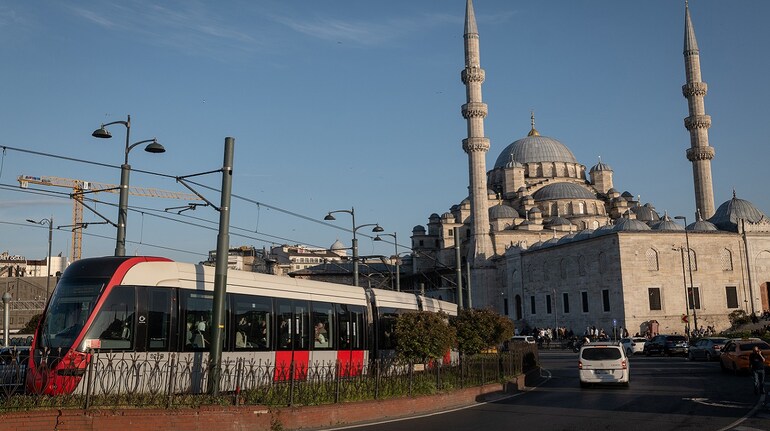
Unemployed Istanbul residents will soon be able to travel for free on public transportation. The measure, announced this summer by Mayor Ekrem İmamoğlu, is seen a way to remove barriers to finding a job in the megalopolis of 16 million people.
Istanbul may be the largest city yet to try such a policy, but it isn’t the first. Similar policies have been launched in smaller European cities such as Budapest; Birmingham, England; and Seville, Spain; as well as in Cape Town and the Australian state of New South Wales.
Istanbul’s program, which it hopes to roll out in October, is unusually large. It will apply to job seekers registered with the municipality’s regional employment centers, a group that totaled 237,893 people in 2023. Each eligible person will receive 96 free rides over a three-month period, with a maximum of four rides per day, via an app or QR code rather than a physical transit card to prevent misuse.
The plan arrives during a period when Istanbul’s transit costs have risen sharply. The price of a single ride on public transportation in Istanbul has soared almost fivefold over the past five years, as Turkey has experienced a series of currency crises and crippling inflation. The nationwide unemployment rate stood at 8.8% as of July, although when the under-employed and seasonally employed are taken into account, the “broad jobless rate” actually reached 27.2% by the end of that month.
“Especially since Covid, the topic of fairness, accessibility and affordability in transport has become an important topic globally,” says mobility expert Kaan Yıldızgöz, a former senior director at the International Association of Public Transport in Brussels, who also previously oversaw Istanbul’s metro system. “Local governments are looking for ways to support people in different financial situations amid ongoing economic crises.”
Subsidizing transit for job seekers is one of a number of ways cities have aimed to make transit more affordable. A few places like Luxembourg and Tallinn, Estonia, have made public transportation free for everyone, with mixed results. Many others have targeted populations with particular needs, like students or low-income residents.
Istanbul’s program seeks to ease a barrier to finding work. Research from the UK suggests that transportation costs make a difference to people trying to re-enter the job market. According to a 2019 report by the UK-based Urban Transport group, 77% of job seekers in British cities outside London lack regular access to a car, van or motorbike, with a quarter reporting their job search was inhibited by transit costs.
But studies have been mixed about how policies like Istanbul’s might affect employment outcomes. While the “majority of evidence suggests a positive association” between transport policies and employment, existing studies are “not conclusive or consistent, and often show mixed results,” according to researchers at the Institute for Transport Studies at the University of Leeds who conducted a systematic review of almost 100 such studies.
Two contrasting examples: A 2014 study by Indiana’s University of Notre Dame, found that clients of a nonprofit employment agency based in Washington, DC, who received a transportation subsidy interviewed for 19% more jobs that those who did not.
On the other hand, a 2016 study co-authored by University of Notre Dame economist David C. Phillips — who also worked on the Washington, DC, trial — found that job seekers in Seattle who were offered free fares “rode transit a lot more, but it didn’t necessarily generate more employment.”
It's difficult to assess the effectiveness of such schemes partly because there is little uniformity among global policies. Budapest’s scheme offers unlimited free transit to all job seekers, for example, while New South Wales only offers discounts, and for a limited 90-day job-seeking period. South Africa’s Western Cape province issues free transit vouchers only for travel to and from interviews with registered partner employers.
Hidden Barriers
Offering help for the job-seeking period alone may also not be quite enough. Since 2021, The UK’s Transport for West Midlands, which runs public transport services in a region that includes the city of Birmingham, has offered free travel to former job seekers during the first eight weeks of a new job and a half-price pass for an additional four-week period.
“We found that people were supported quite well up until the employment offer, but at that point they would be off any benefits they were receiving and often going into debt until they receive their first paycheck,” says Victoria Beddows, Transport for West Midlands’ employment outreach lead. She adds that 52% of respondents in a recent survey of users said they would not have been able to accept their job without transport support.
There is also more to unequal mobility access than transit costs. “Transport equity is multidimensional; it’s not just down to free or affordable transport, but also access issues and service quality,” says Eda Beyazıt, a research fellow in active travel and micromobility at the University of the West of England and founder of the IstanbulON Urban Mobility Lab. Spatially, Istanbul’s level of access is already good, with 95% of the city covered by the bus network. Poor service frequency and long journey times may still be holding back people living on the urban periphery, suggests Beyazıt, with some areas only getting a few buses daily.
Only 17% of Istanbul’s jobs are currently accessible within 30 minutes of public transport travel time. The city aims to increase that figure to 30% by 2040, according to the Istanbul Metropolitan Municipality. With transfer costs meaning that “people will wait longer for one bus to avoid having to pay more than one fare,” Beyazıt says, reaching lower-wage jobs that require shift work can be especially problematic.
More Than Just Jobs
While Phillips’s study in the Seattle area found no direct impact on participants’ work life, it did suggest improvements in their overall well-being and health, including fewer Medicaid-covered visits to health care providers. Phillips and his colleagues are working on a follow-up study to analyze these results, but he suggests they might indicate that free transit allows people to access more than just a wider pool of jobs. They may also find it easier to access preventive care, a broader range of healthier foods and trips that benefit their mental health, such as taking their children to a park or visiting family and friends.
“You have to get to your job, but when transit becomes free, it creates opportunities to do other things in your life,” he says. “If we really care about equity, we should care about the actual preferences of people with low income and what they value.”
Discover the latest Business News, Sensex, and Nifty updates. Obtain Personal Finance insights, tax queries, and expert opinions on Moneycontrol or download the Moneycontrol App to stay updated!
Find the best of Al News in one place, specially curated for you every weekend.
Stay on top of the latest tech trends and biggest startup news.




