Poor human ears. There’s always something stuck to them.
The smartphone has clung to our lobes for a few years now. Otherwise it is earphones.
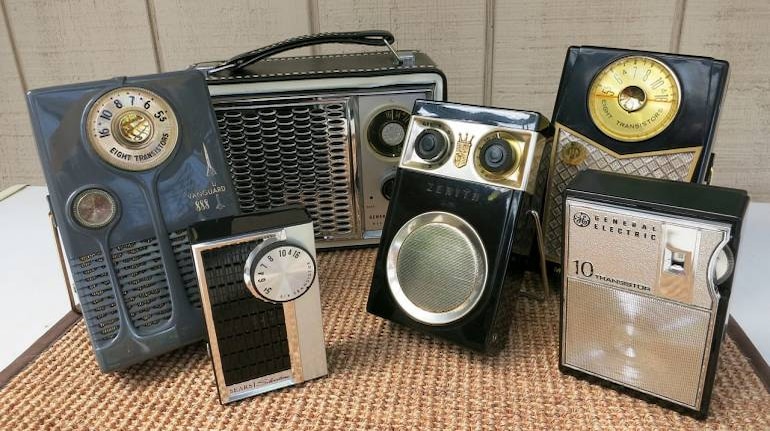
But before, the eternal kiss was between our ears and the radio.
A common emblem of Indian life was people walking with their palms to their ears, listening, in most cases, to cricket commentary. Implicit in the act of carrying a radio in public was the understanding that strangers could stop you at any time and ask – score kya hua?
Ahead of World Radio Day on February 13, it is timely to remember the power and charm of radio, and some of the fascinating moments in its history, as well as that of some broadcasters.
Speaking of cricket, radio commentary started in Australia, when Lionell Watt broadcasted Charles Bannerman’s testimonial game in 1922.
In India, radio has meant film songs and cricket. Stories of early triumphs of Indian cricket were mostly brought to the masses by newspapers and radio.
Sports journalist Pradeep Magazine, in his recent memoir, Not Just Cricket — A Reporter’s Journey through Modern India, wrote, “It was around 3 am in 1971 when the commentator Ravi Chaturvedi broke down on the radio at the moment of India’s first-ever Test victory in the West Indies. Sobbing, he likened it to the greatest events in Indian history.”
Milind Rege, the former Mumbai captain and a childhood friend of Sunil Gavaskar’s, once told The Hindu in an interview, “There were many days when Sunil and I would listen to commentary right through a day’s play. Before television came in, radio commentary was the only way to know what was happening in a particular match. We used to listen to Ranji Trophy matches on All India Radio.”
Commentators’ influence extended beyond players, too. It inspired future broadcasting stars. When Anand Setalvad, popular for his classy, understated narration of a game, passed away in August 2019, Harsha Bhogle tweeted, “As a young man, I imagined I was Anand Setalvad and I would try and copy his style but could never get the lilt and authority his voice produced. He was always the commentator I wanted to be. The brightest light in the finest era of radio broadcasting in India.”
People like #AnantSetalvad played a big part in popularising cricket in the radio era. They were our eyes, our story-tellers. And Mr Setalvad was the best. Distinguished, dignified, a genuine cricket lover. And as good a commentator as any in the world. #RIP— Harsha Bhogle (@bhogleharsha) August 4, 2019
Radio commentators were aware of their reach, of the miracle of words spoken into a mic instantly transmitting to millions of people oceans away. The Hindi cricket commentator Sushil Doshi, a Padma Shri awardee, once spoke about how this awareness was the catalyst behind one of his famous lines, which he first used during the famous Oval Test in 1979. India were chasing 438 to beat England, and Gavaskar’s 221 almost secured an unlikely victory. Battling their opponents and also biased umpiring, India finally fell nine runs short and the match was drawn. Nevertheless, it was a nerve-shredder.
“When India were some 40 runs from victory, the tension was very high,” Doshi told Doordarshan in an interview. “I saw some older people leaving the ground. During a break in my commentary I went downstairs and asked a spectator, ‘How can you leave at such an exciting stage?’ They said, ‘Our doctors have advised us not to undergo this kind of excitement because it can be hazardous for our hearts’. I thought the same must be the case in India. So I said on air that those with a delicate heart should not listen to the commentary – Yeh romanch unke dilo ke liye bhaari pad sakta hai - and it became a popular line.”
There were many challenges radio commentators faced in the early years. Resources were limited. Technology was primitive. And as everything was new, there were no reference points.
When Hindi radio commentary was starting in India at the start of the 1960s, broadcasters had a basic question: How to translate cricketing glossary into Hindi without it becoming laughable? Surely, ‘behtereen taang’ couldn’t be a substitute for ‘fine leg’.
Ravi Chaturvedi, also a Padma Shri, and known as ‘Panditji’ for his erudition and seniority, got the answer from his day job, which was zoology.
“In sciences, you have research papers in different languages, [but] the terminology remains the same, only the description part is taken over by the language,” Chaturvedi said in a television interview.
He applied the same logic to commentary. Fine leg would remain fine leg even in the Hindi broadcast.
This solution may seem obvious in hindsight, but in the '60s, it was valid for a new commentator to wonder if he would have to translate everything.
Research was the other big challenge for radio. With no internet, commentators travelled to tournaments lugging their own books and statistics. For other info, they relied on their network of contacts.
John Helm, whose merry, biscuity voice has been synonymous with football commentary, and a man so besotted with the game that he could name 92 English league teams in about 30 seconds, once addressed the subject in an interview. At the time he was employed in TV but the methods were the same for any medium then.
“[At the 1982 World Cup in Spain] the research was done by the side of the hotel pool and via phone calls to trusted allies within the team camps or at the team hotels where opportunity arose,” Helm said.
It’s a different world now. Media has exploded. With the arrival of podcasts, the definition of radio too has expanded in some ways.
Also, this is a brash, confident generation. It won’t accept radio if the commentator or broadcaster is simply a deferential chronicler or host. There has to be banter, some leg-pulling, even a little roasting. Radio in India thus has come a full circle because the first star of radio commentary in India, Bobby Talyarkan, was a bit of a character himself. When MAK Pataudi once got out for one, Talyarkhan said on air, ‘Pataudi is out 99 runs short of an expected century’.
Discover the latest Business News, Sensex, and Nifty updates. Obtain Personal Finance insights, tax queries, and expert opinions on Moneycontrol or download the Moneycontrol App to stay updated!

Find the best of Al News in one place, specially curated for you every weekend.
Stay on top of the latest tech trends and biggest startup news.