




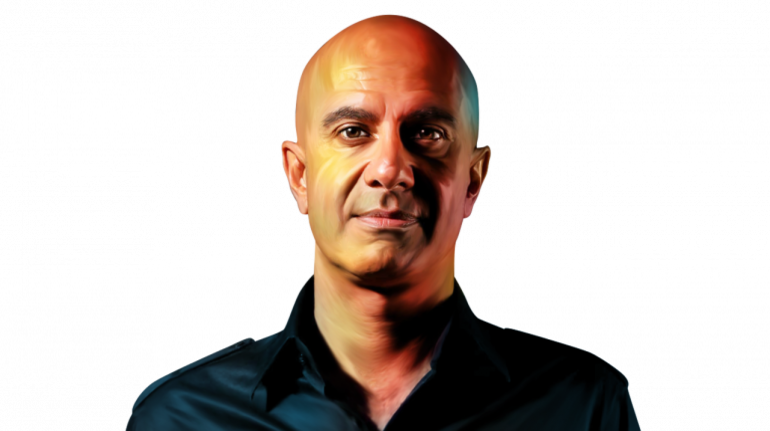
Robin Sharma, the leadership expert and author of The Monk Who Sold His Ferrari and The 5 am Club, was in Mumbai recently and caught up with Moneycontrol to talk about the challenges that executives run into, the fine art of transforming management behaviour and why he thinks old-economy businesses still have an edge on new-age ones. Sharma, who was born in Africa, grew up in Canada and is a litigation lawyer by training, has advised large corporations, rock stars, and royal families, and is of the view that leaders must constantly disrupt themselves to effect change in their organizations. Edited excerpts:
You call yourself a leadership missionary…what does that mean?My mission is to help people understand that we have a choice when we walk out into the world every day; we can be victims or we can be leaders, and you don't have to have a title to be a leader. Leadership is a series of qualities, like a commitment to great service and excellence, to be ethical, to finding solutions versus problems.
So, my mission is to really help people who… might have fallen into the trap of being victims - they think this idea will never work, or I could never get fit, or I could never move up through the organisation, I could never innovate, I could never make a contribution - my mission is to help those people make the leap from CBE (complain, blame and excuse) to APR (absolute personal responsibility).
So even if they're not the CEO, they can show leadership in their role. An example was when I was in a Johannesburg airport, I walked into the restroom, and the janitor said, ‘welcome to my office.’ He was enthusiastic, and he clearly took a lot of pride in his work. It's a great example of someone taking pride in a job that most people wouldn’t, and he conveyed magic. Now, he's not the CEO. No one's seeing him. But he showed leadership.
What, in your opinion, is likely to be an enduring management challenge for business leaders?I think the biggest challenge is to deeply, truly and sincerely lead by example.
We all know the concept. Yet, I talked to so many leaders who say they wish their people were more engaged, or that their people had a sparkle in the eye, or operated at excellence, or over-delivered for the customer. Your culture and your company will mirror who you are. So a lot of leaders – and I'm not criticising, I'm just reporting – are great at sloganeering. I think the opportunity is: do you live it from a place of depth within you? That's why the greatest leaders transformed themselves first. When I look at Nelson Mandela, who spent 27 years in prison, he used that time not to become bitter but to become better. To remake himself into someone who is forgiving and loving and decent, who cares about people.
Just imagine great leaders in business doing all the things like a morning routine where they meditated, prayed, worked on themselves, read the great autobiographies, journalled about the man or woman they wanted to become, looked at their flaws, got fit through exercise. As they became stronger, braver, wiser, more human, more decent, more humble, every interaction they would have with their employees would be powerful, and their employees would just watch them, their example and slowly start to transform and become bigger in their presence. That's the job of the great leader. If that leader works on themselves, the company starts to transform.
How have companies started to recalibrate their business models in recent times?There's a huge appetite now for companies wanting to have not only a mission, but to be seen as contributing to the building of a better world. I remember even 10 years ago, some companies would laugh at that idea; it was just all about the bottom line, it was all about business, it was all about hustle and grind. But now, and especially from the pandemic, companies wanted to be seen as good companies. And they want to be seen as places where it's safe to be human again, they want to be seen as places that are ethical, they want to be seen as places where people can come to work and grow as people. They want to be seen as places that respect the family.
From a business point of view, one of the biggest traps is resting on your winning formula. Because nothing fails like success.
You have to disrupt yourself, have conversations with freaks and interesting people. It's important to travel, it's important to stay open. It's important if you feel that you have a bias toward something, to challenge that bias. I'm far from perfect, but I tried to keep growing every day, I tried to have conversations with fascinating people, I travelled to places I've never travelled to, I read books, on history, on psychology, on business, on philosophy. And I tried to spend a lot of time with young people. I vibe with people in their 20s or early 30s.Those are some of the ways one can try to stay relevant.
Your books talk about making changes for the better and incorporating positive habits for both business and personal development - yet that first step is always the hardest to make for those unable to break out of a rut?Like Lao Tzu said, the 1000-mile journey begins with a single step. Small, daily, seemingly insignificant improvements, when done consistently, over time lead to stunning results. So it's not what you do once a year. It's what you do every day, those little steps, whether it's improving your leadership, creativity, productivity, quality of work, fitness, all stack into massive gains.
What's one idea to do that? I would say do hard things. Hard is easy. What do I mean by that? We mostly resist doing hard things. But let's say you're at work and you're feeling stuck, do the hardest thing in front of you. Maybe it's having a difficult conversation, or dealing with that client who's upset versus doing something easy, because the consistent doing of difficult things actually creates an easy life.
Another example, from the 5am Club book, is things we practice get easier, so obvious but it's so true. But getting up at 5am, giving yourself what I call in the book the victory hour, to exercise, read, pray, meditate, just write in a journal that's sort of hard versus sleeping. It will consistently give you better days. Better days give you better weeks, quarters, years, decades, career, and then a lifetime.
You’ve consulted and worked with a host of leaders in corporations such as Microsoft, Nike, and Starbucks. What’s the common denominators amongst the best leaders you’ve met?The key is to shift from an egocentric leader to a heroic leader - that doesn't mean that you can't be human and want applause and a nice lifestyle, as those things are absolutely fine. The real question is, what is your mission? What's your personal Mount Everest? And I think the great leaders in business and the great leaders in the humanities, I think of Mandela, Gandhi, MLK, the great leaders have a mission that is higher than their own egos. It's not that they don't have egos. I love the phrase from Mandela. He said, ‘If a saint is a sinner who keeps on trying, then I'm a saint.’ But I think great leaders find a cause that's larger than themselves. And it's a cause that helps other people. And that is one of the secrets to being an enduring leader. But I think it's also one of the secrets to happiness. One of the things that makes me happy is to be helpful to people. Also many of the most creative people spend a lot of time alone when they are starting out. So I think we do need to spend more time in solitude, more so as great leaders are paid to think. All geniuses have one thing in common: They spend a lot of time alone thinking about big problems.
What do most business leaders you interact with seem to need help or guidance with?A lot of them come to me and say, look, I'm the captain of industry, I'm a titan of my field, but my kids won't even talk to me. And so I help them reconnect with their family, rebuild relationships, that's very fulfilling.
A lot of them also come to me and say you know, look, I feel like an imposter. The world thinks I am someone amazing but I really don't like myself very much.
Or I drink too much, or I eat too much, or I worry too much, or escape too much, or I am too mechanical, or I'm lacking empathy, or I live in my head because I've escaped in my heart. How can I get better? How can I reconnect with my fundamental nature, so I'm more true to myself, and I live my values, and I don't feel like I'm an impostor. And that's really someone who's dealing with a spiritual crisis.
I can help them through the different modalities I have, reclaim who they truly are, and live a richer lifestyle that's very fulfilling. How? Well, there's ideas like the zero-device day, so many of us are addicted to our devices, having a digital sabbatical once a week is absolutely profound.
The two-telephone solution is another. As most of us are addicted to our phones, I suggest to top leaders or anyone who wants to be more productive, that let's not confuse fake work with real work, have one phone loaded with all your apps and all your social media, and one phone stripped down so it's very basic, and keep that one with you. Twice a day, look at the other phone. I recommend, this is disruptive.
The five great hour rule: only work five hours a day. Because it's not the amount of time you work each day, it's the level of focus, intensity and excellence you bring. So if you had to go on vacation tomorrow, you'd get everyday things done in five hours, and you'd have the rest of the day off. Well, imagine you're working only five hours a day because you are structured, so you're not distracted. You're in a focused place, five hours every day, while CEOs and producers who do that then finish work at one or two o'clock, they can go get a massage, go to an art gallery, have lunch with their children, life begins to transform.
In your book the 5 AM Club, you talk about the importance of digital detox - perhaps even much harder to do in today’s world. Yet necessary?Right, we’ve become digital addicts. The latest research says on an average day, we touch our phones 2,000 times a day. Two-thousand times. It's unbelievable. And we all know this. Most of what we're looking at are trivial pursuits. And so yes, a smart leader and great companies are figuring out ways to do real work. I'm a big fan of hard work, but I'm a big fan of, as simple as it sounds, smart work, again, the five great hour rule. And so what makes a great company in many ways is their culture, and building a culture where people do hard work, but it's not like 24x7 hustle and grind, because rest is not a luxury, rest is a necessity. This old idea of letting me work 14 hours a day, so I get more done, comes from the factory era, where when we're on the assembly lines, if we worked harder, we would produce more. Well, we're not in the factory age anymore. We are creative workers. And we do our best work when we're refreshed. We get our best ideas on a nature walk, or on vacation, not when we're at the office.
Discover the latest Business News, Sensex, and Nifty updates. Obtain Personal Finance insights, tax queries, and expert opinions on Moneycontrol or download the Moneycontrol App to stay updated!
Find the best of Al News in one place, specially curated for you every weekend.
Stay on top of the latest tech trends and biggest startup news.




