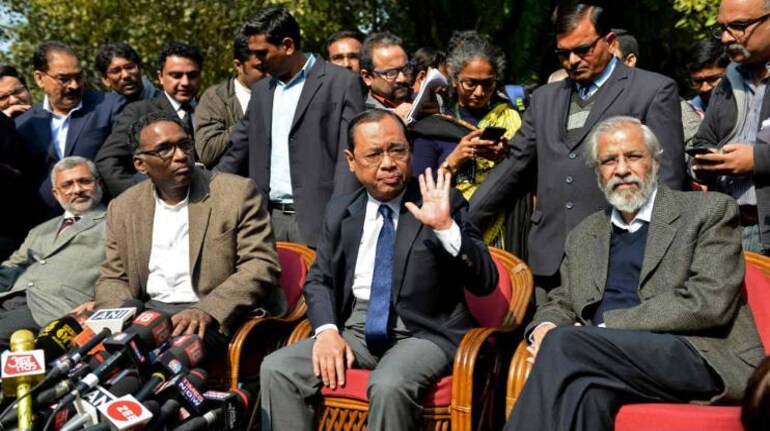
Justice Ranjan Gogoi is likely to take over as the next Chief Justice of India (CJI) after the retirement of incumbent CJI Dipak Misra on October 2 this year. Union Law Minister Ravi Shankar Prasad had urged Misra to recommend the name of his successor.
There is a lot of speculation, as well as surprise, in the legal circles regarding the coronation of Justice Gogoi because of his involvement in the press conference that was held by the four seniormost judges of the Supreme Court. The unprecedented press conference was held in January this year, when the judges had raised concerns over the administration of the Supreme Court and independence of the judiciary.
Justice Gogoi’s involvement in the press conference had reportedly irked the Centre. However, when asked about the same, Ravi Shankar Prasad said, “There was no reason to doubt the intention of the government. There is a convention in place and let the CJI forward the name of his successor and then the government will discuss it.”
Let’s take a look at the protocol and the process involved in the coronation of the CJI:
Is it a part of the Constitution?
To one’s surprise, the Constitution of India does not have any provision for criteria and procedure for appointing the CJI. Article 124(1) of the Indian Constitution says there “shall be a Supreme Court of India consisting of a Chief Justice of India”. The closest mention is in Article 126, which deals with the appointment of an acting CJI.
In the absence of a constitutional provision, the procedure relies on custom and convention.
What is the convention?
When the incumbent CJI retires (all Supreme Court judges retire at the age of 65), the seniormost judge in the SC becomes the CJI. Seniority, here, is not defined by age, but by the number of years an individual has been serving as a judge of the apec court.
In an instance where two judges have served for the exact same time, because they were appointed as SC judges on the same day, other factors are used to determine the seniority of the judges, like which judge has more years of experience in the high court and if either of them were nominated from the bar directly.
This situation had arose ahead of the appointment of Dipak Misra, as both Justice Misra and Justice Chelameswar were sworn in on the same day as judges of the SC on October 10, 2011. Despite being four months younger, Justice Misra was anointed as the CJI in August 2017.
What is the procedure?
The procedure to appoint the next CJI is laid out in the Memorandum of Procedure (MoP) between the government and the judiciary:
1. The procedure is initiated by the Law Minister seeking the recommendation of the outgoing CJI at the ‘appropriate time’, which is near to the date of retirement of the incumbent CJI.
2. The CJI sends his recommendation to the Law Ministry; and in the case of any qualms, the CJI can consult the collegium regarding the fitness of an SC judge to be elevated to the post.
3. After receiving recommendation from the CJI, the law minister forwards it to the Prime Minister who then advises the President on the same.
4. The President administers the oath of office to the new CJI.
Does the government get a say?
Except for the law minister seeking the recommendation from the incumbent CJI, and forwarding it to the Prime Minister, the government has no say in the appointment of the CJI.
Vis-à-vis the appointment of the CJI and the appointment of SC judges, the key difference is that in the former, the government cannot send the recommendation of the CJI (or the collegium) back to them for reconsideration; while in the latter, the government can do so. However, if the collegium reiterates those names, then the government cannot object any further.
The Memorandum of Procedure does not have any provision for the eventuality of the government disagreeing with the incumbent CJI’s recommendation on the new one.
Have there been exceptions to the aforementioned procedure?
Since the establishment of the Supreme Court in 1950, there have been 45 CJIs, including the incumbent Dipak Misra. In all cases, the convention and the procedure was duly followed, except for two – Justice AN Ray and Justice MH Beg. Both exceptions took place when Indira Gandhi was the Prime Minister.
Justice AN Ray was appointed as CJI in 1973 despite being fourth in terms of seniority after Justices JM Shelat, KL Hegde and AN Grover. The reason was the involvement of these three judges in the landmark Kesavananda Bharati case, which had held that Parliament cannot make amendments to the Constitution that would alter its “basic structure”.
Similarly, Justice MH Beg was appointed as the CJI in 1977 despite Justice HR Khanna being senior. This was because of Justice Khanna’s minority judgment in the ADM Jabalpur case. Justice Khanna had pronounced that he did not agree with the government’s argument that detention of persons during the Emergency cannot be questioned, even if mala fide and without the authority of law.
Discover the latest Business News, Sensex, and Nifty updates. Obtain Personal Finance insights, tax queries, and expert opinions on Moneycontrol or download the Moneycontrol App to stay updated!

Find the best of Al News in one place, specially curated for you every weekend.
Stay on top of the latest tech trends and biggest startup news.