Late in 1809, the East India Company’s Resident in Mysuru wrote home to his sister Florence, recounting bizarre stories emerging from the kingdom of Virarajendra Wodeyar of Kodagu. “About the middle of November last, the Rajah having found out a formidable conspiracy that was against his life, ordered 2,000 men to be killed,” he recorded. The Rajah had become “very suspicious”. In one case, he ordered a “bamboo tube being driven into the private parts of his concubine and molten lead poured in; while the eunuch who was found ‘fondling her’ was ordered to be buggered to death”.
The Honourable Arthur Cole, after whom Cole’s Park in Bengaluru is named, reacted to the magic-realist nightmare around him with admirable sang-froid: “Everything in this country that you could feel interested in went on humdrumically”.
“Insanity and politics are often entwined,” the eminent psychiatrists Sanjeev Jain and Alok Sarin have noted in a superb essay on Cole’s papers. Now, as we contemplate the surreal last stand of America’s own Mad King, Donald Trump, there are important lessons to be learned from Cole’s world.
From his bungalow in Bengaluru, Cole looked out a landscape filled with insane leaders. His papers include a carefully-preserved copy of The Madras Courier on the crisis around King George III, whose powers were handed to his oldest son in 1810 after developing what some believe to be bipolar disorder. George III’s contemporary, Queen Maria I of Portugal—popularly known as Maria a Louca or ‘Mary the Mad’—also had to be removed from power after developing religious delusions. The court of Christian VII of Denmark, another contemporary, struggled with his severe emotional instability.
Great political power and great madness have coexisted in the minds of leaders through history. George III might have dragged his Kingdom into a ruinous war with America and supported slavery, but he also extinguished the threat from Napoleon Bonaparte, brought about an agricultural revolution, and drove an extraordinary growth in scientific knowledge. King Virarajendra, for his part, led a shrewd and successful insurgent campaign against the vastly superior forces of Tipu Sultan.

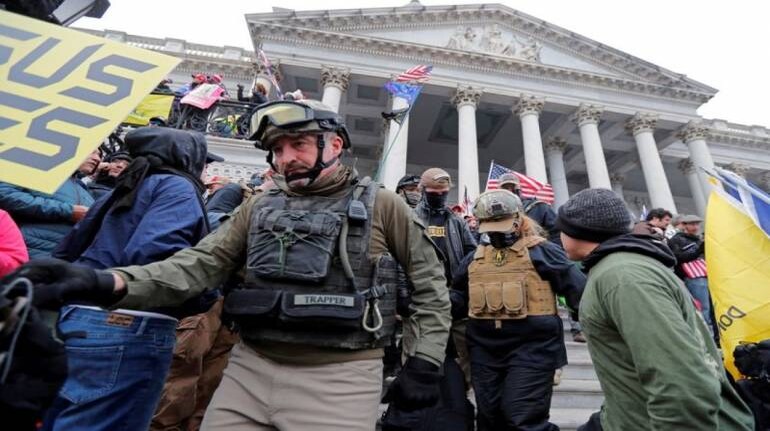
There is a growing body of literature which argues that President Trump’s behaviour—witness his more than 20,000 egregiously false claims leading up to the unfounded allegations of a stolen election—are the results of a pathology. His niece, Mary Trump, a clinical psychologist, has cast him as suffering from a serious narcissist disorder, shaped by a dysfunctional childhood. Large numbers of clinicians agree.
Even though there might be method to Trump’s madness—his appeals to White nationalist rage might, for example, allow him to make another election run in 2024—the President’s conduct cannot be reasonably described as rational. The President’s poor decision-making on the pandemic, for example, has led to several hundred thousand deaths; his conduct on leaving office threatens the fundamentals of American Constitutional democracy, from which his own power derives.
Trump’s madness has, thus, served to undermine American legitimacy and influence—this at a time when, confronting the rise of a new superpower, it needs those assets more than at any time since the end of the Cold War. For America’s citizens—and for Trump himself—this holds out real dangers.
Efforts to seriously examine the influence of mental health on political decision-making have, for the most part, had little success. The psychiatrist Nassir Ghaemi’s book on the issue—which provocatively asserts that the “best crisis leaders are either mentally ill or mentally abnormal”—has been, correctly, assailed for drawing extravagant conclusions from at-best thin source material.
The evidence that is available is not always reliable. The characterisation of Tiberius as a paranoiac sexual pervert rest largely on the lurid telling of his story by the historian Seutonius, authored decades after the Roman emperor’s death. The work of modern historians like Mary Beard has, similarly, have led to stories of the crimes of Caligula told by his opponents to being treated with scepticism.
Even our culturally embedded pop-knowledge of the cruelties of the Spanish Inquisition, we have learned from the scholarship of historians like Henry Kamen and Edward Peters, is in fact a testament to the power of medieval Protestant propaganda.
Yet, it’s hard not to speculate on the impact the mental state of world leaders has had on the course of history. The paralysis that gripped policy-making in the last years of the Soviet Union, it seems reasonable to suppose, must have had at least something to do with fact that it was led by three men likely seized by the mental rigidities which so often accompany old age—Leonid Brezhnev, Yuri Andropov and Konstantin Chernenko. East Germany’s collapse, too, was presided over by the doddering Erich Honecker. It’s possible, similarly, that old age had something to do with the transformation of President Deng Xiaoping from the ruler who transformed China into the one who authorised the massacre at Tiananmen Square.
From 1380 to 1422, when France was torn apart by the civil wars of the Armagnacs and Burgundians, the country was led by Charles VI—now believed to have suffered from some form of schizophrenia or bipolar disorder, which contemporary physicians likely made worse by drilling holes in his head. England suffered its own civil war—pitting the House of Lancaster, represented by a red rose, and the House of York, represented by a white rose—under Henry XI, who appears to have suffered from what modern psychiatrists would call catatonic schizophrenia.
George Washington, the United States’ founding President faced charges of senility. Enemies—including former friends Thomas Jefferson, James Madison and James Monroe—condemned him for adopting the manners of a king when he accepted command of the country’s armed forces in 1798, only a year after stepping down as president.
Fritz Redlich—a psychiatrist who fled Austria when it became part of Nazi Germany, but lost six relatives in the concentration camps—has, in a magisterial if highly speculative work, pointed to Adolf Hitler’s violent mood swings, paranoia, and lack of a moral compass, as symptoms of a possible pathology. Hitler’s well-documented amphetamine abuse—which, as the historian Norman Ohler has established, was rampant across the armed forces of Nazi Germany—may have contributed to his instability.
Indeed, at least some contemporary observers saw the rise of Hitler as part of a wider landscape of messianic madness in 1920s Germany. “Hundreds of saviours were running around Berlin”, Haffner wrote, “people with long hair, wearing hairshirts, claiming that they had been sent by God to save the world”. “The most successful of them was a certain Haeusser, who advertised on advertising pillars and staged mass gatherings and had many followers”.
“Whereas Hitler wanted to bring about the thousand-year Reich by the mass murder of all Jews, in Thuringia a certain Lamberty wanted to bring it about by having everyone do folk dancing, singing, and leaping about”.
Few historians of Hitler’s crazed regime—the scholar Michael Burleigh has listed five excellent biographies—have sought psychological explanations for the irrationality of Nazi Germany, instead choosing to understand his rise and decision-making in the context of the historical processes which shaped them. The historians are right: speculation can tell us only so much.
Looking over history, though, it’s impossible not to wonder why so many rulers have made the self-destructive, profoundly misguided decisions they did. From the time of Athens' misguided siege of Syracuse in 414BCE, which would lead to its own annihilation, there is no shortage of cases illustrating how passion, ego and self-delusion led to decisions which defied reason.
Few human decisions, a wealth of behavioural and neuroscience research teaches us, are arrived at through careful, rational thinking; more often than not, our cognitive biases and instincts lead us to choices that we subject to post-facto rationalisation. The line between rationality and madness is, at the best of times, a thin one.
Like all herd mammals, human beings are hard-wired to follow the steps of their leaders, even missteps leading to the precipice. The lessons both polities and leaders ought to draw from this are not trivial: The success of regimes rests not only on their will or decisiveness, but dialogue, reflection and critical thinking. For polities to succeed, citizens must trust their leaders—yet, in doing so, always beware they may be collaborating in their own undoing.
Discover the latest Business News, Sensex, and Nifty updates. Obtain Personal Finance insights, tax queries, and expert opinions on Moneycontrol or download the Moneycontrol App to stay updated!

Find the best of Al News in one place, specially curated for you every weekend.
Stay on top of the latest tech trends and biggest startup news.