

When the five-month-old Hollywood writers’ strike ended, one of their many demands included establishing new ground rules for AI. It seems imperative that writers coexist with technology in the future. There was this widespread fear that studios would replace human creativity with AI to reduce their role in the process of filmmaking. According to the new agreement, “A writer can choose to use AI when performing writing services if the company consents and provided that the writer follows applicable company policies, but the company can’t require the writer to use AI software when performing writing services.” So, in theory, though AI can be used as a tool, it forbids using the software to exclude the writers.
Joseph McGinty Nichol, who directed Charlie's Angles and Terminator Salvation during a recent conference in Paris had sent out warning bells about the possible implications of AI in cinema. “Actors, writers, and visual effects artists would be replaced by AI within the next couple of decades,” he lamented adding that they were emulating human behavior. If Hollywood is feeling the heat of Artificial Intelligence, what is the Malayalam film Industry’s take on this new technological invasion?
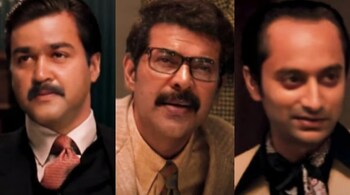
Earlier this year a deepfake video featuring Mohanlal as Micheal Corleone, Mammootty as Moe Greene, and Fahadh Faasil as Fredo Corleone went viral on social media. And to everyone’s astonishment, they seem to fit faultlessly into the scene. Another video featuring Mohanlal as Vito Corleone was also doing the rounds, elucidating joyous responses from his fans for the inevitable comparisons between Brando and Mohanlal. Not only did these videos create an uproar on social media but also demanded a remake of Godfather (1972) featuring the three actors.
Director Akhil Sathyan, who debuted this year with Pachuvum Adbudha Vilakkum and has a master’s in computer science feels AI can make the manual work easier during the pre-production. While assisting his dad’s film he remembers implementing Excel sheets to ease the schedule chart. But that also comes from cinema experience and technical expertise.
Many filmmakers admit that AI can avoid a lot of cyclic jobs during the pre-and post-production. But can AI aid in creative inputs? “That’s its limitation. Creativity requires our signature. Just as cinema has no foolproof success formula, so does AI-generated content.”
Shalini Usha whose film Ennennum premiered at the International Film Festival of Kerala (IFFK) this year agrees that humans cannot be replaced with AI. “We need to figure out how to use AI better. There is no real sense in resisting its advent. But you can look at the ethics of it. How would IT or remuneration work, etc.? We have to figure out the best way to form practices that won’t be unfair. I am curious to know how it will evolve in the future.”
AI can help when you are deciding the casting process, especially in scenarios when the costume isn’t ready. “I can tell my costume designer that I need an actor who looks like Nafisa Ali and speaks English and Hindi. AI can help in narrating that to my team. You can also show that to the producers,” says Akhil. Having said that, things won’t be that easy in Malayalam cinema which is mostly unorganised and runs on quick decisions. And very often a keen presence of mind and contacts would come in handy to help you out of a sticky situation than AI.
Can this be used during edits? Not really, says Akhil — “I think only a filmmaker can decide which shot should be cut. A machine can't capture the emotion. What you get in AI is mostly a random mix and match provided by human data. So, AI doesn’t have the skill to pick judiciously.”
So even if you instruct AI to write three funny scenes, it might come up with a mishmash of several iconic comic scenes than think of something original. An AI can't create deep emotional scenes or help in character development. But the plus is that it has a memory beyond the human capacity. So it can be a reference for filmmakers and writers to pick a line from a book or a film.
Akhil says on a film set you have to deal with multiple temperaments and moods and only a filmmaker will be equipped to handle that. After all, cinema isn’t just about information and technology — you have to interact with artists and their moods. There are a lot of things that are purely under human control. “You need to work in a minimum of five films to get at least 20 per cent of data to feed the AI. I have tried various screenplay apps and finally ditched them for pen and paper.”
Earlier to create a bomb blast, you had to import the date and the green screen in the edit line and erase the green line but now in Adobe Premier AI plugins, you can simply use a drag and drop. Props and backgrounds could be created from scratch with AI.
Reportedly for Vikram when they tried to outsource the de-ageing technique for Kamal Haasan from a foreign studio, they demanded Rs 5 crore and eventually Lokesh and Team collaborated with a Bangalore-based team for Rs 25 lakh. It is said that the digital de-aging is a complex process that uses several special effects. It’s like building a house from scratch. When you shoot, the CGI technicians will be present with the cameraman. A 10-second footage takes 2 months.
Sreejith Nair, who is the co-founder and director of Kabini Films agrees that AI is the future in cinema. “It is already happening, and you can’t stay away from it. When it comes to AI I feel we might be neck-to-neck with Hollywood. Our technicians are pretty smart. As a production house, we have to think of AI-driven stories, and how they will help in ideation, production, pre-production, post-production, and marketing.”
Sreejith agrees that the main challenge is in using it ethically — “Our Indian laws are slow in catching up. Do I use an actor’s voice to dub in another language with AI? As a producer, I can argue for that, but laws are dodgy. Creative people have to figure out what they want to expose and frame the laws around it. And we as producers need to be cognizant regarding who owns what. The lines are very blurred now.”
He says it is important to educate the creative people in cinema about AI. “For instance, we can use AI to make the storyboard as it is just a tool to help you in the final product. So you can use a lot of intermediate stuff that is not used directly to sell. To an extent, an editor can use legal software.”
Will writers be out of work?
Though it is claimed that story-generating AI software will be an efficient and organised tool for writers, according to Rorschach writer Sameer Abdul, Artificial Intelligence can never be a threat to a creative person. “I have tried to use it out of curiosity. They don’t give anything original. Just ideas and plot points. I gave a heist scenario once and it provided references from various heist movies, some plot points, execution methods, and a lead investigation. Nothing creative. There is no detailed screenplay available. Dialogue writing is also out of context. But if you are creatively bankrupt and know how to use this smartly, maybe you can create a screenplay that can be a better cinema thanks to the references. But that still won’t replace human creativity.”
Maybe you can take inspiration from the content it provides. After all, AI doesn’t understand emotions or character development. It knows only what we feed. Something like how a Padmarajan or (Alfred) Hitchcock would have written the scene for instance? With some AI assistance, maybe writers can invest their creative energies in telling stories in different ways.
Akhil feels ChatGPT cannot always dodge the fake trap. He recalls the time when a friend sent him a story and he figured that it was generated by ChatGPT, as it missed its soul. “That worries me as a writer. I think people are taken in by the fanciness of AI.”
But most graphic artists are anxious that it might leave them without jobs. But technicians suggest incorporating this technology to elevate their job profile in the future. Another plus would be to use this in budgeting a film. AI never gets wrong with numbers.
How it weighs visually
In Hollywood, it has empowered filmmakers to create exceptionally complex and fantastic worlds and also enhances the overall quality of visuals as well. Salu K Thomas who cranked the camera for Kaathal: The Core admits that he uses AI apps like MidJourney and Stable Diffusion for concept art. “Earlier we would seek the help of concept artists to get the colors, atmosphere, and actors. But now you feed the software this information and it creates the concept art for you. We can get it according to how creatively we use it.”
Salu says cinematographers are now using it rampantly. Recently a director approached him with a concept art made of MidJourney. That helps in getting a lot of references as well as a clearer picture. There is AI software that helps in finding dimensions from whichever angle a frame is being shot.
Salu says AI is developing at a fast pace. “Earlier we showed reluctance in shifting from Analog to digital and later adapted quickly, The same transition will happen here as well. Face swapping and de-age were used earlier.”
But yes, he agrees that it might cost visual artists their jobs — "The concept ads that I used to do with friends now I do it myself. If concept artists can use it with this new technology that will help.”
He is concerned about AI not having any copyright laws. “If you write poetry that can be faked easily and there won't be any copyrights for that.”
But having said that like most technicians he feels original ideas need to come from humans. “Perhaps this will inspire us to push our creativity to new heights,” he says.
Many from the film industry agree that we lack credible AI experts. “If we invest in the right talent, the younger lot can achieve the skill set of seniors thanks to AI. Who knows? In the future, you can say, please generate Pulp Fiction 2, and it will be there,” says Sreejith.
Discover the latest Business News, Sensex, and Nifty updates. Obtain Personal Finance insights, tax queries, and expert opinions on Moneycontrol or download the Moneycontrol App to stay updated!





