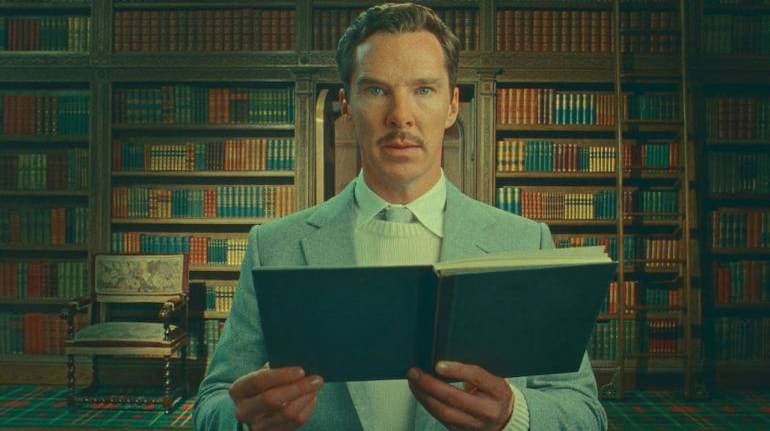
Among the more delightful arrivals on Netflix lately have been the Wes Anderson “Henry Sugar” short films. Based on four short stories by Roald Dahl, these live-action films are anywhere between 13 and 37 minutes long. And they are everything you’ve come to expect of the Anderson-verse: The pastel colours, detailed costumes and sets. The symmetric camera angles. The quirky storytelling. They’re proof that the signature Wes Anderson directorial style is only getting finer with time.
The four movies — The Wonderful Story of Henry Sugar, The Swan, Poison and The Rat Catcher — are all built around enigmatic characters that talk too fast, trip too often and follow their instincts, for better or worse, to thrive or survive. It is in man’s fallibility — including Dahl’s own, articulated through a smart fourth-wall-breaking appearance by Ralph Fiennes — that Wes Anderson finds pathos, humour and horror.
As always, there is a spectacular cast of actors that brings these characters alive. Longtime collaborator Fiennes is joined by Ben Kingsley, Benedict Cumberbatch, Dev Patel, Richard Ayoade — all debuting in the Anderson-scape — and Rupert Friend, who also appeared in Anderson’s latest feature Asteroid City.
While the Henry Sugar shorts are more a group of films with a rotating cast, the ensemble movie is something Wes Anderson has arguably perfected. In his own words: “I like the idea, right off the bat, of having a little company play the whole film.” The cast and crew of the Wes Anderson company have travelled through space and time together.
Actors like Bill Murray, the Wilson brothers, Adrien Brody, and Jason Schwartzman, among others, are fixtures in this company, reprising roles in films like The Darjeeling Limited, The Royal Tenenbaums, The French Dispatch and more — each of which is more the story of a time or event, than any single protagonist. Of course, Wes Anderson didn’t invent the ensemble movie, which by definition leans more towards a sense of “collectivity and community”. Traditionally, this is meant a cast of serious actors and thespians in service of the director’s vision and script; not star-led vehicles.
Back in 1916, DW Griffith’s silent epic film Intolerance introduced the concept of the ensemble through four separate but parallel plots, but covering a time period of approximately 2,500 years. Griffith drew on a “Babylonian” parable, a Biblical “Judean” fable, a Renaissance “French” story and an American “Modern” piece to underline humankind’s persistent intolerance through the ages.
Hollywood is littered with examples of great ensemble movies. The intrigue of Dinner At Eight (1933) plays out in a high-society dinner party. It’s A Mad, Mad, Mad World (1963) had a group of motorists scrambling for a hidden treasure hinted at by a dying man in the California desert. Coming-of-age films like The Breakfast Club (1985) and Stand By Me (1986) present a portrait of the highs and lows of adolescence in Eighties America.
The ensemble movie in Hollywood has arguably lent itself better to certain genres — the war movie (Saving Private Ryan, Platoon), comedy or parody (Tropic Thunder, American Pie, Not Another Teen Movie), the heist (Ocean’s 11, American Hustle, The Usual Suspects), science fiction (Star Wars, Star Trek, Hitchhiker’s Guide to the Galaxy), period dramas (Little Women, every Jane Austen adaptation) and curiously, the mobster movie (the mammoth Godfather series, Once Upon a Time in America, Goodfellas).
There are outliers like Spotlight There have been just as many epic failures too, especially when studios have tried to elevate a middling script with major star wattage. Think Crash, Babel, The To-Do List and The Counselor — all ensemble films that appear perfect on paper but somehow, well, crash and burn. Think every Love Actually copycat rom-com built around a festival — Valentine’s Day, New Year’s Eve, Mother’s Day are proof that without a strong script and a firm directorial vision, no amount of huge stars in bit roles can bring that holiday cheer.
And it really does take a certain kind of filmmaker to pull off the ensemble movie time and again. Indeed, they’ve come to own it. Paul Thomas Anderson used ensemble film early in his career to investigate dysfunctional families in films like Hard Eight, Boogie Nights and Magnolia.
Quentin Tarantino’s oeuvre of neo-noir crime classics — Pulp Fiction, Reservoir Dogs, Inglourious Basterds, The Hateful Eight, True Romance — are stuffed with A-list actors caught up in webs spun out of avarice and self-interest, or his own tapestries of revisionist history. Martin Scorsese’s expansive temporal explorations of life in America have both made and been buoyed by star actors — from Gangs of New York to Once Upon A Time in Hollywood to the upcoming four-hour long Killers of the Flower Moon.
It isn’t altogether surprising that Tarantino and Scorsese were two of the most vocal critics of the “Marvel-isation of Hollywood” at the peak of MCU’s reign. The superhero franchise had effectively turned the ensemble film into a formula. In 2019, Scorsese said: “The value of a film that’s like a theme park film, for example, the Marvel-type pictures, where the theatres become amusement parks, that’s a different experience … it’s not cinema, it’s something else.”
Tarantino later added: “Part of the Marvel-isation of Hollywood is you have all these actors who have become famous playing these characters,” he added. “But they’re not movie stars, right? Captain America is the star. Thor is the star. I think that’s been said a zillion times, but it’s these franchise characters [that] become a star.”
“Back in 2005, if an actor stars in a movie that does as good as the Marvel movies do, then that guy’s an absolute star,” he continued. “It means people dig him or her and they like them and want to see them in stuff. Sandra Bullock is in Speed and everyone thought she’s amazing in it. Everyone fell in love with her… They were excited by Sandra Bullock and wanted to see her in something else. That’s not the case now. We want to see that guy [keep] playing Wolverine or whatever.”
While Robert Downey Jr’s winning performance in Oppenheimer and the buzz around Tom Holland’s role in The Crowded Room demonstrate that there’s more to this picture, Tarantino and Scorsese’s comments do point to the 21st century ensemble movie formula: Because 10 stars, actors or characters, are always going to be better than one, especially for the procedural like Knives Out and Kenneth Branagh’s Hercule Poirot series.
In India too, ensemble films have gone from being auteur-led projects to vehicles for a starry flex on a national or global scale. After RRR’s unprecedented success, Mani Ratnam’s Ponniyin Selvan; the Kamal Haasan, Vijay Sethupathi and Fahadh Faasil-starrer Vikram; and Atlee Kumar’s Jawan, have all pulled upon the power of the actors’ fandoms to fuel hype that goes beyond ligual, state or national borders. The recently announced Thalaivar 170, directed by TJ Gnanavel, is a Rajinikant film — but not just, given that Amitabh Bachchan, Fahadh Faasil, Rana Daggubati and many more.
Despite being a largely star-reliant industry, Hindi films have seen their share of auteur-led ensemble films. The Bollywood family movie of the 1990s and early 2000s from the houses of Sooraj Barjatya and Karan Johar made way for the coming-of-age worlds of Rang De Basanti and Dil Chahta Hai. Anurag Kashyap raised a generation of stars with Gangs of Wasseypur; Vishal Bhardwaj brought out the actors in the stars of Maqbool, Omkara and Kaminey.
The many mindless Hindi comedies of the 2000s that cropped up in a post-Govinda vacuum relied on the rule of threes — three couples or families. In the streaming era, stories of family, identity, personhood, society found more nuance under the direction of a new generation of filmmakers like Konkona Sen Sharma (A Death in the Gunj), Seema Pahwa (Ramprasad Ki Tehrvi), Alankrita Shrivastava (Lipstick Under My Burkha) and, now, Karan Boolani (Thank You For Coming).
If the metric of greatness for an ensemble movie is the impossibility of nominating one actor over another for an award, because they were all so equal in performance and capacity, then Zoya Akhtar’s filmography has much to offer. Barring the underrated gem that is Luck by Chance, Akhtar’s at her best when telling stories of family, friendship and love, while also casting a sardonic eye on prejudice, privilege and first-world problems.
Zindagi Na Milegi Dobara and Dil Dhadakne Do are both built around Akhtar’s preference for “working with characters” and adding “stories behind stories”. Expect no less from her next big title, The Archies, releasing on Netflix in December. Based on the classic American comic book series, The Archies sounds like many things — a coming-of-age movie, a period piece, a comedic musical. And yet, it is so much more.
With its debutant star cast, it also straddles a unique line between elevating new actors into the limelight and mining their existing cultural cache as artists or kids of celebrities. Its content is likely to speak to kids and adults around the world, for it taps into the ageless adolescent phenomenon that was The Archies. Add to that its choice of platform — not a theatre, but straight to Netflix — and you have in front of yourself a case study for building the perfect ensemble movie, at least on paper.
Discover the latest Business News, Sensex, and Nifty updates. Obtain Personal Finance insights, tax queries, and expert opinions on Moneycontrol or download the Moneycontrol App to stay updated!

Find the best of Al News in one place, specially curated for you every weekend.
Stay on top of the latest tech trends and biggest startup news.