





Forty years ago, Ratna Pathak Shah made her debut on screen with Shyam Benegal’s Mandi and the James Ivory’s British historical drama Heat and Dust. Born to the legendary actress Dina Pathak, and elder sister to Supriya Pathak, Ratna’s introduction to the world of showbiz happened backstage, watching her mother perform, from the wings. For years, Ratna did not find work until the Hindi sitcom Idhar Udhar (1985). The actress concentrated on television and theatre for a large part of her life and it is in recent years that she has also increasingly become an integral part of Hindi cinema with impactful performances in films such as Khoobsurat (2014), Kapoor & Sons (2016), Lipstick Under My Burkha (2017), Thappad (2018) and the recently-released Tapsee Pannu-produced Dhak Dhak, in which four women set out on their bikes for a trip to the highest motorable pass in the world.
In a candid chat with Moneycontrol, the Sarabhai vs Sarabhai actress opened up about what has brought upon this change, her journey in acting, on stage and on screen. Edited excerpts:
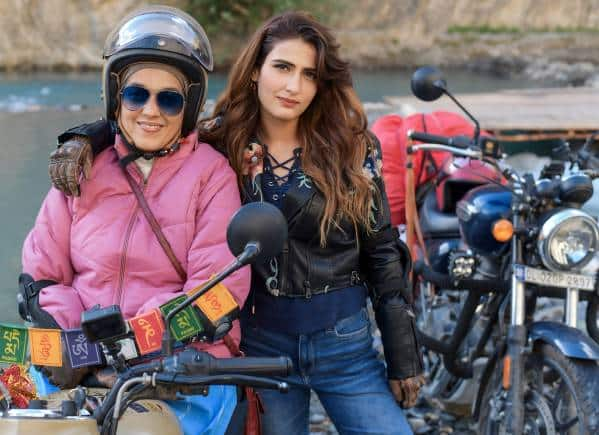 Ratna Pathak Shah with Fatima Sana Shaikh in 'Dhah Dhak'.Your last release Dhak Dhak was appreciated for the story and performances. How was the experience of being a part of this movie?
I liked that the film was about four absolutely average women who wanted to do something different and they did it without any major dramatic upheavals. This was a film about the personal desires and ambitions of ordinary human beings. I also liked that my character was not given to self-pity. A lot of older characters end up being self-pitying or bechari in some form. This one was not, and she did what she wanted to do.
You have done a lot of different and impactful roles in the past few years. What do you think has happened in terms of filmmaking and you as an actor for this festival of Ratna Pathak Shah films?I think filmmakers have ventured out of the rut. Various social and other economic changes have taken place around us which have led to this. Partly, of course, due to the exposure that the internet has provided. Suddenly we are seeing very different kinds of films and we are liking them as an audience. We want something different, but something which is not totally unfamiliar. Something that pushes the envelope and reflects the kind of people we see around us. Indian movies have shied away from showing people as they are in real life. Suddenly, it appears that even regular people can make interesting subjects and, in a country as varied as ours, do we constantly need to have Miss Meena and Captain Rajesh — these generic creatures from God knows where in India! We want to hear stories of what is happening in a place like Dhanbad or Hyderabad or somewhere in the North East. These people are being presented in interesting stories that makes me as a member of the audience keen to find out what’s happening in their lives. There are a lot of young writers and directors who are coming from non-metro backgrounds and they all have stories to tell that are unusual, different, very dramatic sometimes, exciting, funny and sometimes plain stupid. Suddenly I have a buffet of all kinds of dishes laid out in front of me and I feel the Indian is used to a thali. We want as much variety as possible. I happen to be at the right place at the right time. This storytelling world was opening up and they also needed a couple of old people around. I am lucky they needed some older women rather than just older men.
You have done so many intense characters with complex emotions, but there is also dark comedy, black comedy and also full-on comedy like Golmaal. When did you discover this flair for comedy?It has come from television. It was Idhar Udhar in 1984. It was the first thing I did that was even vaguely funny. I grew up thinking I am going to be a dramatic actress like Ma was. Fortunately, comedy happened and one had to just go with the flow. I could get on the wavelength. It was the very early days of television and like any pioneer experience, a very precious experience. When I see it now, I see that I wasn’t very good — the physical comedy was awful and my timing was off but I did not mind. I plunged in and that released me as an actor and that is something I have mined all through my life, even in the serious roles. Just don’t take everything so bloody seriously! Luckily, I got parts that gave me a chance to reflect that side of life.
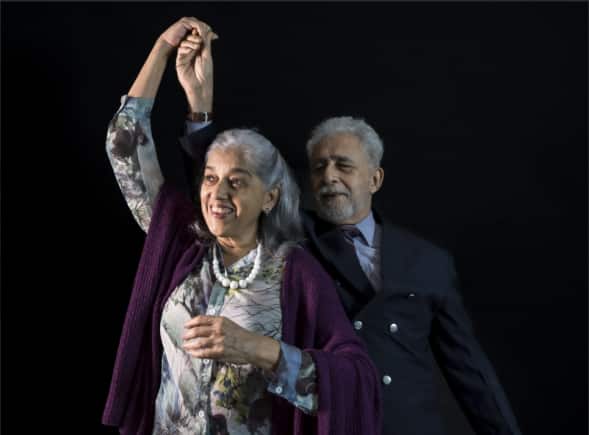 Ratna Pathak Shah and Naseeruddin Shah in 'Old World' play.You mentioned in an interview recently that Naseer sir asked you to stop dyeing your hair which has liberated you as an actress. In what other ways has he helped hone you as an actor?
It is not just him telling me what to do but with me observing as well. I have watched him very closely at work and we have had long discussions. I have been his sounding board for years and years. I am happy to acknowledge him as my guru as much as Satyadev Dubey was. Naseer definitely has played an extraordinarily important role in my understanding of acting. I may not always agree with him but what I do know and what I have been able to build on is things that I have acquired from Naseer, through watching him or through interacting with him, acting with him or being directed by him. It is precious.
It has been 40 years since Mandi and Heat and Dust. What do you recall of them?I shot for both these films in 1982. Mandi was a blink-and-miss role. We had just gotten married. The shoot was in Hyderabad and it was like an extended honeymoon. I just shot for two days or so. It gave me a chance to watch everyone else acting and I did a lot of that in my early days. Naseer was in practically every film, so I would hang around, watch and I learned a lot out of that. There wasn’t much for me to do in Heat and Dust as well. Zakir Hussain played my husband and I enjoyed chatting with him and being in the same space as him. Everyone was having a great time but I can’t say I learnt anything as an actor. I think my first real learning came with Mirch Masala. Again, I didn’t have much to do except for one scene with the subedaar in the tent where we are listening to the record player. I’m afraid I was terrible. I just didn’t know what to do. It was really a devastating experience but I guess it showed how unprepared I was and made me pull up my socks a bit. Idhar Udhar came soon after and then there was Filmi Chakkar and Tara and I was shooting simultaneously for the last two. By the time Sarabhai Vs Sarabhai came, I had done a fair bit of work on stage and that too had helped build up my understanding as an actor. I spent many years being a very poor actor and I am glad I didn’t get much work then. At that time, I wasn’t glad; I was miserable. Looking back on it, I am relieved that I got time to learn how to act.
You made your Gujarati film debut this year with Kutch Express. It is surprising that it happened this late?So late! But again, thank God. I could not have possibly done those Gujarati films that were around. I could not even do Gujarati plays; I just did not have the mindset for it. I have done just one Gujarati play before this called Tokhaar, which is adapted from Peter Shaffer’s Equus sometime in the late '90s or early 2000s. That was a terrific experience. My connection with Gujarati has been on and off, so when this film came to me, I was a little concerned because not only was this in Gujarati but also set in a dialect of Gujarati somewhere between Kutchi and Kathiawadi. I was wondering whether these words will come off my tongue as comfortably as they should. We did a few readings and it was such a pleasure mouthing those dialogues. I enjoyed it thoroughly and I am proud of my performance.
There is a certain level of trust which I don’t have with any other actor. We have been working together since 1975. Naseer does not have a fixed pattern of acting or directing but the one thing that is fixed is that we read the play a lot before moving it. We have done such different plays together and we have lived with these plays for a long time. All that has led to a sense of comfort but also a sense of trust and of knowing that whatever I do, I am not going to throw the other person off. He is a tennis player, so he is ready to lob the ball back at you and I am not a tennis player but I have learnt to lob the ball back at him on stage.
Discover the latest Business News, Sensex, and Nifty updates. Obtain Personal Finance insights, tax queries, and expert opinions on Moneycontrol or download the Moneycontrol App to stay updated!
Find the best of Al News in one place, specially curated for you every weekend.
Stay on top of the latest tech trends and biggest startup news.




