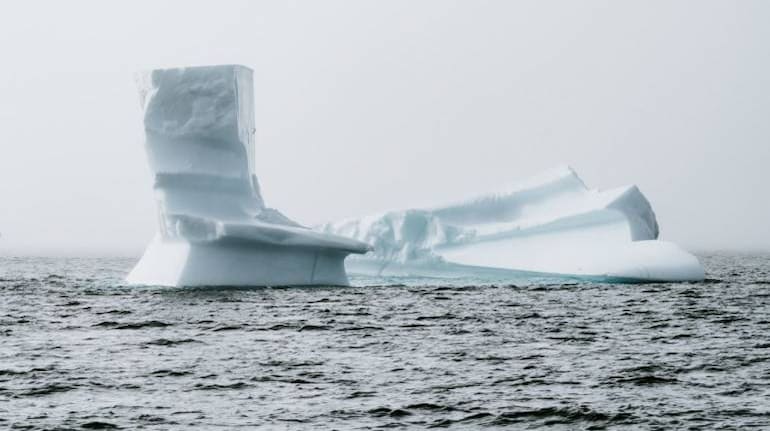
In her hand, the woman nurses a lotus, the symbol of enlightenment and self-regeneration. The man stands above her, holding an umbrella to shield them from the grim sky as they sail together across the savage, black sea. Late last month, Zhai Mo—the man who made that painting, and China’s most famous sailor—began a path-breaking attempt to sail around the Arctic non-stop. Zhai has said it’s a kind of spiritual pursuit: “In those places, I can find artworks closer to the essence of art”.
 Source: https://www.weforum.org/agenda/2020/02/ice-melting-arctic-transport-route-industry/
There’s a visual metaphor, the fig-leaf, missing from the image. In 2013, Zhai set out, escorted by China’s coast guard, into the contested waters of the Senkaku Islands, claimed by Japan. In the waters off the islands, Zhai planted a hundred Chinese flags. “We got there and we claimed our sovereignty”, he asserted, “which is the most important thing.”
Zhai’s 2013 expedition and the Arctic expedition have at least as much to do with geopolitics as celebrating universal values and individual achievement. In 2015, he retraced the routes of the seven great expeditions of the Chinese imperial admiral Zheng He, which projected Ming power across south-east Asia and Africa. That expedition was meant to advertise the so-called ‘Maritime Silk Road’, a key part part of China's Belt and Road Initiative (BRI).
 Source: https://www.weforum.org/agenda/2020/02/ice-melting-arctic-transport-route-industry/
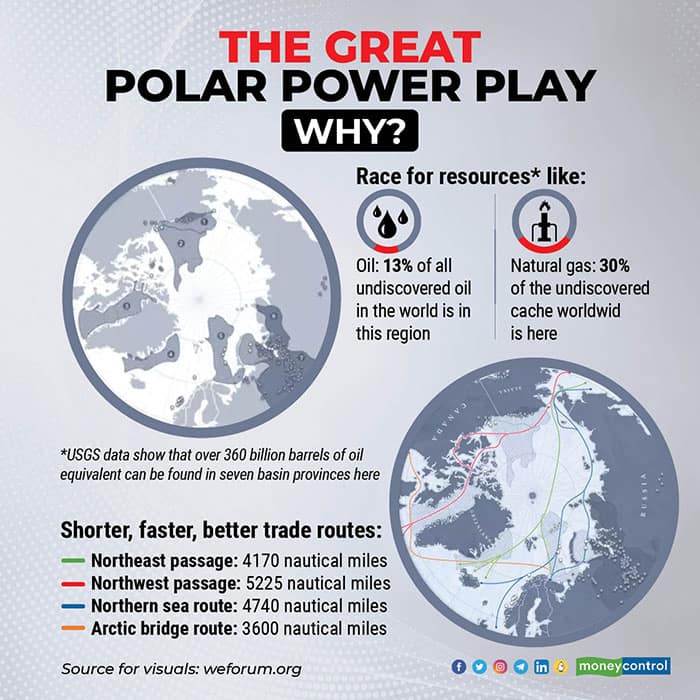
Global warming is, among its other toxic fallouts, melting the Arctic ice cap. That means ships will be able to transit through waters now blocked by ice from July to September. Today, ships leaving Shanghai headed through the Suez Canal to Rotterdam—China is the European Union’s second-largest trading partner, doing business worth over €1 billion every single day—take around 30 days. The Arctic route would shrink the journey from over 11,500 nautical miles to 6,500nm., reducing the duration to around 18 days.
Likewise, ships headed through the Panama Canal to the United States’ eastern seaboard now take about 25 days; Arctic routes would bring that down to 21.

The route has significant geopolitical advantages, too. China’s current shipping routes to Europe transit through waters watched over by the navies of geopolitical adversaries, like the United States, Australia and India. The bulk of the Arctic route, though, is dominated over by an ally, Russia.
In addition, hydrocarbon discoveries in the Arctic will allow China to mitigate its energy dependence on the volatile Middle-East—where the United States, again, has long enjoyed a strategic choke-hold. According to studies carried out by the United States Geological Survey (USGS), the Arctic holds a third of the world’s undiscovered gas, and over 12 percent of its oil.
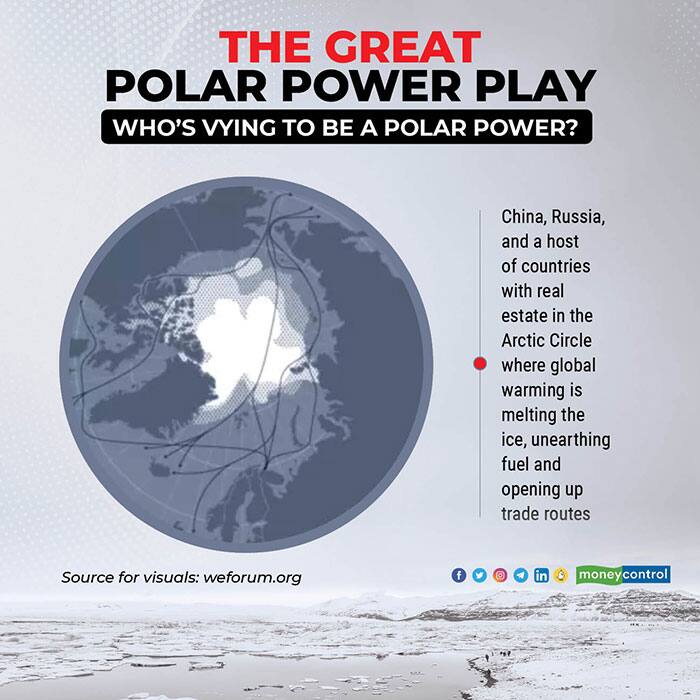
Eight years ago, in November 2014, China’s President Xi Jinping first announced his intention for the country to develop into what he called “a great polar power”. In June 2017, the Arctic was incorporated into the BRI as one of several “blue economic passages”, or futuristic projects. China has also renamed Arctic shipping lanes as the “Polar Silk Road”. In recent years, Chinese and Russian shipping companies have cooperated on extensively testing the northern shipping route.
To push forward these efforts, China completed its first domestically built ice-breaker, the Xue Long II, in 2019. The ice-breaker has completed several voyages; the latest one, which began after Zhai left port, is currently underway. The country has had research stations in Svalbard and Iceland, had set up its first overseas satellite receiving station in Sweden.
Labelling itself a near-Arctic state, although its northernmost tip is some 800nm from the Arctic Circle, China began to pitch for recognition as a stakeholder in the region early in this century. Even though it had no significant corpus of Arctic scientific research, it was granted observer status in the key regional intergovernmental organisation, the Arctic Council, in 2013.
The reason was simple: countries like Norway, which like other European states enjoys a significant economic relationship with China, feared that Beijing would otherwise simply set up its own Arctic club. The Arctic Council, though, also balanced China’s entry by allowing in several other states, including India, Japan, South Korea and Singapore.
Although its public messaging underplays China’s ambitions in the Arctic, scholar Rush Doshi has noted in a recent paper that the country’s military texts are explicit in casting the region as a theatre for geopolitical contestation.
“They note,” Doshi writes, “that, ‘the game of great powers’ will ‘increasingly focus on the struggle over and control of global public spaces’ like the Arctic and Antarctic and argue that China ‘cannot rule out the possibility of using force’ in this coming ‘scramble for new strategic spaces’ Chinese diplomats describe the region as the ‘new commanding heights’ for global military competition”.
“Zhai’s expedition,” notes scholar Mia Bennett, “has the sponsorship of state-owned enterprises like ChinaMobile, whose fittingly icy blue and white logo adorns the vessel’s sail when it is not flying its crimson red one, and China Ocean Shipping Company, COSCO, which has carried out numerous test voyages along the Northern Sea Route.
Fears have begun mounting in many capitals over China’s real intentions in the Arctic. In May 2019, United States Secretary of State Mike Pompeo raised questions over the country’s polar ambitions, while the Department of Defense warned about potential dual use of Chinese facilities. The Swedish Defense Agency, the Finnish Security Intelligence Service, and the Norwegian Foreign Intelligence Services have also expressed concerns regarding potential dual-use of the infrastructure.
As scholar Yun Sun has pointed out, though, western capitals are less clear about what to do about the threat. “The question here is not whether China will try to expand activities in the Arctic, because it will,” she has written. “The question is how to develop sophisticated policies to identify and deny malign or ambiguous behaviours while managing and shaping other behaviours that are neutral or potentially constructive.”
For India, the challenge in the Arctic is a familiar one: combating China’s global rise, but with modest resources and even smaller budgets. India’s draft Arctic policy, notified by the Government last January, underlines the importance of “sustainable engagement” in the region. India has set up several laboratories, focused on climate change, and is seeking to pursue hydrocarbon and trade opportunities.
Like in so many parts of the world, though, catching up with China won’t be easy.
Discover the latest Business News, Sensex, and Nifty updates. Obtain Personal Finance insights, tax queries, and expert opinions on Moneycontrol or download the Moneycontrol App to stay updated!
Find the best of Al News in one place, specially curated for you every weekend.
Stay on top of the latest tech trends and biggest startup news.