-
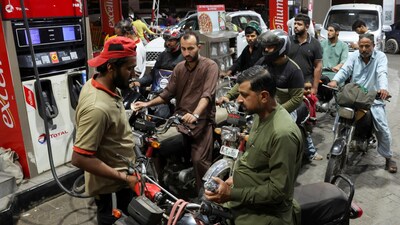
Petrol at PKR 321, schools shut, salary cuts: How Iran war is hitting Pakistan hard while India holds the line
While Pakistan struggles to manage rising energy costs and public panic, India has remained relatively insulated from the immediate price shock thanks to stronger energy management and a more diversified supply strategy.
-

The Hormuz bottleneck: How Iran war is driving up oil, gas and fuel prices worldwide and how countries are responding
Iran War and Hormuz disruption: Despite the turbulence, India has so far managed to cushion the immediate impact through regulatory controls and diversified supply strategies.
-
Chart of the Day | When crude rises, India pays the price
The Iran conflict is a reminder that every spike in Brent crude quickly feeds into India’s oil import bill and the consequences go far beyond fuel prices
-
Spiking pump prices dent Trump’s willingness to extend Iran war
Trump’s war with Iran has fueled one of the biggest spikes in gasoline prices in recent decades, lifting pump prices to the highest levels he’s seen as president.
-
OIL, ONGC, other oil exploration shares fall up to 6.5% as crude prices ease on Trump's comments
Trump said on Monday in a CBS News interview that he thinks the war against Iran 'is very complete' and that Washington was 'very far ahead' of his initial four- to five-week estimated timeframe
-
Putin threatens to cut energy supplies if EU tightens sanctions: 'Without waiting for door to be shut'
Speaking about the proposed measures, Putin said Moscow may consider halting energy exports to the European market if restrictions are imposed.
-
Fuel curbs, WFH and price caps: How countries are responding as Iran war sends oil above $100
Iran War News: With analysts warning that crude prices could rise to $150 per barrel if disruptions persist, countries around the world are scrambling to prepare for prolonged volatility.
-
Strait Of Hormuz crisis sends oil prices soaring: Why India is not panicking yet despite global energy fears
India imports about 88 percent of its crude oil, and roughly 50 to 60 percent of these imports travel through the Strait of Hormuz from major suppliers including Iraq, Saudi Arabia, the UAE and Kuwait.
-
Retail petrol, diesel prices unlikely to be hiked amid rising global oil rates: Govt sources
Brent oil prices surged past $100 per barrel on March 9 touching $120 per bbl earlier in the day before settling to $102 per bbl. Government sources said that India is not planning to release oil reserves in coordination with the International Energy Agency and is not a member of the organisation.
-
Iran–US Conflict: Will India’s Fiscal Deficit, Rupee & Markets Take a Hit? | Centre Point
The Iran–US conflict is raising fears of an oil shock, with crude potentially hitting $115 per barrel. What could this mean for India’s economy, rupee, markets, and fiscal deficit?
-
Bond yield up 7 bps; crude blows past $100 on worsening Iran war
The benchmark 10-year bond yield was trading at 6.7518 percent on March 9
-
Rupee plunges 47 paise to Rs 92.21 against dollar as oil crosses $100
The currency was hovering close to the record low of Rs 92.31, which it touched last week, as world stares at an oil shock
-
Bank Nifty falls over 2% as crude-driven inflation worries weigh; ICICI Bank, HDFC Bank among top Nifty losers
The weakness in banking stocks reflects macro concerns arising from surging crude oil prices amid the escalation of the Middle East conflict. Elevated crude oil prices have reignited inflationary concerns, stoking fears of tighter monetary policies and delay in interest-rate cuts by central banks.
-
Bonds yields hold near 6-week low, US-Iran war, crude in focus
The benchmark 10-year bond yield was trading at 6.6462 percent on March 6
-
Rupee opens 5 paise lower at Rs 91.65 against dollar, oil continues to rise on worsening US-Iran war
The local currency declined marginally on March 6, after rallying more than 50 paise in the previous session
-
Volatile rupee shifts spotlight on banking system liquidity
The rupee sank to new intraday low of Rs 92.30 on March 4 on rising crude prices and growing concerns around widening West Asia conflict
-
Indian aviation industry under pressure: ATF prices, rupee fall and geopolitical tensions weigh on airlines' profitability
While fuel price had previously added a bit of relief, a recent spike, currency depreciation and international flight disruptions are adding fresh challenges to an already cost-sensitive sector
-
Aluminium and steel prices feel the heat from Middle-East crisis
The Middle-East crisis is casting a shadow on metals such as steel and aluminium. Disruption in gas supplies and the blockade of key trade routes could see prices spike but trade hiccups could hurt
-
Indian bonds fall 5 bps on raging conflict in the Middle East
The benchmark 10-year bond yield was trading at 6.7238 percent on March 4
-
Can the Middle-East war undo MPC’s hard-won inflation gains?
With the Strait of Hormuz shut and war continuing, the oil shock is no longer just a tail risk for India’s monetary policy
-
Trade Spotlight: How should you trade Asian Paints, Bharat Dynamics, MCX, BEL, HDFC Bank, Aditya Infotech, and others on March 4?
The market is likely to reel under bear pressure given the weakening momentum and technical indicators amid the Iran war. Below are some short-term trading ideas to consider.
-
Oil prices keep climbing amid Iran conflict, with Brent hitting 19-month high
Brent crude futures were up $5.70, or 7%, at $83.44 a barrel by 1326 GMT after touching their highest since July 2024 at $85.12
-
Explained: How an oil shock from the Iran-Israel-US war could affect Indian housing
On real estate front, experts said that while higher petrol and diesel prices do not directly alter home prices, they influence the cost of living, inflation and interest rates, which may delay home buying decisions. They said that rising fuel prices could also affect construction costs.
-
Can India’s paint giants protect margins as crude oil prices rise amid Iran tensions?
According to a senior paint industry observer, a prolonged conflict may force the hand of paint makers, leading to a moderate price increase. In the near-to-medium term, however, the firms may choose to wait and watch and keep prices as it is, to maintain market share and stabilise supply chains.
-
Rupee’s fall below the Rs 91 per dollar mark sheds light on RBI’s forex reserves
The US-Israeli strikes on Iran and the latter’s retaliation are rattling global crude markets and emerging economies