




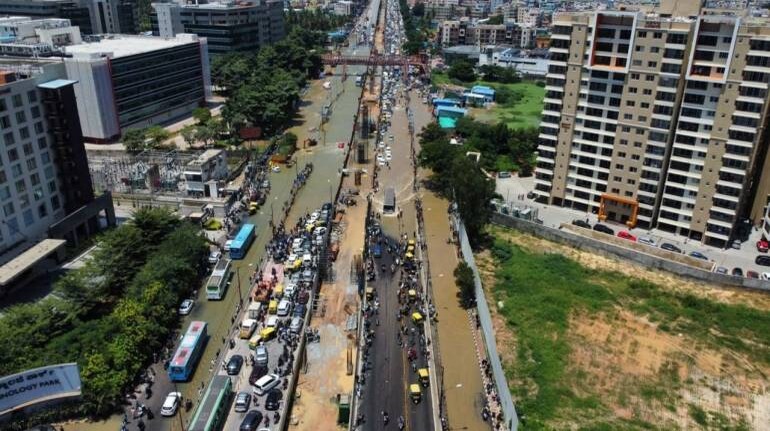
Tractors bearing executives on Bengaluru’s streets, large gated complexes marooned in rain water, stagnant water forcing people to go without power and other utilities for days on end, and more. The images from India’s leading ‘tech’ city last week could be misleading for they might well be from cities that are way behind on the urbanisation spectrum. How could Bengaluru, of all the cities, be in that spot, asked many.
However, the question to ask is: Why would Bengaluru not be in this terrible spot, repeatedly so, especially its newly-urbanised areas?
The answers are in the marooned complexes and stagnant water around some posh addresses, and in the relatively smoother flow of rain water from the old city. Bengaluru is among the fastest growing in the world in terms of both its Gross Domestic Product (GDP) and its population. Thanks to the burgeoning info-tech sector, and supported services, its GDP is expected to rise 8-8.5 percent every year till 2035, according to an innovation report. The city has the largest number of high-growth companies in India, according to the Financial Times’ latest ranking of such companies in Asia-Pacific. It is India’s most digitally-savvy city with a large percentage of millennials migrating in. All this meant rapid, often unplanned or haphazard, urbanisation.
Two aspects of Bengaluru’s urbanisation beg attention, especially after last week’s flood, if its citizens (8.5 million by the Census 2011, but closer to 13 million by recent unofficial estimates) have to avoid requisitioning tractors and boats during every monsoon. This year’s monsoon has been harsher and more intense than in previous years — the India Meteorological Department’s estimates are that Bengaluru got 34 percent more rainfall in the last three months than what it usually receives this time of the year — but then this is in the nature of the Climate Change-influenced events now visible around the world, battering millions in cities.
The first is Bengaluru’s urbanisation model which has spread wide around the old city, in horizontal waves; new concrete complexes replacing old common greens, wetlands and lakes. For instance, the Bengaluru east tehsildar sent out notices to 13 residents of the upscale gated community, Rainbow Drive, after the floods on the grounds that their properties had encroached on storm water drains and culverts. It is one of the complexes on the high-end Sarjapur Road, which has hundreds of plots ‘developed’ over the last 25 years, say residents; the complex has flooded four times since August. No one knows how or why the alleged encroachment went unnoticed for such a long time without attracting penal action.
Typically, urbanisation meant a horizontal spread of a city with new rural or semi-rural areas being enveloped into the city’s limits, either officially as in Bengaluru or unofficially as in New Delhi. It often involved overcoming the challenges of developing greenfield areas and integrating rural or semi-rural layouts into the urban structure. Given the haphazard nature of urbanisation in India, this has meant imposing an urban form — built structures with a markedly urban way of life — on the landscape without expanding and integrating the below-road infrastructure into the old. This superimposed urbanisation, rampant across Bengaluru, Hyderabad, Gurugram or even Thane, pretends all is well till it rains hard or summer temperatures hit 50 degrees C.
Contrasting with this is vertical urbanisation typified by US cities or Mumbai, an approach necessitated in cities that lie close to water which inhibits horizontal spread. This urbanisation is fraught with challenges too such as super-density of people, high density of buildings, relatively less infrastructure to carry the load especially when it rains hard, and so on. When Climate Change-influenced events hit New York or Mumbai, the cities have been marooned too and rainwater has not easily found its way out. Each approach has its merits and demerits, there cannot obviously be a one-stroke approach to urbanisation in a country as vast as India with cities having different natural features and economies.
However, what is non-negotiable in both the approaches is the interplay between natural ecology and urban form. Urbanisation has meant blithely constructing over natural areas such as grasslands, wetlands, lakes, and ponds all of which act as rain channels to soak up water when it rains hard and store it underground to prevent extreme heat or drought. Urbanisation in Bengaluru meant blasting rocks, levelling the undulating terrain around the city, filling up wetlands and lakes. In all, the city’s green areas shrunk from 17 percent in 1992 to barely six percent in 2017, during which urban cover increased a staggering 350 percent, according to a discussion at Bangalore International Centre earlier this year. Where is the rainwater, unquestionably more than in earlier years, supposed to go? The new complexes of concrete and glass cannot soak it as the natural areas used to.
There is now no way to urbanise without factoring in the natural ecology, without mindlessly constructing over it. Else, boats on new streets will be a common sight. The new urban, even in a tech city, will have to be aligned with nature.
Discover the latest Business News, Sensex, and Nifty updates. Obtain Personal Finance insights, tax queries, and expert opinions on Moneycontrol or download the Moneycontrol App to stay updated!
Find the best of Al News in one place, specially curated for you every weekend.
Stay on top of the latest tech trends and biggest startup news.




