

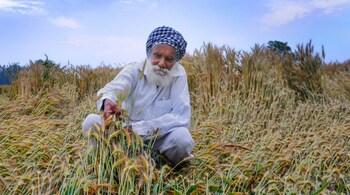
The farmer protests have been going on for nearly a month now. Farmers haven’t accepted the government’s assurance for continuing with the minimum support price (MSP) system and are demanding a complete repeal of the farm laws. Is there scope for a middle path?
Supporters of farm reforms argue that these reforms will lead to higher marketing efficiency and environmental sustainability. Farmers, on the other hand, say the new laws will heighten risks of income instability, and may result in social and economic disruption (or destruction) for them.
A bit of context, first: There is no doubt that restrictive trade policies of the government (under APMC and ECA) have hurt the farmers. In an extensive ICRIER-OECD study of agricultural commodities comprising 70 percent of country's agricultural value of output, spread across nearly 20 years, we found the average Indian farmer was net taxed in all years. That implied the losses suffered by farmers from not being able to realize the "potential" price of their produce far exceeded the benefits he received from subsidized inputs and other budgetary support.
The primary reasons for such "taxation" were government’s restrictive trade policies (mainly trading and stocking restrictions from APMC and ECA and imposition of minimum export prices (MEP) and export bans), lack of a produce aggregation mechanism (fragmented land holdings produce smaller pockets of marketable produce, and aggregation is required for generating scale) and an infrastructural deficit in storages, roads, irrigation, processing etc.
The three farm laws are targeted to solve many of these problems.
However, farmers cite a trust deficit with the government and want the laws to be repealed. They fear that instead of freeing them from APMC traders, these new laws might place them in a new stranglehold of large corporations. Their incomes, which were stable and grew in real terms each year (under MSP) will now become volatile.
Besides, they argue that benefits from greater private sector participation will not automatically follow once the new laws are implemented. They showcase the example of Bihar which has a similar marketing arrangement to what the new laws propose. According to Nabard’s NAFIS 2018, average farmer income in Bihar was Rs 7,175 a month compared to Rs 23,133 in Punjab that has a functional APMC system. This implied that howsoever inefficient, at least there are markets in Punjab which have helped yield decent incomes for its farmers.
That said, we need to remember two things: (i) that it is not the APMC’s efficient functioning per say but government’s MSP operations that have boosted incomes of Punjab (and Haryana) farmers and (ii) on a per hectare basis, Bihar generates greater incomes than Punjab.
About 30 and 65 percent of rice and wheat required for distribution under the Public Distribution System (PDS) is procured from Punjab and Haryana under the MSP regime. Over the years, government has expanded its MSP operations in other states and as per a NSSO survey report, 6 to 19 percent of Indian farmers benefit from them. But there is only as much the government can procure. Growing research literature documents the inefficient grain management systems of the government. More recently, the coexistence of mountains of buffer grains with FCI and the rising levels of malnutrition among Indian women and children is ironic and highlights the inadequacies in the current system. Now the question is if an inefficient system should be saddled with greater responsibilities? Or if an alternate market mechanism be developed? Both the systems have their problems and benefits.
The way forward
While it is clear that the reforms are much needed for Indian agriculture and the Indian farmer, we need to find a middle path to bring cultivators on board. In my quest to research for a middle path, I propose to leave the reader with some thoughts:
Rethink PDS: Can rice and wheat be replaced with nutri-cereals like ragi and pulses like gram? If we review PDS grain basket, we can re-design procurement, and that will need to be preceded by remunerative price incentives for those crops. Nutri-cereals and pulses consume much less water and thus are environmentally more sustainable and can adequately address nutritional insecurity. This transition may be coupled with an option of a direct benefit transfer (DBT) under PDS. The DBT will work particularly well in urban areas with high financial inclusion rates and where the state is surplus in production. Overall, PDS needs a rethink, and because of its close interlinkage with the MSP regime, a 10-year road map for PDS will help address apprehensions surrounding it.
Price recording and reporting: Consider these statistics --- in the 2018-19 kharif season, UP paddy farmers incurred losses of Rs 837 crore; MP maize farmers, Rs 550 crore; and MP soybean farmers, Rs 819 crore due to selling at prices below the prevailing MSP. We calculated these losses using data on prices and arrivals from the Agmarknet portal. This data informs farmers about prices across regions and time and researchers use it to establish the efficacy (or its absence) of agri-markets. Under the new farm laws, for all transactions outside the "market yard," there is no provision to record and report prices and arrivals. The government needs to establish a mechanism to record these transactions and data.
Handhold farmers: Consider the table below. Except for sugarcane, all possible combinations of crops are likely to yield lower returns than a paddy-wheat combination.
When we want Punjab's paddy (non-basmati) farmers to shift to say maize, we need to reckon that their profits are likely to fall by more than 90 percent. This draws a clear case for providing support to farmer possibly through an unconditional cash transfer of up to say Rs 25,000 per hectare.
By undertaking reforms, the PM has shown his intent to drive up the sector. Through empathy and consultation, the Modi government should now bring convergence with the stakeholders, particularly the state governments and farmers.
Discover the latest Business News, Sensex, and Nifty updates. Obtain Personal Finance insights, tax queries, and expert opinions on Moneycontrol or download the Moneycontrol App to stay updated!





