Jetting off to the Mediterranean this summer? I hope you got a good deal, because cheap flights are becoming increasingly hard to find.
You probably had an inkling that the era of absurdly cheap short-haul flights in Europe was coming to an end. After all, according to travel search engine Kayak, summer flights between the UK and the continent are currently one-third more expensive than last year. But two new reports make it clear that this isn’t just temporary turbulence.
It’s the new reality for flying as airlines face a huge decarbonisation challenge and tightening climate-compliance laws.
The first headwind stems from two big changes in the European Union’s Emissions Trading System (EU ETS). Airlines must have enough emissions allowances to cover every metric ton of carbon dioxide released into the atmosphere on flights starting and ending in the European Economic Area, the UK and Switzerland. Right now, they get about half of those allowances for free. But that deal comes to an end in 2026, as the share of allowances they have to pay for starts to rise from 2024. That is effectively going to double their carbon costs over just three years.
The unit price of carbon emissions has also soared recently, topping €100 ($111) for the first time in late February, and it doesn’t seem to be on its way back down. A report by Alex Irving, European transport analyst at Bernstein, puts the resulting cost from these changes for European airlines at about €5 billion in 2027.
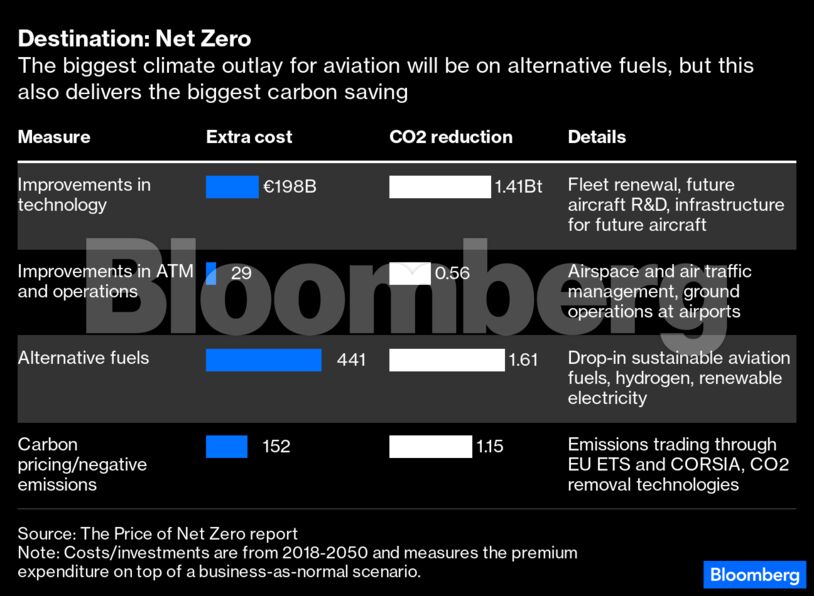
A report by research groups SEO Amsterdam Economics and the Royal Netherlands Aerospace Centre, commissioned by airline industry bodies, has put the cost of reaching net zero by 2050 at a whopping €820 billion.
Demand growth is a touchy subject for airlines, as a recent battle over proposed flight caps between the Dutch government and Amsterdam’s Schiphol airport illustrates. The forecasts are strong: The International Air Transport Association suggested that passenger numbers would nearly double to just under 8 billion by 2040 from 2017 levels. Time will tell if rising ticket prices dampen that, but the question remains whether growth is even compatible with ambitions for carbon-neutrality.
The answer might be hard to swallow. Decarbonising flying is hard enough without the extra passengers. A briefing from the Royal Society, for example, outlined that even meeting existing UK aviation demand with biofuels would require about half of the country’s agricultural land.
Fewer flights is, naturally, the easiest way to slice carbon emissions, and so a demand drop would come with its own climate benefits. The aviation industry’s report calculates that, in 2050, the drop in demand from raising prices to pay for sustainable airplane fuel would reduce emissions by 12 percent, and economic measures — such as emissions-trading obligations and CO2 removal investments — would lead to a further 2 percent reduction, compared with a business-as-usual scenario.
Still, there’s something sad about waving goodbye to the low prices that made globetrotting accessible to millions of people. Especially as those who take the most flights are also most able to swallow the extra costs. In the UK, those in the top 10 percent of earners use far more energy flying than the poorest 20 percent use overall. The introduction of a frequent flyer levy, as has been suggested by climate campaign groups, might help address that inequality and create a new funding stream for decarbonising the sector — though it’d be extremely difficult to implement.
There are lots of unknowns when it comes to decarbonising aviation. Much of the technology the sector is expecting to use, such as electric or hydrogen-fueled aircraft, isn’t ready for takeoff yet. But one thing is for certain: It’s going to be a very expensive, challenging few decades.
Lara Williams is a Bloomberg Opinion columnist covering climate change.
Views are personal, and do not represent the stand of this publication.
Credit: Bloomberg
Discover the latest Business News, Sensex, and Nifty updates. Obtain Personal Finance insights, tax queries, and expert opinions on Moneycontrol or download the Moneycontrol App to stay updated!

Find the best of Al News in one place, specially curated for you every weekend.
Stay on top of the latest tech trends and biggest startup news.