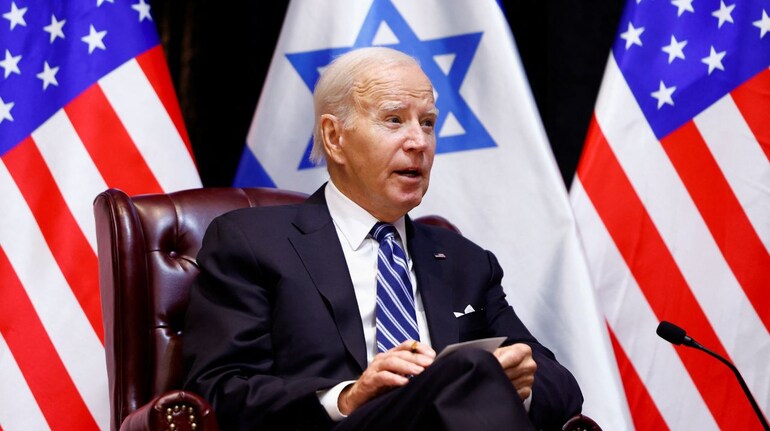
If the ceasefire talks fail again and Israeli Prime Minister Benjamin Netanyahu orders the invasion of Rafah, it’ll be his latest of many snubs to US President Joe Biden, who’s explicitly told him to spare that city where so many Gazan refugees are huddling. But what can Biden do about it? At least two things, actually.
The US could stop shielding Israel from global opprobrium in the organs of international law and diplomacy, notably in The Hague and at the United Nations. Or it could signal a halt in US arms shipments to Israel, following the example of Canada. This week the focus will be on those American weapons.
The White House just put a discreet hold on a shipment of ammo to Israel, the first such delay since the Hamas attacks of Oct 7. This gesture may be part of a larger policy shift. If so, the administration may not announce it with a bullhorn, but instead whisper it in the dense bureaucratic phrases that administration officials will utter in Congress this week.
In February, Biden issued a National Security Memorandum — its technical name is NSM-20 — that requires the Secretary of State and others to collect credible written assurances from countries receiving US aid that American weapons aren’t being used to willfully kill civilians or to commit other crimes under domestic or international humanitarian law. It also obliges the government periodically to certify to Congress whether everything is in order. This week’s briefing is the first such report.
Like everything in polarized Washington, the memorandum has become a partisan football. Republicans don’t like it. Even though NSM-20 applies to all recipients of US weapons, “the timing of its release makes clear that its aim is to placate critics of security assistance to our vital ally Israel,” assert
Michael McCaul, chairman of the House Foreign Affairs Committee, and Jim Risch, the ranking member of the analogous body in the Senate. The memorandum, they carp, only “adds unnecessary bureaucracy.”
Democrats, by contrast, applaud NSM-20, which resembles legislation that a group around Senator Chris Van Hollen has been pushing. More than 80 Democrats in the House have signed a letter to Biden pointing to “sufficient evidence” that Israel is blocking humanitarian aid. Many agree with Senator Bernie Sanders, who thinks that “Netanyahu and his extremist government are clearly in violation of US and international law and, because of that, should no longer receive U.S. military aid.”
The evidence they cite comes in part from non-governmental organizations such as Amnesty International. It claims to have documented “serious violations” by Israel of international humanitarian law and demands the “immediate suspension” of weapons transfers. The accusations range from the general — that Israel uses starvation as a war tactic — to the specific. In one instance, the report says, the Israelis used American-made Joint Direct Attack Munitions — a technology that turns “dumb” bombs into guided explosives — against two Gazan homes, killing 43 civilians, of which 19 were children and 14 women.
In theory, US legislation — such as the so-called Leahy Law — already gives Biden options to suspend aid to Israel if he wanted to. In practice, those tools are cumbersome, and Biden wanted a better one. It’s taken him a while: A lifelong friend of Israel, the president wavers between showing, in his words, “ironclad” support for the Zionist state and horror at Israel’s “indiscriminate” bombing in the Gaza Strip.
The resulting indecision has made him look feckless vis-a-vis Netanyahu. Since “Bibi” launched the current campaign against Hamas, the prime minister has often seemed more eager to placate his far-right coalition partners than to keep Israel’s most important ally onside.
Merely hinting at a suspension of American weapons shipments could change Netanyahu’s calculus, though. Since its founding in 1948, Israel has been the world’s largest cumulative recipient of US aid; just the other day it received additional billions in supplemental funding. The American kit includes everything from fighter jets to bombs, rockets and rifles, and amounts to an estimated 15% of Israel’s entire defense budget. Moreover, Washington gives Israel all kinds of preferential treatment. For example, the US commits to maintaining Israel’s “qualitative military edge”: Israel will always get better weapons than those the US sends to other partners in the region.
Placing a question mark over this American largesse would get Bibi’s attention. It’s not a matter of making American support less ironclad: NSM-20 explicitly exempts purely defensive weapons, such as missiles or other components that form part of Iron Dome, Arrow and David’s Sling, the systems that so masterfully protected Israel against a recent missile and drone attack from Iran. The memorandum also allows for remedies: If Israel moderates its tactics, offensive weapons could immediately move again.
Israel has an absolute right and duty to defend itself against Hamas, which wants to extinguish the Jewish state and deserves to be destroyed in return. But like every other country, Israel must observe international humanitarian law as it fights. As Van Hollen, the Democratic Senator, puts it, “the war to end Hamas’s control of Gaza is just, but it must be fought justly.” It’s high time for the US, as Israel’s best friend in the world, to make sure of it.
Credit: BloombergDiscover the latest Business News, Sensex, and Nifty updates. Obtain Personal Finance insights, tax queries, and expert opinions on Moneycontrol or download the Moneycontrol App to stay updated!
Find the best of Al News in one place, specially curated for you every weekend.
Stay on top of the latest tech trends and biggest startup news.