

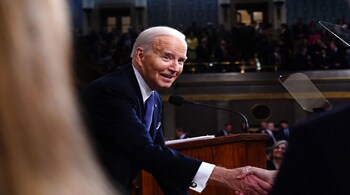
The pageantry unfolding in Washington this week, and again this summer, will speak volumes about the US and its changing role in the world, as telegraphed through its alliances. It signals what’s worked best about American leadership since World War II, but also how that model must be updated for a new century, and how all American-led alliances must be proofed in case an isolationist should ever enter the White House, perhaps even next year.
This week US President Joe Biden is hosting a historic summit with the leaders of Japan and the Philippines, Fumio Kishida and Ferdinand “Bongbong” Marcos. Each country is a long-time bilateral treaty ally of the US, and both are now also converging into a new trilateral arrangement. It’s one of several “minilateral” partnerships that Biden is building in the Indo-Pacific. And all of those are intended to form a “lattice” of interwoven relations, meant to deter Beijing from trying to isolate or attack any nation in the region.
Then, in July, Biden will host the 31 other members of NATO, now including Sweden for the first time. That’ll be an occasion to celebrate 75 years of deterring the Kremlin. (The alliance’s mutual-defense clause has been invoked only once, after the US was attacked by Al-Qaeda on Sept 11, 2001.) But the 32 leaders will also have some hard conversations about their alliance’s design flaws, in particular the problem of burden-sharing.
If Biden has his way — and that remains to be seen — he’ll be able to keep what’s best in the transatlantic alliance, namely deterrence, and extend it to the Indo-Pacific region, while gradually fixing what’s worst in NATO, namely the free-riding by some allies, and making sure it doesn’t happen again in the emerging Asian lattice.
The free-riding problem within NATO has annoyed US administrations at least since the 1990s. It’s also a pet peeve of former president Donald Trump, who feels that tightwads such as Germany fleece American taxpayers by implicitly outsourcing their security to the US. But the wrong response — Trump’s — is to cast doubt on the US commitment to mutual defense, thus undermining deterrence. The right policy is to prod allies to spend their fair share. That’s been the approach since a NATO summit in 2014, when the allies agreed to spend 2 percent of GDP or more on defense. Back then only three members did; this year 18 will. Obviously, there’s work left to be done.
Security arrangements in the Indo-Pacific region evolved differently after World War II, even if the challenges are similar. There was an early attempt to build a multilateral alliance analogous to NATO (called SEATO), but it foundered over diverging interests in the region (and, not least, America’s war in Vietnam). What emerged instead is what Rahm Emanuel, the US ambassador to Japan, calls a hub-and-spokes system.
In this model Washington (the hub) has discrete bilateral treaties (spokes): one with Japan, another with South Korea, others with Thailand, the Philippines, Australia and New Zealand. The goal was and is still to deter adversaries (Pyongyang for Tokyo and Seoul, Beijing for all). But the model, unlike NATO’s, didn’t envision the various allies also cooperating with, much less protecting, one another. Some preferred to loathe each other, notably South Korea and Japan.
That’s what Biden set out to change. In a landmark agreement last summer at Camp David, he brought together South Korea and Japan for a new trilateral entente. This week’s summit adds a second trilateral, between Washington, Tokyo and Manila. There’s also a quadrilateral security “dialogue,” imaginatively called the Quad, which includes the US, India, Australia and Japan. And there’s a third tri (with all the quads and tris, wonks increasingly just say “mini”), called Aukus; it includes the US, UK and Australia.
Each partnership is different, but Biden hopes that they’ll all point in the same general direction: tighter cooperation, stronger deterrence and better burden-sharing than NATO has offered. Washington is especially enthusiastic about developing Aukus, and perhaps extending it to partners such as Japan. (Diplomats need lighthearted relief too, so the race is on to coin the acronym, with Jaukus in an early lead.) Canberra, however, first wants Aukus to work properly, before thinking about enlarging it.
The bigger idea is actually about elaborating on just one aspect of Aukus. The partnership has two parts. The first aims to supply nuclear-powered (but conventionally armed) submarines to Australia. The second, called Pillar 2, is much broader and envisions the three countries jointly developing the tools of future warfare, from electronic weapons to artificial intelligence, undersea robots, quantum technologies and more.
This is where Japan could join in, and eventually other allies. The difficulty is that such collaboration requires the utmost mutual trust in keeping information secure. The Aukus countries, along with Canada and New Zealand, have practice with each other, because they already share intelligence in a grouping called the Five Eyes. Japan still has to adopt some of the protocols.
But then it could bring vast resources to joint lattice defense. Go back to that old NATO problem of burden-sharing. It’s been an issue in the Indo-Pacific too. South Korea spends more than 2 percent of its GDP on defense, and Australia about that much, but Japan, the Philippines and others less. Now, though, Japan has accepted the challenge, and plans to double its military budgets to 2 percent. If it and other allies coordinate these investments with Washington and one another, everyone would have skin in the game, and all would be stronger together.
That’s an idea so good it should be also be re-exported back to NATO. The American side, in principle, is ready. In the past, the US wanted to dominate and hog military technology, says Kurt Campbell, a top diplomat, whereas it’s now open to sharing with its friends, as long as they do their part. I can’t wait to see how that goes down in Berlin, Madrid and Rome.
As the various leaders file through Washington this week and in July, the pomp and circumstance may be distracting — Kishida will address a joint session of Congress, among other events. But it’s good to keep grand strategy in mind, especially as naysayers in the US and the partner nations cavil about costs and affordability.
All this military kit and summitry are certainly expensive. But it’s all meant to persuade potential aggressors — in Moscow, Beijing, Pyongyang and beyond — that they would be foolish ever to test any alliance the US leads. As long as Washington, under Biden, Trump or any president, can send that message credibly, it can deter a major war. And that suddenly makes the bill look rather cheap.
Andreas Kluth is a Bloomberg Opinion columnist. Views are personal and do not represent the stand of this publication.
Credit: Bloomberg
Discover the latest Business News, Sensex, and Nifty updates. Obtain Personal Finance insights, tax queries, and expert opinions on Moneycontrol or download the Moneycontrol App to stay updated!





