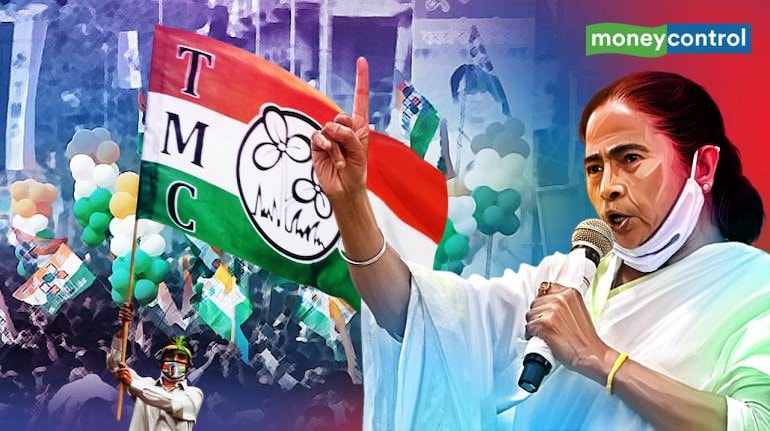
The massive victory of the Trinamool Congress (TMC) in the Bengal panchayat elections clearly indicates the continued dominance of the TMC in state politics. Earlier during the 2021 assembly elections, the TMC had registered a massive victory, improving upon its performance in the 2016 assembly election.
During the 2019 Lok Sabha election, the TMC did face a challenge from the BJP but still was ahead of the BJP winning 22 Lok Sabha seats with 43.4 percent votes. Despite that, this victory in panchayat polls in no way gives a clear indication of how TMC might perform during the 2024 Lok Sabha elections.
Recall that in 2018, TMC had won the Bengal panchayat polls in quite similar fashion only to face a stiff challenge from BJP in the Lok Sabha elections that followed. There are a few explanations for why the results don’t tell us how TMC might perform in the 2024 Lok Sabha elections.
Voters Differentiate Local-State-National
In most Indian states, the ruling party performs very well in the local body elections, if held within 2-3 years of the party coming to power. Recently in Uttar Pradesh, the BJP performed extremely well in the local body elections leaving its strongest rival a long distance behind. There are numerous such examples of the ruling party winning the local body election in the state. The local elections are contested largely on local issues, the constituencies are much smaller and voting considerations are different in local body elections compared to the assembly and Lok Sabha polls.
There are many examples in recent years which clearly indicate voters vote differently in different elections. In the Delhi Assembly elections of 2013, 2015 and 2020 voters opted for the Aam Adami Party (AAP) in a big way, but turned out massively in favour of the BJP during the 2014 and 2019 Lok Sabha elections. While AAP won 67 and 63 in the house of 70 assembly seats in 2015 and 2020 assembly elections, the BJP won all the seven Lok Sabha elections both during the 2014 and 2019 Lok Sabha elections.
During the 2018 Assembly election in Madhya Pradesh, Rajasthan and Chhattisgarh, the Congress defeated the BJP in all the three states, but during the 2019 Lok Sabha elections, the BJP won all the 25 seats in Rajasthan and polled 59 percent, while Congress trailed behind with 34.6 percent votes. In MP, only Nakul Nath, son of senior Congress leader Kamal Nath managed to win from the Chhindwara Lok Sabha seat. The remaining 28 Lok Sabha seats of MP were won by the BJP which polled 58 percent votes. In Chhattisgarh, the BJP won nine Lok Sabha Seats with 50.7 percent votes while Congress won only two seats with 40.9 percent votes.
The voters indicated a different choice for assembly and Lok Sabha elections. In fact of the total 65 Lok Sabha seats from these three states the BJP won 62 and Congress won only three Lok Sabha seats. Compared to that of the total 520 assembly seats from these three states BJP won 197 seats and Congress won 282. Similarly, the BJP on an average polled 38.8 percent votes in these three states during the 2018 assembly election, but its average vote share in these three states went up to 57 percent during the 2019 Lok Sabha elections. On the contrary, the average vote share of the Congress in MP, Rajasthan and Chhattisgarh during assembly elections 2018 was 40.6 percent but it polled only 34.5 percent votes during the 2019 Lok Sabha election in these states.
The Bengal Picture
Even in West Bengal, voters have expressed slightly different choices while electing their state government and for Lok Sabha elections. During 2014 Lok Sabha elections, the BJP polled 16.8 percent votes, but during the assembly elections held two years afterwards (2016) BJP secured just 10.2 percent votes. We find similar patterns during the 2019 Lok Sabha and the 2021 Assembly elections. The BJP polled 40.2 percent votes during the 2019 Lok Sabha election but its vote share declined to 37.8 percent during the 2021 Assembly elections.
The TMC polled 39.4 percent votes during the 2014 Lok Sabha elections but its vote share went up to 44.9 percent during the 2016 assembly elections. During the 2019 Lok Sabha election, the TMC polled 43.3 percent votes, but its vote share increased to 48 percent in 2021. Clearly the choice for TMC was more for the assembly elections compared to the Lok Sabha and for BJP it was vice-versa.
Hence, it is not surprising to note that the TMC performed extremely well in the recent Panchayat election. The TMC may still do well in the 2024 Lok Sabha election, given its massive support base in Bengal, but the panchayat election results cannot be taken as indication of how well or how bad TMC might perform in 2024.
Opposition Unity
With the panchayat results sealing the political dominance of the TMC in West Bengal, and BJP emerging as the sole challenger by a fair distance, these results may have adverse impact on the effort for opposition unity and seat sharing.
The TMC would certainly showcase this result as its complete dominance and complete marginalisation of the Congress and the Left parties in the state, and would be extremely reluctant to concede seats to the Congress and Left in case the three join hands against Narendra Modi for the electoral battle of 2024.
The TMC remains in the win-win situation, but these results may create further roadblocks in the way of a opposition unity platform that has both Congress-Left and TMC on board.
Sanjay Kumar is a Professor at Centre for the Study of Developing Societies (CSDS). He is also a Political Analyst. Views are personal and do not represent the stand of this publication.
Discover the latest Business News, Sensex, and Nifty updates. Obtain Personal Finance insights, tax queries, and expert opinions on Moneycontrol or download the Moneycontrol App to stay updated!

Find the best of Al News in one place, specially curated for you every weekend.
Stay on top of the latest tech trends and biggest startup news.