At the turn of the millennium, inheriting a few paternal acres of rubber was a mark of prosperity and clinching factor in securing marital alliances in the central Travancore belt of Kerala. It signified financial security and affluence, and stamping its western imprint on the crop, one could pursue any profession without wasting a minute on its nurture.
All you had to do was to plant it by taking ditches and spacing them out by fifteen feet, followed by a seasonal helping of NPK fertilisers. Within six to seven years it would be ready to yield, which typically went on up to thirty years.
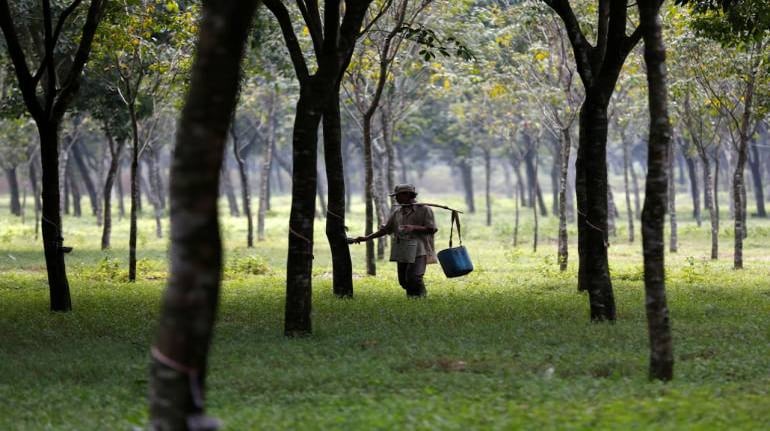
The rubber tappers calmly went about their business from early dawn. The tapped latex would be filled out in aluminium trays till it coagulated, and then it would be neatly rolled and converted to ribbed sheets, before being smoked to perfection in smoke houses. It would invariably supplement the household’s income, a ticket to prosperity in those days.
Boom To Bust
Then came the boom of 2008, when prices crossed Rs 100 per kg for the first time. By 2011, aided by China’s ravenous demand for commodities, when prices inched towards Rs 250, tappers demanded their pound of the flesh asking for a three-fold hike in tapping rates.
By 2013, however, the prices were steeply on the decline, and within another couple of years, the production cost was higher than the selling cost, causing many rubber growers to leave their land fallow.
Only farmers with marginal holdings tapping on their own could carry on with it, leaving even estate owners high and dry. Some rubber farmers resorted to selling it in latex form, which gave slightly better returns. This has remained the case for the better part of the last decade.
A Bishop’s Gambit
Cut to the present, Tellicherry Archbishop Joseph Pamplany’s open offer of a Lok Sabha seat to the Bharatiya Janata Party (BJP) for a hike in rubber prices to Rs 300 brought the sorry plight of farmers back into focus. The prelate’s political motivations and the circumstances causing it is a matter for another write-up, but it led to some respite for the farmers when a wary state government cleared the arrears of the “price stabilisation fund” pegged at Rs 170, with current prices hovering around Rs 140.
Seeking a second term, Pinarayi Vijayan had made it a manifesto promise to offer Rs 250 per kg as support price for rubber. Upon assuming power, the promise was quickly forgotten by the cash-strapped government, despite periodical reminders by its ally, the Kerala Congress (M).
It is also unlikely that the central government will take up the archbishop’s offer going by its fiscal prudence. That could set off a similar demand by farmers elsewhere, which it can ill-afford. The Rubber Board, headquartered in Kottayam, was functioning without a chairman for a couple of years into Modi’s first term in 2016, betraying its own priorities.
Piyush Goyal, the Union Minister of Commerce and Industry, only recently turned down a request to announce MSP for rubber from Kerala parliamentarians. When this came to light, the state BJP attempted damage control by sending a delegation led by KM Unnikrishnan, vice-chairman of the Rubber Board, to meet with the archbishop.
Market Vagaries
The sheer impracticability of fixing an MSP for rubber was proved way back in 2001, when the Vajpayee government announced it following a Supreme Court directive, thereby causing a protracted deadlock. The price of natural rubber is very much a variable of demand and supply, and it will remain so as long as India is bound by the World Trade Organisation (WTO) and Association for South East Asian Nations (ASEAN) agreements. For the WTO, natural rubber is an industrial raw material rather than a cash crop.
China accounts for over 40 percent of the worldwide consumption of natural rubber while India’s production is only two-thirds (8 lakh tonnes) of its total consumption. The prices remaining low have generally been on account of the demand not matching the glut in the world market. The rubber prices in India’s domestic market are always higher than the international prices.
It was in the aftermath of the Second World War that Kerala witnessed its first rubber boom, and it is estimated that 5.5 lakh hectares of land is presently under rubber cultivation. The high production cost has made rubber unviable to sustain in Kerala. The solution could be to move away from rubber to fruit trees such as Mangosteen and Rambutan in the long run.
The archbishop’s offer cannot change this reality, even if the BJP comes up with a knee-jerk market intervention plan. And that only reinforces the futility of politics over rubber.
Anand Kochukudy is a Kerala-based journalist and columnist. Views are personal and do not represent the stand of this publication.
Discover the latest Business News, Sensex, and Nifty updates. Obtain Personal Finance insights, tax queries, and expert opinions on Moneycontrol or download the Moneycontrol App to stay updated!

Find the best of Al News in one place, specially curated for you every weekend.
Stay on top of the latest tech trends and biggest startup news.