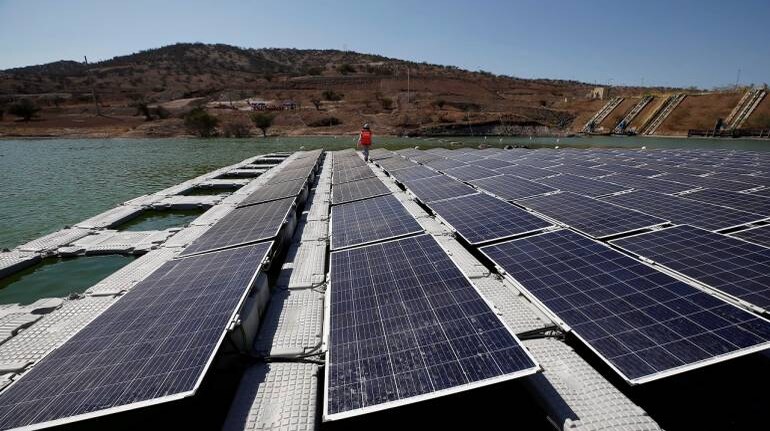
Prime Minister Narendra Modi’s push for ‘Make in India’ to bolster domestic manufacturing and make its economy ‘self-reliant’ in the post-COVID-19 era is a welcome opportunity for India’s solar energy sector. Supply disruptions from China due to the Coronavirus outbreak and subsequent shortage of solar components and modules have impacted India’s ambitious energy target of achieving 100 GW of solar capacity by 2022.
Despite making significant progress in solar power generation since 2014 and emerging as the world’s third largest solar market, India’s solar equipment manufacturing industry has not been able to capitalise on the opportunity. As India imports from China 80 percent of components required for its solar energy production, the question is: does India have the core competence, capital and capacity to offer domestic solar equipment manufacturing at a scale that could substitute its massive imports?
As the dependence on fossil fuel sources such as coal and oil is projected to decrease significantly by 2030, low-carbon sources, led by solar photovoltaics (PV) is expected to meet more than half of the new increased energy demand.
Moreover, India, under its climate action commitment, has pledged to generate 40 percent of its power from non-fossil sources by 2030. Yet, while India’s annual demand for solar cell manufacturing is 20 GW, its current average annual capacity is just 3 GW. Therefore, any further delay in domestic solar manufacturing and production will have severe ramifications on India’s energy security and economy.
There is an urgent need to devise a policy framework aimed at creating a diversified domestic manufacturing industry for solar modules as well as ancillary products, which could significantly reduce its import dependence, ensure a self-sufficient, sustainable and affordable energy access, and generate greater employment opportunities.
Until 2011, India was one of the largest exporter of the best-in-class modules, with domestic manufacturers including Bhel, Tata Solar, Moser Baer, Indosolar and Lanco, pioneering the industry. However, the lack of a consistent government policy and finance support to match the scale, quality and low price of Chinese imports, undercut the growth of India’s solar technology and manufacturing.
An aggressive strategy for long-term development of the industry in line with the National Solar Mission addressing price competitiveness, profitability, feasible finance and capacity gaps is an immediate imperative. A sustainable domestic manufacturing industry can save $42 billion in equipment imports by 2030, provide equipment supply security, and create 50,000 direct and 125,000 indirect jobs in the next five years.
Solar cell manufacturing is technology- and capital-intensive. In the value chain of solar PV manufacturing that involves polysilicon, wafer, cell and module assembly, most Indian companies are engaged in later processes of module assembly. India has no technological expertise in capital intensive processes of silicon and ingot production. With 246 patents, India’s competence in solar technologies remains critically low as compared to leading solar manufacturing country China with 39,784 patents.
There are incremental changes in technology at frequent intervals in the process of manufacturing that require capital and know-how to absorb. As the cost of acquiring technology is high, India must incentivise and step up its own research and development of cost-effective, indigenous, next-generation solar panel manufacturing technology.
As the process of manufacturing demands a multi-tiered work force with specialised skill sets such as design and manufacturing engineers, building system specialists, modellers, and assembly line workers, analysing skill gaps at each level of the value chain and devising focused capacity-building measures will be a key step. While the Ministry of New and Renewable Energy’s (MNRE’s) National Institute of Solar Energy (NISE) is engaged in R&D, testing, certification and skill development, it remains focused on solar energy generation. Joint collaboration between the NISE and leading technical education institutions such as IITs, ITIs, Council of Indian Scientific Research, and the National Skill Development Council could help develop programmes particularly focused at building India’s solar manufacturing capacity.
However, any attempt to setting up solar manufacturing facilities would entail high upfront costs. In India a major financial disadvantage for setting up of industries is the high rate of interest. The cost of debt in India is 11 percent or highest in the Asia-Pacific region, compared to 5 percent in China. Setting up a specialised financing institution on the lines of the Indian Renewable Energy Development Agency (IREDA) that can invest in equity or debt of domestic solar manufacturing companies and support guarantees for debt taken from other financial institutions will open up new sources of financing for the manufacturing industry.
The government’s Aatmanirbhar Bharat Abhiyaan has opened up a huge opportunity for India’s solar ambition. However, for achieving it, it is imperative for the government to implement the urgently-required reforms on ground.
Aparna Roy is Associate Fellow at Observer Research Foundation, New Delhi Views are personal.


Discover the latest Business News, Sensex, and Nifty updates. Obtain Personal Finance insights, tax queries, and expert opinions on Moneycontrol or download the Moneycontrol App to stay updated!
Find the best of Al News in one place, specially curated for you every weekend.
Stay on top of the latest tech trends and biggest startup news.