






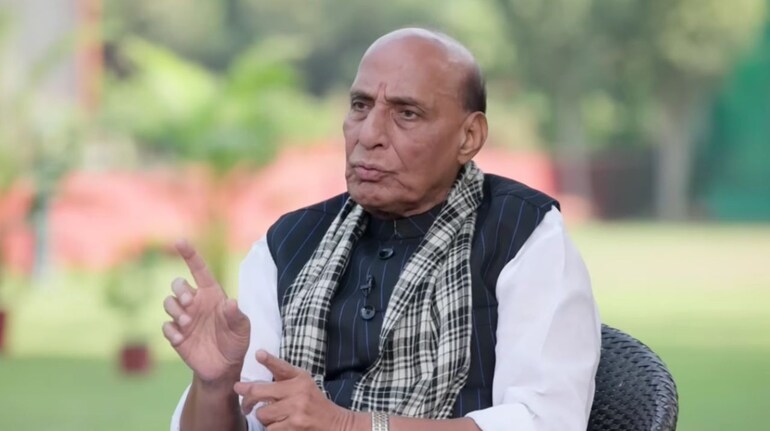
In an exclusive conversation with Network18 Group Editor-in-Chief Rahul Joshi, Defence Minister Rajnath Singh opens up on India’s defence preparedness, geopolitical strategy after Operation Sindoor and the upcoming Bihar elections. Singh also said that India is ready to produce its own fighter jet engines from next year and spoke about the prospects for Uttar Pradesh elections 2027. Here's the full text:
Rahul Joshi:Rajnath Ji, thanks for giving this exclusive interview to News18. Bihar is buzzing with the fervor of the ongoing elections. This is your first interview with us after Operation Sindoor. There are many questions. Let's start with the election atmosphere in Bihar. You have addressed many rallies in Bihar. You are very active. First of all, we would like to know what is the atmosphere like? The first round of the Bihar elections was held yesterday, witnessing a record voter turnout of nearly 65%. How many seats do you think NDA will get?Rajnath Singh:Based on the public response we are seeing at our rallies, I am confident that the government will be formed, and the NDA could secure a two-thirds majority of the seats.Rahul Joshi:More than 160 seats?Rajnath Singh:More than 160 seats.Rahul Joshi:This question is being asked again and again. Can you state clearly who your Chief Ministerial face is? Will Nitish Kumar become the Chief Minister? Will he stay for 5 years? Rajnath Singh:Given that the elections are being conducted under his leadership, it is only natural that he would become the Chief Minister.Rahul Joshi:
Do you think one Deputy CM will be from the Bharatiya Janata Party and one from Chirag Paswan’s party? Will there be such consensus?Rajnath Singh:
Whatever will happen in the future, all the people will sit together and decide what to do and what not to do.Rahul Joshi:
Rajnath Ji, one issue you’ve raised from the very beginning is that Lalu’s tenure in Bihar represented what you call the Jungle Raj. Earlier, the state was dominated by gangs — a period often referred to as Jungle Raj. So, this time too, you have been involved in this issue for a long time. But this time, Anant Singh from your own party has been arrested. There was also a shooting incident in which Dular Chand Yadav was killed. What would you like to say about this?Rajnath Singh:
There may be one or two isolated incidents — such things can happen. But just because of this, no one can be labelled as a mafia person. In social life, certain personal frustrations are bound to exist within society, one cannot deny this fact. But we take full precautionary measures that those who have clean image will only be made candidates. But it is possible, where there is such a big community, there can be wrong decisions. I do not deny this possibility.Rahul Joshi:
Rahul Gandhi has been actively campaigning in this election. As the elections approached, his attacks became personal. He remarked that Modi Ji can do anything for votes — even dance on stage. During Chhath, he also said that Modi Ji did not take a dip in the Yamuna but performed the rituals in a sanitized pond. How do you view such comments?Rajnath Singh:
I believe there is no need for such remarks. Regarding the question of theatrics, I think the country understands very well that such accusations against Modi Ji are completely unacceptable.Modi Ji always presents simple and straightforward matters to the people. He has never tried to gain support by misleading anyone; instead, he earns the people’s trust by presenting facts honestly.Rahul Joshi:
Rajnath Singh:
Jeevika Didi is certainly a factor, but beyond that, women feel that under Nitish Kumar as Chief Minister, the law and order situation has improved. Today, the situation is very different from what it was during the RJD rule. This sends a clear message across Bihar.Women voters, irrespective of political affiliation, are primarily looking for a government that can ensure safety and maintain law and order. They want to feel secure — able to step out anytime, even at night, without fear. In Bihar, women have experienced this change firsthand.During the RJD government, when Lalu Prasad Yadav was Chief Minister, people would hesitate many times before going out after 5 p.m., and for women, going out at that hour was almost impossible.Rahul Joshi:
Do you believe the ban on alcohol has contributed to this outcome? Opposition leaders, Tejashwi Yadav and Prashant Kishor, have stated that if they form the government, they will revoke the prohibition. Has this position worked in your favor politically?Rajnath Singh:
How much has been benefited, how much has not been benefited, it is very difficult to calculate it correctly. But I can say that it has definitely benefited.Rahul Joshi:
Rajnath Ji, in this election...Rajnath Singh:
And women have felt very good about it.Rahul Joshi:
Yes.Rajnath Singh:
Because when they used to see their relatives drinking liquor and drinking alcohol, they didn't like it.Rahul Joshi:
There’s also a major angle of revenue loss in this — they claim that the state has lost nearly ₹20,000 crore in revenue because of the liquor ban.Rajnath Singh:
But to remove such social evils, we should not talk about revenue profit or loss. We have never looked at it from that perspective. Our politics is aimed at building a better society, not merely at gaining power.Rahul Joshi:
Rajnath Ji, there’s also discussion about the Prashant Kishor factor. Many are calling this a three-way contest now. PK has launched his party, Jan Suraaj, and spent the last three years reaching out to villages across Bihar. How significant do you think the PK factor is? What vote share do you expect him to get, and which side — your alliance or the Mahagathbandhan — will it affect more?Rajnath Singh:
I believe that factor is insignificant.Rahul Joshi:
Okay, insignificant.Rajnath Singh:
The PK factor is insignificant; we should not focus on it. Over the years, the people of this country have become politically very aware. They now clearly understand who is contesting merely to divide votes and who is genuinely contesting to form a government. It is on this understanding that they cast their votes.Rahul Joshi:
So, in your view, they are contesting merely to divide votes — and this is also the perception among the people?Rajnath Singh:
Yes, the people think so. They know that they may not get even a single seat. This is what the people believe in Bihar. This is what we have discussed. I am saying this on the basis of my own assessment.Rahul Joshi:
On one hand, you talked about Jeevika Didi and brought it like a game-changer scheme. On the other hand, Tejashwi Ji talked about giving a government job in every house. All of you — all politicians — had questioned how this was possible. You asked, how can anyone provide 2 crore jobs to two crore families? Where will the money come from? But later, your own party announced a promise of 1 crore jobs. How do you explain this?Rajnath Singh:
See, it is like this. In almost every family, they have talked about giving employment. I mean giving a job. I think it is not possible in any case. They have talked about giving a government job. We have talked about giving a job. Wherever government jobs are possible, we will certainly provide them as well. But they should get a job so that they can run their lives properly. We will ensure this. We do not want to deceive the public and get their support. We do not want to mislead the public and get their support. In our politics, we always face the people directly and act with transparency. And in any case, we do not allow a crisis of credibility to arise in politics by creating a gap between our words and our deeds. We remain fully conscious of this. Whatever we say, we say it with complete responsibility and careful consideration.Rahul Joshi:
Rajnath Ji, that’s a very good point. But this brings us to another important question — the question of the ‘Rewari culture’.The Prime Minister himself has criticized this. But if you see today, in every state, whether it is Madhya Pradesh or Karnataka, and nowadays in Bihar, the way the promises that are being made, how is it possible to fund it? Where will the revenue come from?You are also promising free electricity. You have already provided ₹10,000 each to 1.4 crore women, and now you’re saying that even more will be given — possibly up to ₹2 lakh. So, where is all this money coming from?Rajnath Singh:
See, whatever we announce, we do it with a lot of thought. And it is a well-calculated figure that what is necessary for the development of the state, what is not necessary. We do it keeping this in mind.And whatever announcements we have made in our election manifesto — whether it is about providing free electricity or a certain number of free units per family — all of it is aimed at improving people’s financial condition, enhancing their purchasing power, and increasing their earning capacity. Whatever we announce is carefully considered and based on well-calculated figures.Rahul Joshi:
So, like the Ladli Behna and similar schemes in other states that focus on direct benefit transfers, is your Jeevika Didi scheme different? Does it place more emphasis on entrepreneurship?Rajnath Singh:
The core purpose of the Jeevika scheme is to support women in achieving economic development and improving their conditions compared to the past. When everyone has work — in any form — they can contribute to the state’s economy. Every state government should strive to ensure this, and political parties, before releasing their manifestos, should carefully consider these issues. Our announcement was made only after thorough consideration and due diligence.Take, for example, the Pradhan Mantri Kisan Samman Nidhi, through which we provide farmers a minimum of ₹6,000 every year. If you ask the farmers, they’ll tell you how directly they benefit from it. After sowing their crops, they can meet their fertilizer needs through this support, which ultimately helps increase food grain production. Naturally, such measures strengthen the overall economy. So, with a long-term vision, we give assurances and take steps that are both responsible and sustainable.Rahul Joshi:
Let's move towards SIR. In the beginning of the Bihar elections…Rajnath Singh:SIR.Rahul Joshi:
At the beginning of the Bihar elections, Rahul Ji and Tejashwi Ji launched the Voter Adhikar Yatra. They allege that around 65 lakh names have been deregistered from the voter list in SIR, Bihar, and that your party stands to gain from this because, according to them, many of the intruders were removed which were their voters. How do you respond to this allegation?Rajnath Singh:I say, at least they should tell us clearly…Rahul Joshi:Yes.Rajnath Singh:
At least they should tell us whose names should have been registered as voters but weren’t. Not a single concrete case has been brought forward. The Election Commission has repeatedly said that if there’s any complaint, bring it to us — we are ready to investigate. But instead of doing that, they are only trying to mislead the people of the country. Sometimes they stand in front of big blackboards and give dramatic presentations to confuse people. If they have facts, they should take them to the Election Commission — it will investigate. And if they don’t, then the truth is clear.As for their statements on SIR, sometimes they talk about blowing hydrogen bombs, sometimes atom bombs — but they are unable to even light a simple firecracker.Rahul Joshi:
They are alleging that you plan to ‘steal’ the elections in Haryana and Maharashtra, and now they’re making the same claim about Bihar. Do you think these statements are an attempt to cover up their own shortcomings, or are they actually suggesting that your party is violating and bypassing the democratic process?Rajnath Singh:
The truth is, they had made similar allegations earlier about Bihar. They even held a padyatra there, questioning the SIR process that was underway. But there was nothing to validate their claims — not a single example was ever presented. Even after the elections have concluded, they continue to raise the same issues. No political strategy can endure for long if it relies on deceiving the public.Rahul Joshi:
Other opposition parties like TMC, Mamata Banerjee or Stalin in Tamil Nadu are also saying that we will not let SIR happen in our state.Rajnath Singh:
Why will they not let it happen?Rahul Joshi:
They are saying that you are trying to remove the legitimate voters by bypassing the democratic process.Rajnath Singh:
I want to ask them — who are the legitimate voters they are talking about? Do they mean individuals who have migrated from outside and entered the country unlawfully?Rahul Joshi:
So, do you believe that most of the people who have entered from outside — the ones being referred to as intruders — are among those 65 lakh names in Bihar?Rajnath Singh:
Not most of them. Many of those people have passed away, yet their names remained on the voter list. They are being removed. There are also many who have gone elsewhere to earn a living, to make their daily bread. Some have even moved to other countries, but they no longer reside here. Naturally, their names should not be included in the voter list.Rahul Joshi:
One more controversial statement that Rahul Gandhi has made which you have commented on and I want to understand it in detail. He has said that only 10% people are running the armed forces. Why did he say this? What is his intention? What does he want to say? And what is your response?Rajnath Singh:
I would like to say that whatever they say, it seems aimed at creating anarchy in the country. They know very well that through their actions and work, they cannot earn the trust or support of the people. So they make baseless statements to mislead the public. I believe that healthy politics is not based on misleading people, but on trusting and having faith in them.Rahul Joshi:
So, politics should not involve or drag the armed forces into such matters?Rajnath Singh:
There is no question about that. As far as the armed forces are concerned, I believe that this is the only religion. They have said a lot about reservation and so on.The armed forces follow only one religion — Sainya Dharma. Beyond this, there is no other religion. And you see, the armed forces include people from all castes and communities. It is a space where people of every faith and background come together. There are arrangements in place, with priests of different faiths serving in the armed forces. There is no discrimination based on caste, religion, or creed in our army. I am of the view that these issues should be addressed without bringing the armed forces into it, and the army must not be drawn into political matters.Rahul Joshi:
Rajnath Ji, the opposition has already created a lot of controversy around the Agniveer scheme. In 2026, four years of this scheme will be completed. Considering the current state of the country and our security concerns, do you think it will be possible to retain more than 25% of the personnel?Rajnath Singh:
The Agniveer scheme is a great initiative. We have clearly stated that after the 4-year tenure, the personnel leaving the scheme will be supported in specific ways. For those seeking employment, the necessary assistance and funding will be provided. Rahul Joshi:More than 25%...Rajnath Singh:
At the same time, maintaining youthfulness in the army is very important, and this decision has been made with that in mind. I believe there is no need to worry about the future. Our approach is clear, and we will ensure that no one is adversely affected.Rahul Joshi:
They may be disheartened by such talk. Moving onto Donald Trump, who has been in news. Donald Trump has stated that Pakistan is conducting a nuclear test and suggested that, in view of Russia and China, the United States should also consider doing the same.Rajnath Singh:If they want to do, let them do it.Rahul Joshi:
What will India do in response to this? Does India plan to conduct a nuclear test as well?Rajnath Singh:What India will do, only the future will tell. But whoever wants to do it, should do it. We do not want to say anything in this regard. Whether Pakistan, America or any other country takes such steps is their concern. India does not take any decision out of fear or under pressure. We act solely in our national interest, and we will take the right step at the right time.Rahul Joshi:
Right step at right time.Rajnath Singh:We will take the right step at the right time.Rahul Joshi:
I’m speaking with you for the first time after Operation Sindoor. I remember — in 2024 you said, ‘Bharat woh Bharat nahi hai ghar main ghuss kar marega’ (This is not the India that will stay silent — this India will enter enemy territory and strike). You said it with such conviction that even the international media covered it.Rajnath Singh:
And we proved it right.Rahul Joshi:
Yes. You proved it to be true in Operation Sindoor. But some people feel that you pulled back too soon. Why did you stop so soon? They wanted to teach Pakistan a lesson with more force.Rajnath Singh:
Let me be very clear. There was a call from Pakistan’s DMO, and after that we acted. India is not a warmonger — we do not seek confrontation. Some may want war, but India has always insisted on restraint. We did what was necessary at the time, and there is no desire to prolong this conflict. But make no mistake — if it becomes necessary again, we will act.Rahul Joshi:
You are saying this again and again. Do you still think that there is a situation in place where Operation Sindoor will have to be repeated?Rajnath Singh:
The future always holds uncertainties — what will happen and how it will unfold is unknown. I want to clarify about Operation Sindoor: the operation has not ended; recently, it has been temporarily suspended.We acted because terrorists had infiltrated into India and killed innocent citizens. Our response targeted terrorist centers in Pakistan, and not ordinary civilians.Our people are cautious and sometimes criticize the government, even alleging discrimination based on religion or caste. But India is a country where our sages have taught that we should consider not just those living within our borders, but all people across the world as part of one family.The message of ‘Vasudhaiva Kutumbakam’ (The world is one family) has been conveyed globally, and India continues to champion this philosophy.Rahul Joshi:
You have said this very clearly today and earlier. Your government has also said that there was no one between India and Pakistan. This war was stopped only by their insistence.Rajnath Singh:Operation Sindoor has not been halted due to pressure from anyone, nor on any pretext. I want to make this clear in just a few words. You must know that I take full responsibility in my political life, and I have always strived never to lie. No one can point to any incident in my political career where I have been dishonest. Of course, I cannot speak for my childhood or my early political life — I was still learning then. Since that time, I have become more careful. I am human, so mistakes can happen, but in this matter, I am completely confident. Whatever I am saying, I am saying with full thought and consideration.Rahul Joshi:
President Trump has repeatedly said that he played a major role in preventing this war. He claims that because we did not agree with him, we have had to bear the consequences — facing tariffs and visa restrictions. Despite all this, you have completed 10 years of defence cooperation with Pete Hegseth. Why is that?Rajnath Singh:
He is saying — despite this, they entered into an agreement with us, which indicates that all signs are positive.Rahul Joshi:
Yes. Do you think that the situation of tension between the two countries is better than before?Rajnath Singh:
Now we have to consider whether there is any tension and what its nature is. I cannot comment on that; only those making these claims can provide clarity.Rahul Joshi:
This time you have taught Pakistan a lesson. Along with terror camps you have destroyed 11 defence bases.Rajnath Singh:
Destroyed it.Rahul Joshi:
Despite this, General Munir was promoted. He talks about many things. Will Pakistan ever stop doing this?Rajnath Singh:
He has either been promoted or received the promotion. We cannot comment on Pakistan. As you know, the army holds a certain kind of supremacy.Rahul Joshi:
Let's move a little away from Pakistan and move towards Afghanistan. Afghanistan's Foreign Minister, Mr. Muttaqi Ji was here.Rajnath Singh:
Yes.Rahul Joshi:
There has been a conflict between Pakistan and Afghanistan, with Pakistan reportedly bombing Kabul. Pakistan has alleged that India is behind these actions and is pointing fingers at us. How do you respond to these claims?Rajnath Singh:
These are completely baseless and unfounded allegations. We do not believe in any kind of confrontation. We want peace across the world, and we stand firmly on that side. We will never encourage anyone to fight. But if anyone provokes or threatens us, we will not let it pass. Our stance is entirely transparent and well-defined.Rahul Joshi:
Afghanistan and Pakistan -- yes, sir.Rajnath Singh:
We do not rely on any partner to protect our self-respect; we do it ourselves. We make our own decisions and take the necessary actions independently. At the same time, we do not seek conflict in the world — avoiding it is a fundamental principle of our approach.Rahul Joshi:
The current problem between Pakistan and Afghanistan is related to the Durand Line, which remains a subject of debate. My question is simple: what is India’s position on this issue?Rajnath Singh:
All issues should be resolved between the countries concerned. India does not wish to interfere in the internal affairs of any nation. If both countries agree to establish a new state of affairs and wish to initiate dialogue, we can consider supporting that. The idea of ‘Maan na maan, main tera mehmaan’ (whether you accept it or not, I’ll be your guest) is not something we subscribe to.Rahul Joshi:
So, do you believe this is primarily an internal issue for them?Rajnath Singh:
Yes, they have an internal issue. They will decide.Rahul Joshi:
Bangladesh’s interim leader, Muhammad Yunus, has often made provocative statements. Recently, he reportedly showed a map of India to Pakistan’s military leadership, depicting Bangladesh’s north-east differently. What is your response to this?Rajnath Singh:
This is a very unfortunate incident, and such actions should be avoided. As far as our neighboring countries are concerned, we aim to strengthen our relations with them. We do not seek any kind of tension with our neighbors.Rahul Joshi:
Rajnath Ji, a bigger question arises from this. At one time, we had conflicts with Pakistan, and our relations were tense. After the Galwan incident, we faced a tense relationship with China. Now, there is tension with Bangladesh as well. This means all three fronts are active. How does India plan to manage this situation, and how should we move forward?Rajnath Singh:
India has the capacity to overcome any challenges and resolve all problems that come our way. But we are a people who believe in peace; we do not seek unrest. This, however, does not mean India is weak. Any affront to India’s dignity will be met with a strong and resolute response — that is all I want to say.We hope for stability and normalcy in our neighboring countries. Our goal is to build strong and positive relations with them, following the principles of our leader Atal Ji, who always emphasized caution and prudence. Friends may change in life, but neighbors never change.Rahul Joshi:
You’ve made some very important points. Having served as Defence Minister for a long time, we’d like to hear from you about the changes and reforms that have taken place since your tenure began. In today’s era, air superiority is particularly crucial — could you shed some light on this?Rajnath Singh:
And we have shown our air superiority.Rahul Joshi:
Yes, absolutely. I wanted to ask a few questions. Recently, we have finally retired the MiG-21, and we are relying on the Tejas as its replacement. Where do we stand on this transition? Are discussions with GE progressing at the right pace, or is there any delay? Are we considering any alternative options?Rajnath Singh:
We have engaged with GE, Safran and several other firms and have taken concrete steps forward. I don’t want to make an open announcement at this stage — these matters will be decided only after presentation to the Cabinet Committee on Security (CCS), so I can’t comment in detail. We do, however, have clarity about the direction we are going. If the situation remains favorable over the coming year, our aim is clear: to produce the engines for these fighter aircraft in India — on Indian soil and with Indian hands.Rahul Joshi:
This is a big statement. So, will you manufacture the engines entirely in India, or will some components still be sourced from abroad?Rajnath Singh:
Yes, for the time being, we will need to source the engines from abroad.Rahul Joshi:
Is there any American pressure that you will have to take it from America?Rajnath Singh:
There is no pressure. And whatever we source from abroad, we will not compromise on our terms.Rahul Joshi:
Yes.Rajnath Singh:
This is a possibility we cannot ignore. It is a very real and powerful option that we may source engines from abroad for now. But the manufacturing of these engines must take place in India, and the technology should be fully transferred to us.Rahul Joshi:
Is this an ongoing discussion directly between you and the company?Rajnath Singh:
I don't want to make a disclosure on this.Rahul Joshi:
But discussions are going on.Rajnath Singh:
What I am saying is not baseless — it is grounded in fact, and that should be acknowledged. As for which companies we have engaged with, what exactly we will do, and the details of these discussions, I will not comment on that at this moment.Rahul Joshi:
The French company Safran is collaborating on the engine for our fifth-generation fighter aircraft. Can you tell us when the first engine is expected to arrive? When will we receive it? I know you have mentioned this before, but could you provide a little more detail?Rajnath Singh:
Our goal is to manufacture the engine in India as soon as possible — very soon. A decision on this matter has to be taken by the CCS, and I believe it will be made shortly.Rahul Joshi:
So collaboration can be done with foreign companies, but it has to be Make in India.Rajnath Singh:
In India.Rahul Joshi:
Work is currently in progress on this issue.Rajnath Singh:
Absolutely.Rahul Joshi:
Fifth generation fighter.Rajnath Singh:
Our effort is that whoever we enter into an agreement with, whoever we make arrangements with, they should also transfer the technology to us.Rahul Joshi:
Technology transfer. So the talks on the fifth generation fighter, Advanced Medium Combat aircraft…Rajnath Singh:
AMCA.Rahul Joshi:
AMCA. The design of AMCA is ready. How far has it progressed?Rajnath Singh:
The progress is good. It is satisfactory.Rahul Joshi:
Can you give some timelines on this?Rajnath Singh:
It should be done soon.Rahul Joshi:
Soon. Experts are saying that it can take up to 10 years to complete this process. Is this right?Rajnath Singh:
It can take some time, but it will take 10 years. I don't think so.Rahul Joshi:
It can be done before 10 years?Rajnath Singh:
Yes, it can be done before that too.Rahul Joshi:
We have acquired 114 Rafale jets under the Multi-Role Fighter Aircraft (MRFA) project. Could you tell us about the progress of this project? Also, how was our experience with the Rafale during Operation Sindoor?Rajnath Singh:
It was a very good experience. Rafale has done a miracle. And it is a very magnificent fighter plane.Rahul Joshi:
So, by when is the full induction of all 114 Rafale jets expected to be completed?Rajnath Singh:
Wait and see. It is a matter of time. It will take some time. But the overall progress is good.Rahul Joshi:
Rajnath Ji, it has been seen that drones play a big role in modern warfare.Rajnath Singh:
Yes, a very big role.Rahul Joshi:
We observed the performance of our forces during Operation Sindoor. So, is it too late to procure MQ-9 drones from the United States? Also, how are we developing swadeshi (indigenous) drones, and what is your vision for Swadeshi drone capabilities?Rajnath Singh:
We have already started working on the swadeshi drones. Swadeshi drones will be made in our India.Rahul Joshi:
So can you tell us more about this? And are the MQ-9 drones being delayed or on time?Rajnath Singh:
Deliveries should be completed as per the scheduled timelines. That is my belief.Rahul Joshi:
Are we procuring the S-400 missile systems from Russia? Is it possible to manufacture Russia’s Su-57 fighter jets in India? Could you elaborate on these plans?Rajnath Singh:
Regarding the S-400, yes, we do need it.Rahul Joshi:
So, we’re going to buy more from Russia?Rajnath Singh:
Absolutely. If the opportunity arises, we will acquire it.Rahul Joshi:
Is there any discussion about manufacturing the Su-57 fighter jet in India?Rajnath Singh:
I will not comment on this at the moment.Rahul Joshi:
If we talk about the BrahMos missiles, they proved to be highly effective during Operation Sindoor.Rajnath Singh:
Very effective.Rahul Joshi:
We are seeing interest from several countries. If this interest continues, could it have a significant impact on India’s defence exports?Rajnath Singh:
It will have a huge impact.Rahul Joshi:
Can you explain this with some figures?Rajnath Singh:
Yes, of course. Our defence exports are set to increase. So far, we have been exporting approximately ₹25,000 crores. Our target is to reach a minimum of ₹50,000 crores by the end of 2029-30, and we are confident of achieving this goal.Rahul Joshi:
Only in BrahMos or?Rajnath Singh:
No, no, the whole…Rahul Joshi:
The total defence, yes.Rajnath Singh:
You must have seen that we have also accelerated the process of indigenization. We have made decisions on numerous items that whatever can be produced in India, will be manufactured on Indian soil. We want to ensure that these are made by Indian hands. This is our firm commitment.Rahul Joshi:
Agni-6...Rajnath Singh:
I would like to inform you that we have identified a list of positive indigenous products. We have decided on 550 such items that will no longer be imported from any country — they will be made in India. Additionally, for certain local replacement units, we have decided to produce around 5,000 units domestically.I am pleased to share that we have already begun producing approximately 2,500 of these items in India. This represents significant progress in the fields of indigenization.Rahul Joshi:
We can say that the defence sector is leading the way in achieving self-reliance.Rajnath Singh:
I cannot claim to be at the forefront, but the progress in indigenization within India’s defence sector is truly very satisfying.Rahul Joshi:
When is the test of the Agni-6 missile planned? Being our longest-range intercontinental ballistic missile, could you share some details about it?Rajnath Singh:
Wait for it.Rahul Joshi:
There has been a lot of speculation and discussion about this. I thought if I asked you directly, you might be able to answer some of these questions.Rajnath Singh:
How can I tell you? But you’ll have to wait for it.Rahul Joshi:
But it will happen.Rajnath Singh:
It will happen. Whatever the outcome, everything will be in order. You will be satisfied and happy with the results.Rahul Joshi:
Okay. You hinted at something earlier even without directly saying it. Has the nuclear submarine project been delayed?Rajnath Singh:
We cannot say that the project is delayed. However, yes, it has taken a little more time, and I acknowledge that. But it will be ready, and there is no significant delay.Rahul Joshi:
The project has cost ₹1 lakh crore. Are you satisfied that this will be on time…Rajnath Singh:
Yes, it is very good progress.Rahul Joshi:
Progress is good?Rajnath Singh:
The progress has improved compared to earlier stages.Rahul Joshi:
Since we are talking about self-reliance and indigenous, would you also say that our weapon systems and platforms today should be indigenous, and that we should not be dependent on anyone else?Rajnath Singh:
This is it.Rahul Joshi:
What is your perspective on this? Is this aligned with your vision?Rajnath Singh:
No, no. Our defence and our weapons should not be dependent on other countries. We aim to be completely self-reliant, and our efforts are moving in that direction. I can also say that the progress in this area has been very encouraging.Rahul Joshi:
Rajnath Ji, what is the status of theaterization — that is, a unified command of the Army, Navy, and Air Force — which is being discussed? How soon will this be possible? I was observing that the Army…Rajnath Singh:
I cannot specify a timeline at this moment, but I can say that our progress on theaterization is going well.Rahul Joshi:
In the Air Force…Rajnath Singh:
We have made significant progress in achieving jointness.Rahul Joshi:
The Army Chief has mentioned that progress is going well. But is the Air Force raising any objections or concerns? If so, how are these being addressed?Rajnath Singh:
The Air Force has not raised any objections so far. Whatever steps we take, we will move forward with full confidence, in coordination with the Air Force, Navy, and Army.Rahul Joshi:
The Armed Forces have been conducting large-scale exercises for several weeks. Are these routine exercises, or is there a specific threat prompting them?Rajnath Singh:
No, there is no danger. These are routine exercises, and they are continuing as part of regular training.Rahul Joshi:
Rajnath Ji, in China, the Line of Actual Control has been reduced, but there has been no visible de-escalation. Should this be seen as a defeat…Rajnath Singh:
There has been de-escalation at many points. You may have also seen that China has stated its intention to normalize the tensions along the LAC with India. During my participation in the ADMM-Plus meeting, I had a constructive conversation with the Chinese Defence Minister. He conveyed that they wish to maintain a military-to-military relationship along the LAC to prevent any tense situations. Their desire for dialogue and stability has been clearly expressed.Rahul Joshi:
So this is a big development. We can trust China that here…Rajnath Singh:
They have expressed this, and we have conveyed our agreement. During the Shanghai Cooperation Organization meeting, I spoke to China’s Defence Minister and asked him to consider whether the ‘ice’ in India-China relations should be allowed to melt, and how long it should remain frozen. I also requested permission to convey this message to the Chinese President.I am pleased that our meeting with China’s Defence Minister took place, and he expressed readiness to discuss the issue. According to him, if there is difference of opinion regarding the border, both sides want to resolve this matter through dialogue.Rahul Joshi:
So, are you suggesting that concrete steps can now be taken?Rajnath Singh:
Yes, concrete steps should be taken.Rahul Joshi:
Rajnath Ji, you’ve answered many of our questions already, but I cannot let you go without asking about Uttar Pradesh. The elections there are scheduled in about one and a half years.Rajnath Singh:
Yes, we will form the government for a third term.Rahul Joshi:
You have already answered the question. No government in Uttar Pradesh has ever been elected for a third consecutive term; not even two terms have been completed by any government so far.Rajnath Singh:
What has never happened before is now happening across India.Rahul Joshi:
My question is: looking at the results of the 2024 Lok Sabha elections, especially in Uttar Pradesh, do you think your government can be formed for a third term? And on what issues do you expect this election to be fought?Rajnath Singh:
Look, we should not view this solely in the context of the parliamentary elections. There may have been specific circumstances that influenced the outcome. However, the atmosphere in Uttar Pradesh is very positive. Yogi Adityanath Ji is running the government effectively, and you can see the significant progress achieved in law and order in the state.Rahul Joshi:
No, it is a great success…Rajnath Singh:
Yes, it is a great success. And you will also agree that the first prerequisite for development is strong and effective law and order. When law and order is well-maintained, development progresses at a rapid pace.Rahul Joshi:
So, in the next election, will you focus on the issue of development?Rajnath Singh:
Yes, we consider the issue of development in every election. Wherever we have a government, we contest elections for the second term, third term then development is a key issue for us because the progress is tangible and visible to the people. That is why we emphasize it in our discussions.Rahul Joshi:
Everyone has the same question, and my colleagues have asked me to definitely pose it to you: When will the next president of the Bharatiya Janata Party be elected, and when will the announcement be made?Rajnath Singh:
I think that after the Bihar elections, the results will become clear.Rahul Joshi:
So, does this mean it is almost decided who will be appointed?Rajnath Singh:
There is no controversy in our party. Decisions are made collectively — we have four people here, and matters are decided among us.Rahul Joshi:
Why has it taken so much time? Mohan Bhagwat Ji mentioned that if it were up to them, it would have been done long ago. Why is there a delay? Is there any conflict with the RSS?Rajnath Singh:
No, there is no conflict with the RSS. The RSS never interferes in our political matters. It is true that we have always been, and will continue to be, supporters of the Rashtriya Swayamsevak Sangh. However, in political matters, the RSS does not intervene.Rahul Joshi:
Since we are talking about the RSS, I would like to ask you a personal question: You joined the RSS at a very young age.Rajnath Singh:
Yes.Rahul Joshi:
Could you tell us a little about that? How did you first get in touch with the RSS? At what age did you join, and how did the RSS shape your political life and give it direction?Rajnath Singh:
I was studying in high school when I came into contact with a Tehsil full-time worker. After meeting him, I decided to join the RSS.Rahul Joshi:
High school means you were very young.Rajnath Singh:
Yes, I joined at a very young age. I was studying in the 10th grade at the time.Rahul Joshi:
That means at about 14–15 years of age?Rajnath Singh:
From then on, I began moving up the ranks of the RSS. The environment there, the way of life, the art of living that is taught, and the way patriotism is instilled in the mind — all of these had a profound influence on me. The simplicity of the organization and the spirit of leadership through sacrifice shaped me significantly.Rahul Joshi:
Who inspired you? Were there any individuals whose names that you..Rajnath Singh:
There are many such people. From those who were leading the RSS at that time to even those at the most basic level, I observed lives marked by simplicity and humility. I also learned that every individual should carry responsibility — responsibility towards the nation and society. That sense of duty profoundly influenced me.
Discover the latest Business News, Sensex, and Nifty updates. Obtain Personal Finance insights, tax queries, and expert opinions on Moneycontrol or download the Moneycontrol App to stay updated!
Find the best of Al News in one place, specially curated for you every weekend.
Stay on top of the latest tech trends and biggest startup news.




