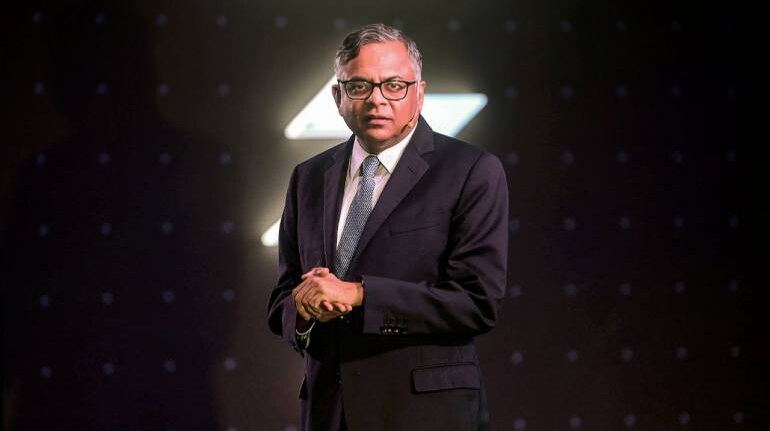
Tata Sons Chairman N Chandrasekaran on Monday said India needs to get as many different COVID-19 vaccine licences as possible and replicate multiple factories on a war footing to ramp up production in order to meet the requirements as the country reels under the devastating second wave of the pandemic.
Terming the second wave as 'concerning and scaring', the head of the over USD 100 billion conglomerate also called for accelerated tracing and vaccination and tracking supply of the vaccines while asserting that a nationwide lockdown is not the solution as it would hit the economy hard and impact people at the lower strata of the society to the largest extent.
"We need to get as many different vaccines licences as possible and we are going to scale up, even if we have to replicate multiple factories," Chandrasekaran said while speaking at an event organised by AIMA. He was responding to a query on how he would have handled the current situation if he were to be given the responsibility.
While terming it as a tough question, he added, "We have to really do this on a war footing..." Also, whatever investments are required need to be done in a short span so as to be able to scale up production, he emphasised.
"We need to figure out how we replicate, how do we mass produce, so that we are able to meet the requirement because this is something that needs to be done. It is an urgent situation," Chandrasekaran said. The immediate thing that can be done during this period, he said, "is to do tracing even now and vaccination" and track supply of vaccines.
On April 13, India had fast-tracked emergency use approval for eligible foreign-produced shots against COVID-19, in a move to expand its basket of vaccines and speed up the inoculation drive that got a boost with a third vaccine Sputnik V from Russia getting clearance. Already two vaccines -- Covaxin by Bharat Biotech and Covishield by Serum Institute of India (SII) -- are being used for inoculation in India.
Commenting on the possibility of lockdown and its impact, Chandrasekaran said, "The most important thing now is to manage the current situation very delicately. On the one hand, you have to protect people, you have to ensure that people don't end up in hospitals in large numbers. "At the same time, we protect the economy because there are segments of the society who will suffer so strongly because of severe economic disruptions. That's a fact of reality."
He further said, "We don't have 'either or option' unfortunately. We often like the binaries but this is not a binary option. This has to be carefully managed and we need to vaccinate at a level of urgency that we have never taken in any initiative at that pace. A lot needs to be done."
Stating that "nobody has been able to predict the behaviour of the pandemic in the last 12 months" and several countries have struggled, he said it was not the time for finger pointing.
"It is very unfair to be criticising somebody everyday. The nature of the beast is such that it has a lot of unpredictability. "No one predicted so many variants, we are learning new terms -- variants, mutation, double mutation. Every single day there are new things that we are learning. The way it has ramped up in the last 10 days or 2 weeks has taken everybody by surprise," he said.
However, he suggested the usage of artificial intelligence and predictive analytics based on what has been witnessed in places like Delhi and Mumbai. Chandrasekaran also declined to comment much on the impact of the second wave of the pandemic on the economy, saying "it will be a wrong day today to say too much about the economy because there is a lot of suffering. We need oxygen. We need hospital beds. We need the vaccines. We need Remdesivir. We need so many things... In a manner of speaking, today everybody's attention is to address these things."
He, however, said sectors like airlines and hospitality will take time to recover from the impact of the pandemic. Reiterating that a lockdown is not the solution to the current situation, he said, "If we go on a serious lockdown and these industries (manufacturing and construction) don't function, we are going to hurt the economy big time. When we hurt the economy big time, we will hurt a section of labourers big time, their livelihoods will suffer, which we saw last time."
Chandrasekaran suggested the use of predictive analytics to anticipate pockets where there will be rise in COVID-19 cases, learning from what has happened in Delhi and Mumbai and have a concerted plan to be able to handle those segments. "This is not a nationwide, one solution fits all," he asserted.
Discover the latest Business News, Sensex, and Nifty updates. Obtain Personal Finance insights, tax queries, and expert opinions on Moneycontrol or download the Moneycontrol App to stay updated!

Find the best of Al News in one place, specially curated for you every weekend.
Stay on top of the latest tech trends and biggest startup news.