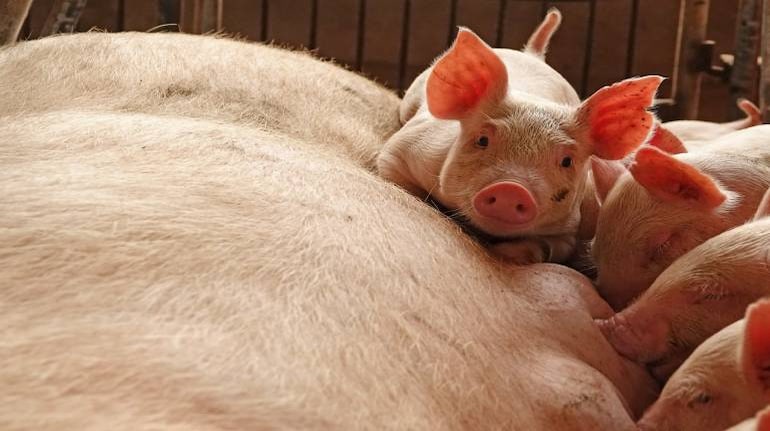
In the first instance of African swine fever in India, the disease has killed around 2,500 pigs across 306 villages in Assam.
"The National Institute of High Security Animal Diseases (NIHSAD), Bhopal, has confirmed that it is African Swine Fever (ASF). The central government has informed us that it is the first instance of the disease in the country," said Animal Husbandry Minister Atul Bora.
What is African swine fever?ASF is a highly contagious haemorrhagic viral disease of domestic and wild pigs. It is responsible for serious economic and production losses, according to the World Organization for Animal Health (OIE).
According to OIE’s website, the ASF is caused by a large DNA virus of the Asfarviridae family, which also infects ticks of the genus Ornithodoros.
Although signs of ASF and classical swine fever (CSF) may be similar, the ASF virus is unrelated to the CSF virus.
Transmission and spreadThe epidemiology of ASF is complex and varies depending on the environment, types of pig production systems, the presence or absence of competent tick vectors, human behaviour, and the presence/absence of wild pigs, according to OIE.
Routes of transmission can include:
> direct contact with infected domestic or wild pigs;
> indirect contact, through ingestion of contaminated material (e.g. food waste, feed, or garbage);
> contaminated fomites, or biological vectors (soft ticks of the genus Ornithodoros), where present.
Public health risk and vaccineUnlike swine flu that can spread from animals to humans, swine fever does not, and therefore is not a public health threat.
Currently, there is no approved vaccine for ASF.
What Assam is doing to prevent the spread of AFSThe state has discussed with experts if it can save the pigs without culling them, said Bora.
Despite the go-ahead from the Centre, the state government will not cull the animals immediately and choose an alternative option to prevent the spread of the disease, said Bora.
“The death percentage of the pigs affected by the disease is almost 100 percent. So we have made some strategies to save the pigs, which are not affected by the virus,” Bora said.
The department will collect samples within one km radius of the areas affected and test them, he said.
"After testing, we will cull only those pigs which will be found infected. We are avoiding the immediate culling of the pigs. We will have daily updates and take a decision as and when the situation demands," Bora said.
Further testing will be done in three Assam laboratories itself, he said.
The virus spreads through pig's meat, saliva, blood and tissue. So there will also be no transportation of pigs between districts, the state minister said.
Also, the state will see what can be done about pigs passing through Assam.
"We will have a surveillance zone within 10 km radius so that no pigs are transported out of the area or no feed is moved from a different location. We will also do GPS mapping," Bora added.
(With inputs from PTI)Discover the latest Business News, Sensex, and Nifty updates. Obtain Personal Finance insights, tax queries, and expert opinions on Moneycontrol or download the Moneycontrol App to stay updated!
Find the best of Al News in one place, specially curated for you every weekend.
Stay on top of the latest tech trends and biggest startup news.