

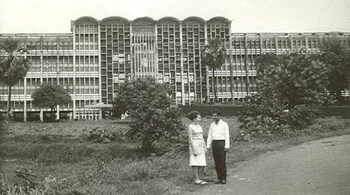
Earlier this year, QS World University Rankings listed the Indian Institute of Technology Bombay (IITB) as the top university in India. IITB moved up significantly in world rankings from 172 last year to 149 - breaching the top 150 and top 10 percent in QS World University Rankings for the first time.
Of the 40,000 who cracked the IIT (Advanced) 2022, 16,585 applicants had mentioned Computer Science at IITB as their first choice. And of the top 100 successful candidates, it was the first option for 90. In 2023-24 academic year, 47 of the top 50 have picked computer science at IITB.
The numbers are staggering, the reputation is unparalleled, and the stories many. But not many non-IITians know that the idea for an institution of technical eminence in India was articulated as early as 1945.
A high-powered committee headed by Sir Nalini Ranjan Sarkar, a businessman, educationist, industrialist and public figure, recommended in 1946 the establishment of four higher institutes of technology on the lines of their counterparts in Europe and the United States. In 1950, the first of the IITs was set up in Kharagpur at a site in Hijli village which used to be a detention camp. Four more IITs followed in quick succession - IIT Bombay was established in 1958, followed by those at Madras (1959), Kanpur (1959) and Delhi (1961).
Planning for the institute at Mumbai began in 1957 and a tract of semi-forest land between the two lakes, Powai and Vihar, was picked for the campus. The enclave was expansive and the institute campus at Powai extends over 200 hectares. The first batch of 100 students were admitted in 1958 and the first lecture was delivered on July 25, 1958.
IIT-Bombay was India’s first Advanced Centre of Learning and Research to be set up with foreign assistance – the cooperation and participation of UNESCO, utilizing the contribution of the government of the then Union of Soviet Socialist Republics (USSR). The Indian government’s initial estimate stood at $2 million for equipment and $1 million for recurring costs annually, over five years. This amounted to $7 million in all, or about 28 million rubles. The UNESCO promised half of the sum – 14 million rubles - and the Government of India was to be responsible for all other expenses, including the cost of buildings and recurring expenses. The institute received substantial assistance in the form of equipment and expert services from the former USSR through UNESCO from 1956 to 1973.
IITB received 59 experts and 14 technicians from several reputed institutions in the USSR. The UNESCO also offered fellowships, numbering 27, to train Indian faculty members in the USSR. Under the bilateral agreement of 1965, the Government of the USSR provided additional assistance to supplement the Aid Programme already received by the institute through UNESCO.
UNESCO’s generosity is commemorated on a plaque in IITB that reads: UNESCO’s assistance to the Indian Institute of Technology, Bombay Stands Unique as the First Venture of Generous Assistance in Establishing an Advanced Centre of Learning and Research’.
A total of 79 faculty were planned to be inducted - four professors, 29, assistant professors and 46 lecturers. In the early days, the Indo-Soviet team operated from IIT-Bombay’s first foster home: the Electrical Engineering department of the VJTI in Matunga.
On January 19, 1959, Brigadier Sisir Kumar Bose joined as the first director and served the tenure until June 9, 1969. He was actively involved in the construction of the buildings and laboratories at IITB while at IITB published a book titled The Early Years at IIT Bombay.
From July 1959 onwards, one half of IITB was functioning at Worli, catering to the 1958-batch while the freshers of 1959 were studying in Powai. For two years, IITB was a male preserve, the first female student, Tejaswini Saraf, joined in 1960, picking up electrical engineering – she was the lone female student among 300 boys. The Institute’s annual report for the year 1962-63 boasted of an achievement - the total number of women students had risen from 1 to 6.
In 1963, the first PhD of IITB was awarded to Dr V.R. Koteswara Rao of Chemical Engineering, who submitted his thesis in May 1963 and earned the doctoral degree in September that year.
IITB’s song: During the sixties, the institute picked a song to call its own - an incantation translated from the Bengali, its original credited to Nobel Laureate Rabindranath Tagore. The song is devotional in nature; in it the worshipper asks the 'Infinite One' to grant them, among other virtues, enlightenment, diligence, and fearlessness: arguably the prime ingredients of the academic spirit.
Currently, IITB has 16 departments with Economics being the newest. Beyond the academics, the institute has a Student Wellness Centre, half a dozen counsellors as well as a Student Mentor program.
What makes IITB so special?
“IITB is known for two things – it probably has the best academic and non-academic atmosphere and of course, the faculty. Add to it the benefit of being located in a major city,” a senior professor of IITB said. “We do not focus excessively on the ranking system. However, it means something, it is a rough indication of where we stand,” the professor added.
(Source: IIT-Bombay, and Monastery, Sanctuary, Laboratory, 50 Years of IIT-Bombay written by Rohit Manchanda)
Discover the latest Business News, Sensex, and Nifty updates. Obtain Personal Finance insights, tax queries, and expert opinions on Moneycontrol or download the Moneycontrol App to stay updated!





