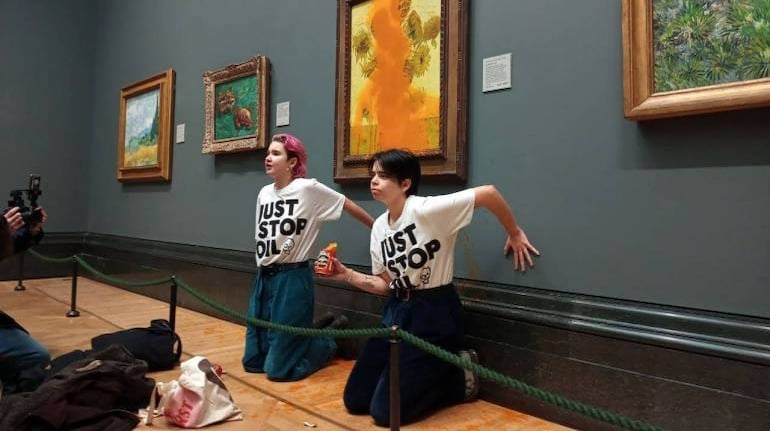
The reaction of many to last week's Just Stop Oil protest episode, where two protesters threw tomato soup at the Vincent van Gogh painting Sunflowers (1887) — one of the most prized possessions of the National Gallery, London — and glued themselves to the wall, sounded like Tennis legend and social-cause activist Martina Navratilova's.
"Effing morons — this is not the way to protest!" she tweeted. Others have called them "privileged White morons", "climate fanatics" and their act "pernicious protest".
While we gasped, the vandals raised a pertinent point — do we care more about the art sunflowers than the real ones? This is not to demean art or endorse destruction, however, if there remains no life, what will inspire art? And why were tin cans of soup chosen as a weapon of destruction? Look at the big picture.
 Just Stop Oil blocks throws soup on UK government building. (Photo: Juststopoil.org)
Climate change protests have been a concerted effort, and myriad groups of protestors — mostly visible in the Western world — have been on the rise. One such is Just Stop Oil. These UK-based climate protestors' group defines itself as a coalition working to “ensure that the government commits to ending all new licenses and consents for the exploration, development and production of fossil fuels in the UK.” And throwing soup was a symbolic resistance against the rising inflation in the UK, which is "part of the cost of the oil crisis. Fuel is unaffordable to millions of cold-hungry families, who can't even afford to heat a tin of soup," a protestor said.
Part of the group's daily, since October began, acts of resistance have also included blocking traffic and roads across the UK, climbing bridges, gluing themselves on tarmac, throwing soup at a government building (Department of Business, Energy and Industrial Strategy), spraying orange paint on police headquarters (New Scotland Yard) and showrooms of high-end brands (luxe carmaker Aston Martin, luxury department store Harrods).
 Just Stop Oil block traffic and spray paint on upmarket Aston Martin showroom (Photo: Juststopoil.org)
Vandalism, which uses shock therapy, provokes more than convey. Although insurers are now withdrawing from fossil fuel projects amid climate-change fears. The protests have most definitely stirred up that fear. What is amiss in these bursting-at-the-seams climate protests across the First World is the glaring absence of ethnic diversity, since climate change affects the developing world the most. To think that air pollution was a prime reason to have killed a nine-year-old Ella Adoo-Kissi-Debrah in London in 2013. The UK's first such case. While climate action should have primarily been the White man's burden all this time, in the wake of a depleting planet, any effort to save the Earth cannot and should not be exclusionary.
Forms of agitation include a whole gamut: sit-ins and dharnas, occupation of public spaces (the Occupy movement), marches (with placards, candle-light), civil disobedience, boycott, hunger strikes, demonstration (Greta Thunberg at World Economic Forum at Davos in 2020 and leading a global school-children protests), or, closer home, environmental movements like Bishnoi, Chipko, Appiko, Save Silent Valley, Save Aarey, Jungle Bachao Andolan, Narmada Bachao Andolan, Tehri Dam conflict, etc. While there are calmer and civil ways to register protest, to allow the brickbats and detractors to drown the very cause for protest — to effect immediate climate action — will be tragic.
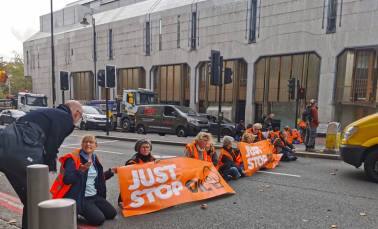 Just Stop Oil blocks road in the UK. (Photo: Juststopoil.org)
Just Stop Oil isn't alone in these series of shaken-and-stirred acts. Some of them are Extinction Rebellion (XR), Insulate Britain and Tyre Extinguishers in the UK, Blockade Australia and Fireproof in Australia, Ultima Generazione (Last Generation) in Italy, Letzte Generation (Last Generation) and Rocks in the Gearbox in Germany, Återställ Våtmarker in Sweden, Declare Emergency in the US, Save Old Growth in Canada, Renovate Switzerland, Stopp Oljeletinga! in Norway, Dernière Rénovationin France.
While blocking roads, traffic, and transport systems (in 2019, Extinction Rebellion blocked and glued themselves to trains in Canary Wharf) seem common praxis, here is a hit list of other targets of disruption in the name of climate:
Art
Earlier this year, a cake was flung at, and cream smeared on, Leonardo da Vinci's 16th century work Mona Lisa at the Louvre, Paris (Mona Lisa has been attacked in the past, too, by a rock in 1956 and a tea cup in 2009). Victims in the UK include the JMW Turner's 1809 romantic painting Tomson's Aeolian Harp, at Manchester Art Gallery (for it portrays a bucolic London around the Thames, which would be regularly flooded come 2030), Da Vinci's The Last Supper at The Royal Academy (to protest against crop failure and malnutrition), John Constable’s 1821 idyllic work The Hay Wain, at the National Gallery (on which was glued a colour printout showing a paved road, dead trees, factory smokestacks, airplanes). In Germany, Peter Paul Rubens' The Massacre of the Innocents, 1612, and in Italy, the ancient Laocoon sculpture in Vatican and Sandro Botticelli’s 15th century painting Primavera/Spring) faced the protesters' ire.
Would you call graffiti vandalism or protest art? Cultural vandalism has a longer history. Somewhere in that history, a British suffragette, used a meat cleaver to slash a portrait of philosopher Thomas Carlyle in London in 1914. Artist provocateur Ai Weiwei's 1995 black-and-white triptych photographic artwork Dropping a Han Dynasty Urn has him, literally, and symbolically, holding, dropping, and standing over the remains of the 2,000-year-old Chinese cultural symbol.
Banks
In April 2021, nine women, members of Extinction Rebellion, wielding hammers and tools labelled with “Love” and “We Act with Love”, smashed to smithereens 19 windows of the HSBC bank’s London headquarters building at the Canary Wharf, to protest against the said bank’s links to the fossil fuel industry. "Despite HSBC's pledge to shrink its carbon footprint to net zero by 2050, their current climate plan still allows the bank to finance coal power," noted a statement on the group's website. HSBC is Europe's second-largest financier of fossil fuels after Barclays, according to a 2020 study by Rainforest Action Network (RAN).
April this year saw a group of climate scientists chain themselves to — not vandalise — the investment bank JPMorgan Chase's Los Angeles building, to make the company stop funding fossil-fuel projects.
Oil companies
In April 2019, the Anglo-Dutch oil giant and world's leading natural-gas producer Shell's London headquarters was vandalised by Extinction Rebellion, causing around $7,800 worth of damage (smashed doors and glued their hands to windows), in a bid to draw attention to fossil fuels with their message "Shell Knows", which is a direct reference to Shell's 28-minute film, Climate of Concern (1991), which the oil company had issued as a warning of the catastrophic risks of climate change, it was meant for public viewing.
Coal plants
This September, the German police cleared protestors off the rail lines and a coal power plant near Hanover. In 2020, coal-fired power plant Datteln 4, owned by utility company Uniper, was occupied by over 100 activists. In 2019, thousands blocked the Lausitz Basin coal mines in east Germany.
In 2008, a coal train was halted outside Drax, Britain's biggest power station, and more than 20 tonnes of coal dumped on the tracks.
In November 2021, Blockade Australia shut down activity at the Port of Newcastle, a key bottleneck in the multibillion-dollar coal supply chain in the nearby Hunter region, bringing coal export to a standstill.
Car showroom
Tyre Extinguishers and Rocks in the Gearbox vandalise high-end cars (Jaguar, Land Rover, Aston Martin). This week, Just Stop Oil sprayed orange paint on Aston Martin's showroom in London.
Fashion shows
In October 2021, Extinction Rebellion members barged in and walked the ramp at Paris' Louis Vuitton fashion show with banner-messages such as "Overconsumption = Extinction". They hoped the government would enforce "an immediate reduction in production levels in the sector, since 42 garments were sold per person in France in 2019."
Sports tournaments
This September, at the Laver Cup, at the O2 Arena in London, in the middle of a match between Stefanos Tsitsipas and Diego Schwartzman, an activist rushed to the middle of the court and set his arm, and the playing surface, on fire. The man wore a white shirt and the message: "End UK Private Jets".
In June's semi-final match of the French Open between Marin Cilic and Casper Ruud, a woman walked on to the court and glued herself to the net, her T-shirt read: “We have 1028 days left”, signalling the UN report on climate change.
In July, nine activists from Dernière Rénovation group ambushed Tour de France, spraying thick smoke of colourful fumes, squatting on the bicycle race track, demanding French government to renovate all buildings for energy efficiency by 2040.
Same month, five Just Stop Oil members barged on to the British Grand Prix circuit demanding a halt on all new gas and oil projects in the UK.
Sure, these guys have no right to disrupt life and order. Sure, these White protesters aren't half as affected as the rest of us in the developing world. But while we question why they are resorting to such acts, it's high time we taxed the makers of decision, policies and profit.

Discover the latest Business News, Sensex, and Nifty updates. Obtain Personal Finance insights, tax queries, and expert opinions on Moneycontrol or download the Moneycontrol App to stay updated!

Find the best of Al News in one place, specially curated for you every weekend.
Stay on top of the latest tech trends and biggest startup news.