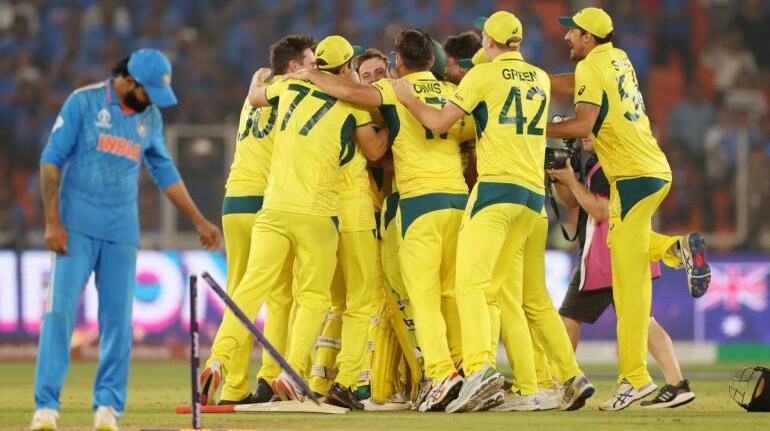
Three weeks back in Lucknow, India defended 229 for nine, their lowest total in the 2023 World Cup, with tiger-ish zeal. On a dicey track at the Ekana International Cricket Stadium that barely changed character for the duration of the game, they sent England packing for 129 to complete a crushing 100-run victory, riding on the strength of their formidable bowling unit to extend their winning run in the competition to six matches.
On Sunday in Ahmedabad, therefore, they wuld have had every reason to believe that their 240, admittedly below par, was sufficient to make a match of the final against Australia, the former champions with a sense of occasion and the ability to raise their game on the big stage. After all, India possessed, by a distance, the best bowling attack of the tournament, an attack that had attained exalted status because of the variety and incisiveness it possessed.
India wouldn’t have been unaware that unlike in Lucknow, the conditions would vastly vary during the two halves of the title clash. That, while in the first stanza, in natural light, batting wouldn’t be the easiest of tasks – not batting per se, but making big, fluent, attacking, aggressive, intimidating runs like India had all tournament – there wouldn’t be too much joy for bowlers under the floodlights that lit up the Narendra Modi Stadium.
A hundred thousand fans had made a beeline to the venue hours before the toss, convinced that a fairytale victory would herald the end of a 10-year drought for a global trophy. That belief was given wings by Rohit Sharma’s customary early fireworks that rocked Australia, but disturbed neither their focus nor their composure.
Such has been Rohit’s high-risk approach that a chance always appeared imminent. That he had stacked up 550 runs before the final in 10 innings despite taking it upon himself to fire the opening salvos is credit to India’s admirable and affable skipper, because to fuse unalloyed aggression with remarkable consistency doesn’t come to anyone beyond the chosen few. Rohit’s wasn’t mindless, premeditated ball-bashing. When he left his crease, it was at the proverbial last second, almost after the ball had left the bowler’s hand. When he launched into aerial assaults, it was with confidence and total commitment. But given his propensity to aspire for sixes, there was also the possibility that he would put one up in the air, put the opposition in business with one attacking stroke too many.
An average of 64 and a strike rate in the vicinity of 130 despite taking more than the odd calculated risk is tribute to Rohit’s remarkable hand-eye coordination as well as the burning desire to earn a World Cup winner’s medal around his neck. Still to reconcile to not being a part of the 2011 World Cup-winning side, Rohit came into this tournament in the knowledge that this would be his last tilt at the 50-over World Cup windmills. He exited Ahmedabad with his eyes shiny with unshed tears (in public), but also in the knowledge that he didn’t leave anything behind, that gave his team everything and more than he could.
Where England wilted under the combined might of India’s bowling, Australia showed why they have won the World Cup five times previously. Their quest of 241 for a sixth crown got off to an interesting start – 15 runs off Jasprit Bumrah’s first over, a wicket (David Warner) in the next, bowled by Mohammed Shami. Two more wickets lost inside the Powerplay, both to Bumrah, the first (Mitchell Marsh) to a loose stroke, the second (Steve Smith) to a horrible error of judgement with the batsman refusing to review a leg before decision when it appeared even in real time to the naked eye that he was outside off and attempting a stroke when he was struck on his pad.
The India of the previous 10 matches would have been all over Australia like a bad rash once they had reduced their opponents to 47 for three. This, sadly, wasn’t that India, not the gathering force that swept through the opposition like a gale force. Despite the triple strikes, there seemed a lack of conviction about their stint in the field. Maybe it was a hangover of their timidity with the bat that netted them only four fours in their last 40 overs, perhaps, it was the realisation that Australia are no England who will keel over at the first hint of pressure.
Almost certainly, it had something to do with the presence of a certain Travis Head in the opposition ranks.
 Travis Head scored a match-winning 137 off 120 balls in the India-Australia final on Sunday. (Photo: Getty Images)
India had a taste of the damage Head can leave in his wake in the final of the World Test Championship at The Oval in London this June. Then batting in the middle order, the left-hander had unleashed a bruising 163 to earn the Player of the Match honours in a contest the Aussies lorded by 209 runs. Head had provided an indication of what was to come with a sensational catch running backwards from cover to end the entertainment provided by Rohit, then chose to turn up the entertainment quotient a few notches with a flurry of boundaries that India were powerless to staunch.
For the first time in the competition, Ravindra Jadeja and Kuldeep Yadav both went wicketless in their 10 overs, failing to find the purchase that Adam Zampa, Head and Glenn Maxwell had in the afternoon. For the only time in the World Cup, Bumrah and his pace pack were defanged, reduced to a wing and a prayer as Head, fearlessly, and Marnus Labuschagne, with obdurate accumulation, thwarted their half-hearted designs. For the first time in the last 45 days, India’s die-hard fans feared the worst, feared that the heroes through whom they were seeking to live out their dreams might not deliver after all. For the first time in 11 matches, India were bested, their stirring run of 10 successive victories running into a tartar in the Aussies, the masters of the big stage with a penchant for the dramatic.
Head joined the peerless Ricky Ponting and the ebullient Adam Gilchrist as the only Aussies to score a hundred in a World Cup final. Like his illustrious predecessors, his effort, too, came in a winning cause. As the head of the team, Ponting had laid India asunder in 2003; 20 years on, Travis was the head as Australia silenced a huge crowd. And a nation still starved of global cricket success since 2013.
Discover the latest Business News, Sensex, and Nifty updates. Obtain Personal Finance insights, tax queries, and expert opinions on Moneycontrol or download the Moneycontrol App to stay updated!

Find the best of Al News in one place, specially curated for you every weekend.
Stay on top of the latest tech trends and biggest startup news.