

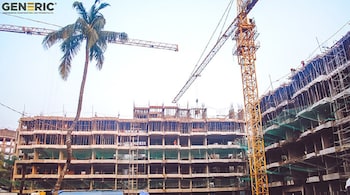
With COVID-19 cases rising in Maharashtra, several real estate developers are undertaking precautionary measures as mandated by the state government to ensure the safety of workers at construction sites and have urged the government to prioritise vaccination for workers above 18 years.
On April 4, the state government had announced several restrictions for containment of COVID-19 for the period up to April 30, 2021. Construction activity is to be allowed only for sites where labourers’ are living on site. Movement to and from the site must be avoided, except for the purposed of material movements.
The new guidelines have said that everyone engaged in the activity needs to get vaccinated at the earliest, as per criteria of GOI and until that is done they would have to carry a negative RTPCR test result certificate, which will be valid for 15 days. This rule will come into effect from April 10, 2021, the guidelines have said.
They have said that any defaults will lead to a fine of Rs 10,000 for the developer of the construction site and repeated defaults may lead to closure of the site till existence of notification of COVID-19 epidemic.
The guidelines have said that if a worker is found positive, he or she would be allowed medical leave and cannot be discontinued during this absence for this reason. “He or she will be entitled for full wages that he or she might have earned had he or she not contacted corona,” the guidelines said.
Real estate developers told Moneycontrol that they are adhering to the guidelines. Credai MCHI said that government protocols are being followed at construction sites and have urged the government to prioritise vaccination for workers above 18 years.
“Vaccination of construction workers is being undertaken across sites to safeguard their health and restrict transmission. Given that the workers belong to the lowest pay grade and are at a high risk of exposure, we urge the Government to allow prioritized vaccination of workers who are 18+ to ensure their safety,” it said.
“CREDAI MCHI and our over 1800 developer members are currently overseeing and implementing various safety initiatives and measures to ensure adequate preparation in view of the new set of restrictions imposed by the state government to combat the spread of the virus," said Deepak Goradia, president, CREDAI MCHI.
"We are grateful to the authorities for not putting a halt on construction activities and as a consequence, we are leaving no stone unturned to ensure the safety of our workers and employees at the construction sites. In addition to the basic accommodation and food/ refreshments amenities, CREDAI MCHI is also beginning a vaccination drive for all our workers to ensure maximum safety and restrict transmission,” he said.
Naredco said that all its members are adhering to the government guidelines.
Developers are aligning themselves with the well-balanced approach of the state government to break the chain and permit continuation of construction work by in-situ labourers. The industry has learnt from previous experience and made arrangement for migrant labourers and their families on the site, said Niranjan Hiranandani, national president, NAREDCO and MD, Hiranandani Group.
“We are following healthcare protocols, undertaking periodic check-ups, sanitization and accelerating the vaccination drive to ensure safety,” he added.
Anuj Khetan, director, Vijay Khetan Group, said that the company would provide paid leave to all the eligible workers for vaccination. “For workers we are getting RTPCR tests done as per the government guidelines. We are maintaining thorough sanitization at all our sites for the safety of our workers and stakeholders," he said.
Discover the latest Business News, Sensex, and Nifty updates. Obtain Personal Finance insights, tax queries, and expert opinions on Moneycontrol or download the Moneycontrol App to stay updated!





