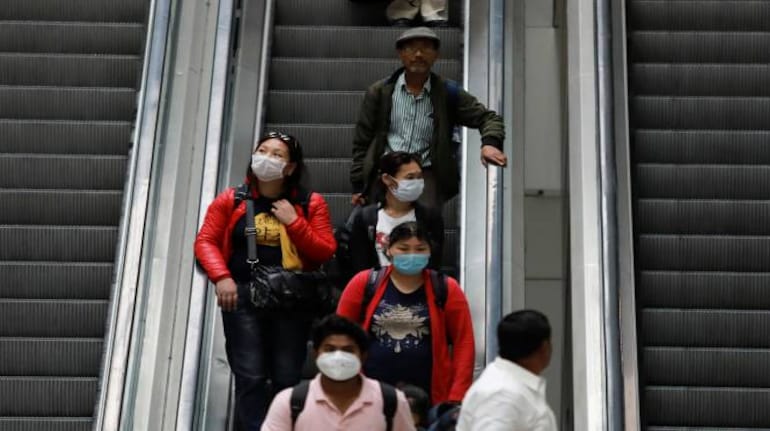
A day after the Indian government came out with guidelines to regulate the entry of international passengers from countries that have detected the Omicron variant of the coronavirus, many visitors had to wait at airports for more than three to four hours on average to complete testing procedures, travellers told Moneycontrol.
“Our flight landed at Delhi around 2:40 am and we were at the airport till 8 am, waiting for our RT-PCR test results before we were allowed to leave,” said a couple who arrived at New Delhi’s Indira Gandhi International Airport from London on December 1.
The couple said they were travelling on a budget to meet their families and had planned to visit India for a week, but due to new quarantine rules they would have to revise their travel plans.
The guidelines require those who test negative to quarantine at home and get tested again on the eighth day.
Another traveller on the same flight who was stuck at the airport for about six hours said that the faster Covid-19 test offered at the airport was very expensive and not everyone could afford it. He added that he missed his train to Lucknow because of the delay in leaving the airport.
An individual from Paris who landed in Kempegowda International Airport in Bengaluru at 12:40 am said he was in the airport till 6:30 am waiting for his RT-PCR test results. He spent the past 19 hours in airports or on a plane and is dreading the return trip, scheduled in two days.
However, most travellers also said that airport officials were doing their best to ensure that the testing process is carried out in a systematic manner and there is no chaos.
Smooth operations
Going forward, air passengers from “at-risk” countries may have to wait 3-4 hours for their test results before being allowed to leave.
Operations for international arrivals are running smoothly after implementation of the new guidelines, the Delhi Airport Twitter handle said in a series of posts.
The airport handled 1,013 passengers on four flights from “at-risk” countries on December 1. Of these passengers, 792 opted for the rapid PCR test and 221 passengers chose the RT-PCR test.
A rapid PCR test costs about Rs 4,000, whereas an RT-PCR test can cost Rs 500 to Rs 900, depending on the airport.
Chennai airport handled 88 passengers on flights from “at-risk” countries on December 1.
Mumbai’s Chhatrapati Shivaji Maharaj International Airport is scheduled to start testing passengers from “at-risk” countries from December 3, company officials said.
All airports in India have been asked to carve out a separate area for passengers arriving from “at-risk” countries.
Delhi airport can accommodate 1,400-1,500 passengers at a time. The waiting hall at Chennai airport can hold 700 passengers at a time and the airport authorities have asked incoming passengers to book their tests to reduce the wait time.
However, some people have raised concerns about the safety of passengers confined at airports.
Kiran Mazumdar-Shaw, founder of Biocon Ltd., tweeted that the extended waiting time for travellers at airports could also lead to people getting infected.
“Even if you did not have the infection, you are likely to acquire it at the airport!” she said on Twitter.
Exemptions removed
Following the emergence of the Omicron strain of the coronavirus, the Indian government released new guidelines on November 30, listing “at-risk” countries and removing exemptions for vaccinated people.
As per the guidelines, all countries in Europe, the UK, and South Africa, Brazil, Bangladesh, Botswana, China, Mauritius, New Zealand, Zimbabwe, Singapore, Hong Kong and Israel are considered “at risk.”
Passengers from these countries will have to undergo RT-PCR testing on arrival in India and wait for the results before leaving the airport or taking a connecting flight, according to the health ministry.
Travellers who test positive will be taken to a medical facility for isolation and their samples will be sent for genomic testing. If they are infected by variants other than Omicron, their release will be at the discretion of a doctor based on their condition.
Those who test negative will need to quarantine at home and get tested again on the eighth day. Travellers will also have to declare their travel history for the previous 14 days.
Discover the latest Business News, Sensex, and Nifty updates. Obtain Personal Finance insights, tax queries, and expert opinions on Moneycontrol or download the Moneycontrol App to stay updated!

Find the best of Al News in one place, specially curated for you every weekend.
Stay on top of the latest tech trends and biggest startup news.