






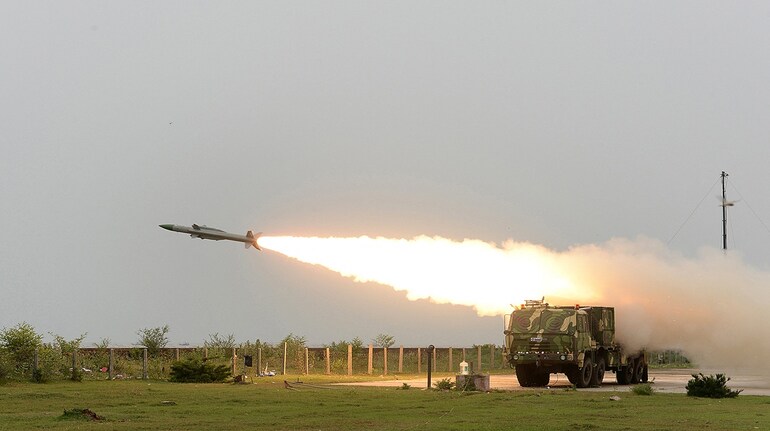
As India carried out precision strikes against terrorist camps in Pakistan, what it also showcased was its prowess in Made in India defence equipment. The country is learnt to have used the BrahMos supersonic cruise missile in targeting many Pakistan army and air bases, located deep within its territory.
Prime Minister Narendra Modi in his address to the nation on May 12 also highlighted India’s success in defence manufacturing. "During the operation (Operation Sindoor), our 'Made in India' defence equipment’s authenticity was established. Today the world is watching. 'Made in India' defence equipment’s time has come in 21st century warfare," Modi said.
India’s domestic defence industry has seen a sharp increase in output since 2015. The total value of indigenously produced equipment in FY24 was Rs 1.3 lakh crore, 174 percent higher than the figure of FY15. Crucially, from being a monopoly of state-owned enterprises, the sector now has a sizeable presence of private players, one that experts say should be enhanced further.
Made in IndiaRavi Kumar Gupta, a former director with the Defence Research and Development Organisation, told Moneycontrol that many of the military hardware developed largely indigenously, such as the Akash surface-to-air-missile (SAM) system; the Drone Detect, Deter, and Destroy System (D4S); as well as the BrahMos missile, were used in Operation Sindoor.
Gupta said as of today India has achieved almost-complete "atmanirbharta" (self-dependence) in radar installations and use. "The strength of India’s defence capabilities was clearly visible during the four-five-day operation. I must say Akash SAM played a bigger role (as against the Russian S400 system) in countering waves of drone and missile attacks from Pakistan," he said, adding that the private sector’s participation in the defence industry needs to be increased sharply.
The D4S played a stellar role in anti-drone deployment. Manufactured by Bharat Electronics Ltd, the D4S can be vehicle- or static-mounted with an integrated command and control centre. The vehicle-mounted versions are actively used in war-like situations, and the static units are deployed at key military installations, offering a 360-degree coverage.
During the May 7-11 conflict, India’s private sector also played a significant role in bolstering the country’s defence against its aggressor neighbour. Moneycontrol reported on May 9 the leading companies adding to India’s drone power: Tata Advanced Systems Limited, Adani Elbit, Adani Defence, Solar Industries, ZMotion Autonomous Systems, Raphe mPhibr and IdeaForge. All of them are actively supporting Indian defence forces with cutting-edge unmanned aerial platforms.
According to the Drone Federation of India, these companies are delivering a range of drone capabilities. Asteria Aerospace is providing surveillance UAVs or unmanned aerial vehicles, Solar Industries and ZMotion Autonomous Systems are supplying the Nagastra Loitering Munition Drone while Tata Advanced Systems is offering the ALS-50 Loitering Munition Drone.
Raphe mPhibr is contributing surveillance and logistics UAVs, Adani Alpha Design & Elbit Systems are providing the SkyStriker Loitering Munition Drone, Adani Defence is supplying the Drishti (Hermes 900) surveillance drone and IdeaForge is providing surveillance UAVs.
Agnishwar Jayaprakash, founder and CEO, Garuda Aerospace —one of India’s largest drone manufacturing start-ups—said that advancements in AI are revolutionising defence drones, enabling autonomous decision-making and enhanced payload accuracy through sophisticated targeting algorithms.
"AI is also helping in improving stealth capabilities via radar-absorbing materials and low-emission modes. Safety measures are also being integrated, including geofencing and collision avoidance systems," noted Jayaprakash.
Experts say that modern-day conflicts have become multidimensional, which require countries to have the capacity to improve their technological sophistication and enhance their military prowess.
"I must say, cutting-edge technology is not only restricted to the state sector. The Ukraine war, for instance, has been shaped by the private sector in many ways," said Harsh V Pant, vice president, Observer Research Foundation, a private think tank.
"Opening up space to the private sector has been an important development. In some ways, the process of bringing together the private sector and the state’s requirements with regards to defence has increased in the past few years, but it needs to be accelerated now," Pant added.
Role of private sectorA recent report by Elara Securities noted that India’s private sector is looking to increase its contribution to domestic defence production in the coming years. As of now, various companies are already involved in projects along with defence public sector units (DPSU) to supply components and subsystems. "However, these companies are looking at becoming full-scale system integrators to increase their TAM (total addressable market) to target large projects," said Harshit Kapadia, vice president, Elara Securities.
Companies such as Vem Technologies have developed fully indigenous anti-tank guided missiles in addition to supplying central fuselages to Hindustan Aeronautics Ltd for its light combat aircraft Tejas Mk 1. Additionally, prominent private sector companies such as L&T Defence, Adani Defence and Tata Advanced Systems are partnering global leaders to compete with DPSUs on various projects.
Defence minister Rajnath Singh had earlier said that he is optimistic the country would meet its domestic defence production and export targets by FY26. India now meets about 70 percent of its defence needs domestically, driven by increased budget allocation, private sector involvement and technology transfers.
The budget for FY26 allocated Rs 6.8 lakh crore to the Ministry of Defence, with 75 percent of modernisation funds earmarked for domestic procurement.
Discover the latest Business News, Sensex, and Nifty updates. Obtain Personal Finance insights, tax queries, and expert opinions on Moneycontrol or download the Moneycontrol App to stay updated!
Find the best of Al News in one place, specially curated for you every weekend.
Stay on top of the latest tech trends and biggest startup news.




