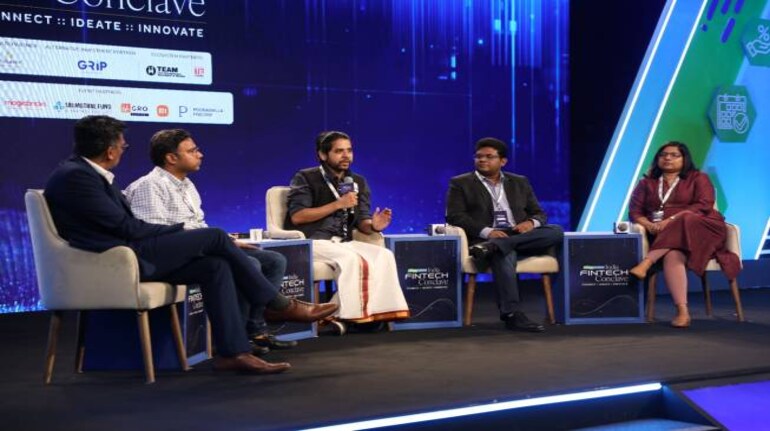


Moneycontrol's inaugural India Fintech Conclave (IFC) was held today. It featured power-packed discussions on the burgeoning financial technology or fintech landscape in the country as it puts the spotlight on defining trends to position the sector for transformational growth.
From Union Minister of State for Entrepreneurship, Skill Development, Electronics & Technology Rajeev Chandrasekhar, RBI's Executive Director Ajay Kumar Choudary to Zerodha founder and CEO Nithin Kamath, the MC fintech conclave saw discussions on pertinent topics such as digital payments, market regulations and lots more! Through fireside chats and deep-dive panel discussions, Moneycontrol's editors along with India's top industry leaders, changemakers, regulators, and unicorn founders probed the biggest trends that are reshaping fintech in India.
"We are definitely going to use AA Framework and this data is going to change the way we do lending." says DeenaJacob co-founder, CFO, Open
"Before digital lending guidelines came in the industry was confused about how things work and many assumptions were being made. This was the need for the DLG to come in" adds Madhusudan E, Co-founder, CEO, Kreditbee
"We are seeing a shift where public sector banks are trying to partner with NBFCs and that is adding an edge" says Gaurav Kumar, founder, CEO, Yubi. "Complexity on lending needs to be simplified. We need more horizontal business models within fintech which is both inter and intra operabld." he adds.
"The entire confusion or chaos that happened is that we started off when it was an unregulated space and the growth was massive. Then RBi felt that with this massive growth without regulation there could be systemic risk.There are two extreme views in fintech. Whenther fintechs are a challenge to bank… Then it was that whether fintechs are a bubble that will burst... But fintechs will coexist whether with banks or other institutions, they are nimble." he adds.
"Data is the new oil but did we have dearth of data today?This is where the challenge is.Open helps enable or make sense of this data"Deena Jacob co-founder, CFO, Open
- We have come to a critical point where we have to think about things over and above access. The market is forcing people to think about financial planning.
- The key thing back in 2016 was all about build fast and break things. Today, it has become about being compliant.
"No product is ever built until you go and speak to your customers" he adds
Radhika Gupta, MD and CEO, Edelweiss says that historically, the issues that have happened with the bond market have been related to transparency.
"DPIs are interplaying very well with each other.Look around you and see what has changed fundamentally for you. It will be one of the apps built on DPI: Kumar adds.
"In a few years time, every product or service owner will be able to catalogue it on this open network or ONDC" he said.E-commerce, according to him,will become just one more channel to sell.
- Future is not decades, but years. ONDC will lead to specialised buying applications which will help clients source what is good for them. E-commerce as we know today is going to become irrelevant
"If you are venture capital funded, you are dousing one fire after another throughout the day...The first advice anyone will give to a founder is to survive whether through DPI or a closed system." he says.
"There's a lot of excitement when somebody is fighting somebody else. Ours is an inclusive agenda" said T Koshy, ONDC CEO. "ONDC is an inclusive agenda. It is going to expand...Ecommerce is 5% on buying side and 1% on selling side in India today. This will balloon and expand" he adds.
"If you have to achieve 10X growth, huge investment is needed from the industry... Government incentives have helped us survive the zero-MDR in some way, but the government may change this,'' said Dilip Asbe of NPCI.
-"I think in thelast five years, the government and regulators have always be open with industry for QnA and other dialogues... When we say fintech has grown, the ecosystem is built too and wemust give the credit to the RBI,'' added Asbe.