

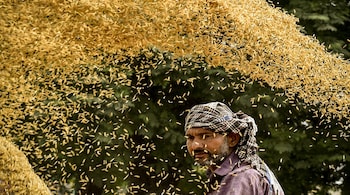
U.S. President Donald Trump, on Tuesday, raised concerns over the alleged “dumping” of Indian rice into the American market during a White House event where he announced $12 billion in new aid for U.S. farmers. Trump said he would “take care” of the issue, suggesting that cheap imports from India, Vietnam, and Thailand were hurting domestic producers.
“They shouldn’t be dumping,” Trump said, further adding, “I mean, I heard that, I heard that from others. You can’t do that.”
The U.S. President's latest remarks came amid complaints from farmers who blame falling rice prices on cheaper imports, putting pressure on the administration to support the farming community ahead of next year’s midterm elections.
What is rice dumping?
In trade terms, dumping occurs when a country sells a product abroad at a price lower than its domestic price or production cost. This can give exporters an unfair advantage, potentially harming local producers. In the U.S., some farmers argue that Indian rice imports undercut their crops, contributing to declining farm incomes.
Indian trade bodies, however, say the claims are overstated.
The Indian Rice Exporters Federation (IREF), on Tuesday, stated that most of the tariff burden is absorbed by U.S. consumers, while Indian exporters continue to receive stable returns.
Dev Garg, Vice President of IREF, said, “The Indian rice export industry is resilient and globally competitive. While the U.S. is an important destination, India’s rice exports are well-diversified across global markets. The Federation, in close coordination with the Government of India, continues to deepen trade partnerships and expand new markets for Indian rice.”
Meanwhile, according to the Global Trade Research Initiative (GTRI), Trump’s comments appear more political than policy-driven, aimed at appeasing domestic farmers during the election season.
Even if additional duties were imposed, the impact on Indian exporters would be limited due to strong demand in other markets. Conversely, higher tariffs could make rice costlier for American households dependent on Indian varieties.
It should be noted here that India is the world’s largest rice producer, projected to harvest around 150 million tonnes this season, giving it a 28 percent share of the global market. It is also the top rice exporter, accounting for 30.3 percent of global exports in 2024-25.
Despite U.S. scrutiny, American imports constitute less than 5 percent of India’s total basmati exports, with West Asia remaining the dominant destination.
In FY 2024-25, India exported 274,213 metric tonnes of basmati rice to the U.S., valued at $337.1 million, making the country the 4th largest market for Indian basmati. Non-basmati rice exports to the U.S. totaled 61,342 metric tonnes, worth $54.6 million.
Indian varieties like Basmati and Sona Masoori are highly prized for their aroma, texture, and elongation, and are largely consumed by South Asian and Gulf communities in the U.S. These varieties cannot be easily replaced by domestic American rice.
Also to be mentioned here is that, before Trump's latest tariff threat, Indian rice already faced a 10 percent duty in the U.S., which has now spiked to 50 percent for some categories. Despite this, exports continue to be resilient.
Global rice production is set to reach a record 556.4 million tonnes in 2025–26, according to the UN Food and Agriculture Organization. Strong harvests in India and elsewhere, combined with reduced purchases from major importers like Indonesia, are putting pressure on global prices.
Asia’s benchmark rice price fell to a 10-year low in October, easing household budgets but squeezing farm incomes from India to Thailand, according to a Bloomberg report released this November.
(Data inputs from agencies)
Discover the latest Business News, Sensex, and Nifty updates. Obtain Personal Finance insights, tax queries, and expert opinions on Moneycontrol or download the Moneycontrol App to stay updated!





