

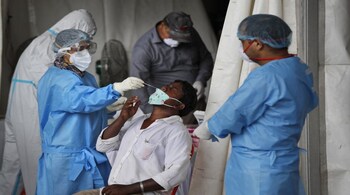
The central government on December 31 held a fresh meeting with top officials and experts to review the country's COVID-19 situation and the compliance with directions issued by Prime Minister Narendra Modi last week.
The meeting, chaired by P K Mishra, principal secretary to the prime minister, comes in the aftermath of Modi holding a high-level review meeting on December 22 in view of the concerns raised over the Omicron BF.7 variant of coronavirus.
Mishra was informed by officials that as per the prime minister's direction, a mock drill was held at several health facilities across the country on December 27. A total of 21,097 facilities, spread across all states and union territories, conducted the mock drill, of which 16,108 were government facilities.
"As directed by the prime minister, detailed guidelines for 2 percent random screening of international passengers on arrival were issued and 2 percent random sampling was initiated from December 24," a press release issued by the government, following the review meeting, stated.
As many as 1,716 international flights have been screened and 5,666 samples collected for COVID-19 testing, it added.
During the meeting, it was also noted that Union Health Minister Mansukh Mandaviya held a meeting with representatives of pharmaceutical companies and senior officials on December 29 to review the availability of medicines and monitor their stocks and prices.
The companies were also asked to keep a close watch on the global supply chain scenario, and to ensure adequate stocks and availability of all drugs including COVID drugs, the release said.
"As per directions, the Ministry of Commerce has been asked to monitor ongoing exports of medicinal products and equipment to China," it further added.
Mishra was also apprised by officials over the evolving global scenario of the pandemic, with spikes in cases observed in countries such as China, Japan, South Korea, Singapore, and Brazil.
Notably, the guideline for international arrivals was revised on December 29, with passengers coming from China, Singapore, Hong Kong, South Korea, Thailand, and Japan being required to under mandatory pre-departure RT-PCR testing from January 1.
In the review meeting chaired by Mishra, it was further noted that "strengthening of whole genome sequencing (WGS) and ensuring that larger number of samples are sent from across the country to INSACOG Network is being done, as per directions of PM", the release said.
Around 500 samples received during December 2022 are currently being genome sequenced by INSACOG Labs across the country, it added.
The status of vaccination was also reviewed with officials and experts. As per the recent numbers shared by the health ministry, more than 220 crore doses of COVID-19 vaccine have been administered, of which 102.56 crore first dose (97 percent) and 95.13 crore second dose (90 percent) have been given so far to the eligible beneficiaries.
Discover the latest Business News, Sensex, and Nifty updates. Obtain Personal Finance insights, tax queries, and expert opinions on Moneycontrol or download the Moneycontrol App to stay updated!





