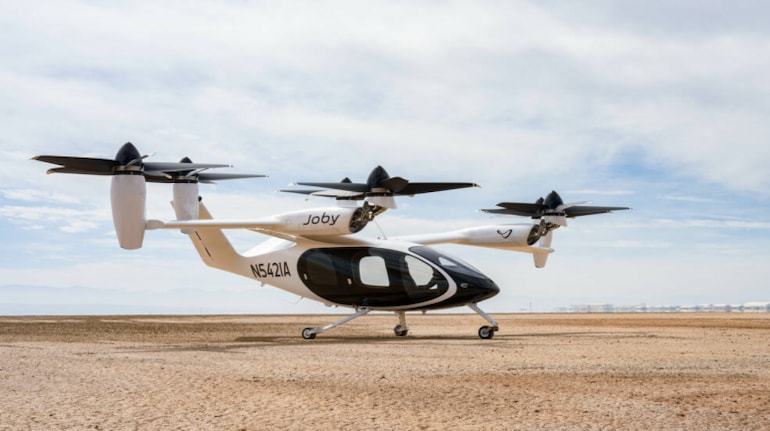
The notion that hundreds or even thousands of electric-powered air taxis could be whisking people over jammed roads is inching away from science fiction and closer to reality.
Battery technology is improving enough for eVTOLs short for electric vertical takeoffs and landings, the name given to these aircraft that can act like helicopters near the ground but fly like small planes. The bigger question may be whether there is a profitable business in producing them.
JoeBen Bevirt is an evangelist for the new industry and the founder and CEO of Joby Aviation Inc., which delivered its first eVTOL to the Air Force last month. Bevirt insists that his Santa Cruz, California-based company, whose largest shareholder is Toyota (11%), can meet an ambitious target of entering commercial air taxi service in 2025.
Like other eVTOL startups, Joby is losing money more than $400 million in 2021-2022. Analysts dont know when, if ever, it will be profitable.
Bevirt spoke to The Associated Press. His comments have been edited for length and clarity.
A. This has been my dream since I was a little boy. I wanted a better way for people to be able to get from A to B. In college (in 1993 at the University of California, Davis) I became convinced that electric propulsion was the way to make these aircraft sufficiently quiet, but at that point batteries didnt have the specific energy we needed. I came back to it 15 years ago and founded Joby Aviation once batteries had matured.
A. The first was to build an aircraft that was dramatically safer, was dramatically quieter, and that had operating economics that would make this a viable daily mode of transportation. And were very, very pleased with the progress weve made on delivering on those metrics.
A. I would like to see this be a mode of transportation thats accessible for people to use for a large percentage of the trips that they take. The progression from something that youre using occasionally — like you would use a taxi — to something thats more and more regular, well see how long that takes. I actually think its better to have a shared model where youre able to increase utilization. And you dont have a capital asset thats tied up for just a single user.
A. Thats one of the beautiful things about the air taxi model. You can think about it similarly to when you hail a taxi or an Uber. Your goal is to get from A to B. As the operator, Jobys role is to get you there as quickly and conveniently as possible.
A. This is something weve worked on and has been a passion of mine since the very founding of the company making an aircraft which is quiet enough to fit in the places where people want to go, something that sounds more like a whoosh that blends in the background than the whop-whop of a helicopter or the high-pitched whine that people associate with a drone or a small airplane. At 1,000 feet it is less than 45 decibels, so its below the background noise level of most cities.
A. Moving from maybe a little north of $5 a mile down below $5 a mile over the launch period.
A. It really comes down to utilization. The more of the seats that youre selling, the lower the cost per passenger, and the more hours per day the aircraft is flying, the lower the cost per passenger. (That will require making) the takeoff and landing locations and the overall experience compelling enough that were seeing a significant volume of people using it many hours per day.
A. The first piece is on pilot training. Were going to need to bring on large numbers of pilots, so building up that capability and those processes are really valuable. The next piece that weve also accomplished is building the infrastructure. And then the next piece is on the operations and building up the cadence, just getting good at operating the aircraft on a regular basis.
A. There will certainly be valuable learnings and the operational experience, the feedback from the Air Force pilots to the FAA flight-test pilots.
A. We have submitted all of our area-specific certification plans on stage three, and the FAA is making fantastic progress on approving those. Once those get approved it unlocks a big chunk of work that were able to submit to the FAA in preparation for stage four.
A. The big hurdle that lies between here and the finish line is a mountain of work of testing every single component and system for credit, whether thats environmental testing or structural testing. Were making fantastic progress on it. Were knocking them down one by one, but there is lots and lots of work to do.
A. Our goal is absolutely still to achieve commercial service in 2025, and given the progress were making on certification and the progress were making on the manufacturing front, were excited to just be day after day knocking down the milestones.
A. For our commercial service? Yes.
A. That is still in an ongoing investigation with the NTSB (National Transportation Safety Board), and so I cant comment on it, but I can say that we are extremely confident in the design of our aircraft.
A. Its really exciting — the birthplace of aviation. Dayton specifically is where the Wright brothers got going, and it has an incredible aviation heritage. Youve got Wright-Patterson Air Force Base, which is the home of the Air Force Research Laboratory and AFWERX (the Air Forces technology-innovation program). Ohio is the largest supplier of parts for Boeing and Airbus, so theres a deep manufacturing bench there.
A. Im very passionate about sustainable aviation and am very excited about what electric … propulsion can mean for aviation sustainability writ large.
Discover the latest Business News, Sensex, and Nifty updates. Obtain Personal Finance insights, tax queries, and expert opinions on Moneycontrol or download the Moneycontrol App to stay updated!
Find the best of Al News in one place, specially curated for you every weekend.
Stay on top of the latest tech trends and biggest startup news.