
India’s exports to the US fell sharply in September, but the headline 11 percent decline masks a more complex shift. While several traditional labour-intensive categories weakened, a close look at the April–September data shows that exporters are discovering new pockets of demand in categories such as electronics, speciality chemicals, machinery parts and even specific consumer goods such as golf balls.
The trend points to a steady diversification of India’s export basket, with niche and technology-linked products cushioning the impact of broader weakness.
Electronics has now moved to the centre of India’s trade relationship with the US. Smartphone exports surged from about $258 million to $885 million in September, a rise of more than 240 percent, making them one of the most significant positive contributors during the period.
The strength in electronics was not limited to finished devices. Upstream components and sub-assemblies also posted strong gains. Photovoltaic cell exports increased from $44.6 million to $79.4 million, while optical fibre bundles and cables rose more than sixfold to $25.6 million.
Digital processing machines, including laptops and palmtops, grew from a negligible $400,000 last year to $20.9 million this year. Even monitors used for data-processing systems, which had virtually zero exports in the base period, climbed to roughly $5.4 million.
Machinery components and automotive parts displayed a similar pattern of resilience. Several high-end items recorded strong gains, including parts of engines and motors, which grew nearly 72 percent. Exports of automatic bank-note dispensers also rose sharply, more than tripling from $3.2 million to $11.7 million. This expansion in capital goods and industrial components suggests that Indian firms are making inroads into niche segments of the US supply chain even as larger categories remain subdued.
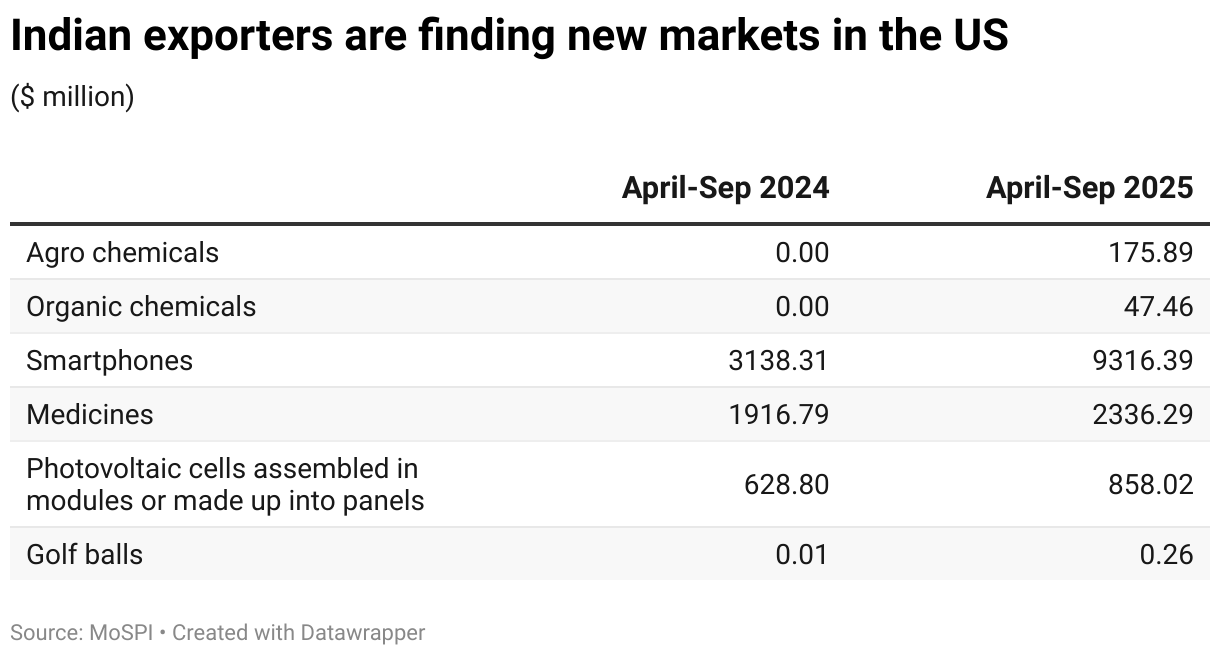
One of the more unexpected bright spots came from golf balls, which saw noticeably higher demand from US buyers. Their rise from a near-zero base reflects India’s growing foothold in the manufacturing of speciality and recreational goods.
Speciality chemicals and agro-chemicals also recorded impressive growth, largely because exports were negligible in the base period. Even though they started from a low base, the scale of expansion indicates a shift toward high-value, customised chemical products.
Pharmaceutical exports showed a split trend: while drug formulations such as non-steroidal anti-inflammatory and analgesic medicines grew about 36 percent, several specialised lines contracted steeply. Exports of anti-cancer drugs, for instance, fell nearly 89 percent to just $15 million.
The overall picture was weighed down by traditional labour-intensive sectors, which continue to struggle in the US market. Cotton T-shirt exports were down about 19 percent, while cotton bed sheets and bed covers declined by more than 53 percent. Carpets and floor-covering items also posted steep double-digit losses. Gems and jewellery, a longstanding pillar of India’s export basket, experienced some of the sharpest declines, with cut diamonds and gold jewellery falling between 30 percent and over 50 percent.
While India’s exports to the US contracted overall, the underlying shifts point to a structural diversification in India’s export profile.
Discover the latest Business News, Sensex, and Nifty updates. Obtain Personal Finance insights, tax queries, and expert opinions on Moneycontrol or download the Moneycontrol App to stay updated!

Find the best of Al News in one place, specially curated for you every weekend.
Stay on top of the latest tech trends and biggest startup news.