The live blog session has concluded. For more news, views and updates, stay tuned with Moneycontrol.com.


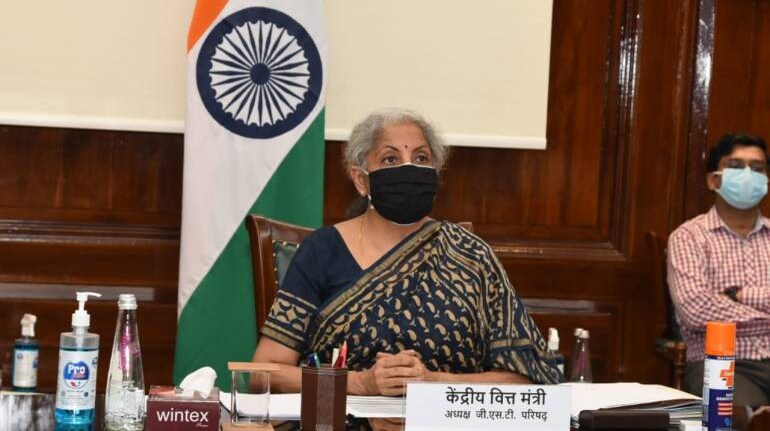
GST Council Meeting Highlights: Finance Minister Nirmala Sitharaman chaired the 44th GST Council Meeting via video conference on June 12. At the press briefing following the meeting, Sitharaman announced that the GoM's recommendation on bringing down rates on certain COVID-19 essentials have been accepted. The new rates will remain in effect till at least September 30. After the GST Council's previous meeting on May 28, a Group of Ministers (GoM) was set up to recommend tax relief on COVID essentials, including PPE kits, masks and vaccines, to the GST council. The GoM had recommended cutting the GST rates on a number of COVID-related essential items including medical oxygen, cylinders, ventilators, concentrators, and life-saving drugs like Remdesivir, which are domestically produced or commercially imported.
The live blog session has concluded. For more news, views and updates, stay tuned with Moneycontrol.com.
| The Goods and Service Tax Council, on the recommendation of the Group of Ministers (GoM), slashed the GST rates on a number of items crucial in the fight against the COVID-19 pandemic. These include essential medicines, oxygen, oxygen generation equipment and related devices, and diagnostic and testing machine kits.The new rates will remain in effect till at least September 30. Read full report.
The GST on anti-coagulants like Heparin, high flow nasal canula (HFNC) device and pulse oximeters has been reduced to 5 percent from 12 percent at present. The tax rate on"any other drug recommended by Ministry of Health and Family Welfare (MoHFW) and Dept. of Pharma (DoP) for Covid treatment" would also be capped at 5 percent, the Finance Ministry said.
The GST on hand sanitisers and temperature check equipment has been reduced to five percent from 18 percent at present, as per the press release issued by the Finance Ministry following the 44th GST Council meeting.
The GST on ventilators, medical grade oxygen, COVID-19 testing kits, oxygen concentrators and BiPAP machine have been brought down to 5 percent from 12 percent at present.
"Five percentGST on vaccines will stay. The Centre will buy the 75 percentvaccine as announced and will pay its GST too. But 70 percentof income from GST will be shared with states," Nirmala Sitharaman said, as she justified the decision to maintain GST on vaccines. Earlier, she had claimed that waiving off the GST would compel the manufacturers to raise the cost to offset the impact of taxes paid on inputs.
"GST rates have been decided for 4 categories of products- medicines, oxygen, oxygen-generation equipment, testing kits and other machines and other COVID19 related relief material. Rates to be announced soon,"Finance Minister Nirmala Sitharamansaid.
The GST Council has approvedrate reduction for Remdesivir from 12% to 5% and a nil tax would be charged onTocilizumab, the finance minister said.
"GST on electric furnaces and temperature checking equipment brought down to 5% and on ambulances to 12%. These rates will be valid till September as against August end recommended by the GoM,"Finance Minister Nirmala Sitharamansaid on the outcome of 44th GST Council meet.
No GST would be levied on Amphotericin B, the antifungal drug used for black fungus treatment, Nirmala Sitharaman said following the 44th GST Council Meeting.
There will be no change in the GST rate for COVID-19 vaccines, Finance Minister Nirmala Sitharaman said. The vaccines are currently charged a GST of 5 percent.
GST Council approved all recommendations of GoM on rate rationalisation.GST on ambulances reduced to 12 percent: CNBC-TV18, citing sources
The COVID-19 second wave resulted in further slowdown for startups that were just beginning to recuperate and revive from the impact that the first wave left on them. Despite good attention from the government, there are many sectors that have suffered due to the GST applicability in a manner that has eroded their working capital. Therefore, there is a definitive need now to ensure that corrective actions are taken to remove certain anomalies.
Let’s have a closer look into few of sectors that need immediate corrections.