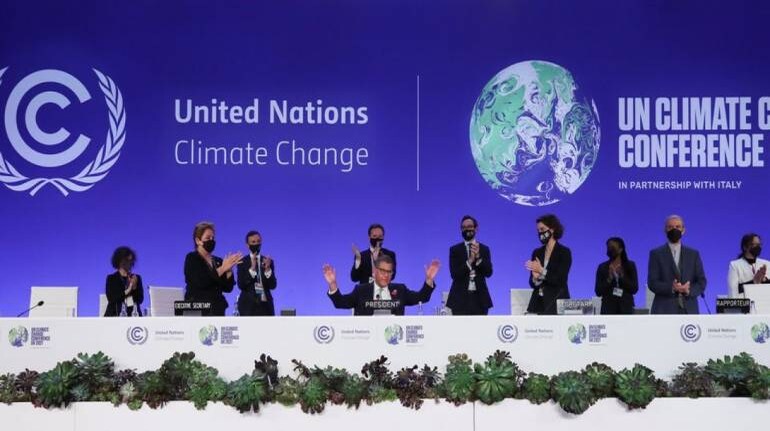
The government will take stock of developments at the recently concluded climate summit on November 22 and assess India’s new targets based on the latest declaration.
In what was one of the most-followed yet contentious such meetings till now, the 26th UN Climate Change Conference of the Parties (COP26) in Glasgow had sought stricter commitments from nations to check climate change, building on their pledges in Paris six years ago.
The COP26 deal promised to update the timeframe for revised targets for countries to the end of next year—much earlier than the initial goal of every five years, as laid out in the Paris Accord.
Back then, India had pledged to improve the emissions intensity of its GDP by 33-35 percent below 2005 levels by 2030, increase the share of non-fossil fuel-based electricity to 40 percent by 2030, and enhance its forest cover to absorb 2.5-3 billion tonnes of carbon dioxide by 2030.
This was updated at Glasgow, with India promising to increase installed renewable energy capacity to 500 GW, meet 50 percent of its energy needs from non-fossil fuel sources, and bring down the carbon emissions intensity of the economy by 45 per cent from 2005 levels.
“India had made one of the most promising national commitments among all large economies, to cut down on carbon intensity and reduce emissions. We will now work with all relevant ministries, government research facilities and environmental agencies at state and central levels to bring about that change. But first a timeline will be required,” a senior official with the Cabinet Secretariat said.
This timeline is set to be discussed on November 22 and relevant matters such as a rapid expansion in installed solar energy capacity marked out. Based on this, policy will be accommodated, another official said.
Glasgow deadlock
The final outcome, known as the Glasgow Climate Pact, reaffirms the devastating impact on humanity and the planet if the global temperature rises more than 1.5 degrees Celsius above pre-industrial age levels. But the participants stumbled on measures needed to reach the goal of containing the rise in temperature.
Reduction of emissions from coal, considered one of the most polluting of all fossil fuels, had been the target since the beginning of the summit. However, the demand for climate finance went on simultaneously.
Instead, the pact calls on 197 countries to report their progress towards more climate targets next year, at COP27, set to take place in the resort of Sharm el-Sheikh, Egypt. As a result, experts say that despite high ambitions, the text of the final agreement has barely managed to hold on to previous commitments. Senior United Nations officials have said this constitutes “the least worst outcome” as no country has left the summit fuming or happy.
No finance
Even before the delegates reached Glasgow, climate experts had stressed that the biggest issue at the summit would be the question of who would provide the promised $100 billion in annual climate finance and how. The Glasgow meeting started with the stated intention by all parties to find out how much money should be committed.
All nations now agree that upwards of $1 trillion—not the $100 billion estimated in 2008—would be required annually to help poorer nations mitigate and adapt to climate change-led extreme weather events.
But with the richest economies not agreeing on who will foot the bill and when the financial assistance will begin, the debate on climate finance has remained inconclusive.
Officials said the government will continue to bring up the issue at non-climate-related global conferences as well.
“Climate change is an emergency and India’s position, like so many other developing nations, is that national commitments will not mean much if the rich nations do not provide financial support. We will therefore continue to raise the issue at relevant multilateral fora,” a senior official said.
The deal asks rich countries to “at least double” by 2025 the sums they give to developing countries to help them adapt to climate change from 2019 levels.

Discover the latest Business News, Sensex, and Nifty updates. Obtain Personal Finance insights, tax queries, and expert opinions on Moneycontrol or download the Moneycontrol App to stay updated!

Find the best of Al News in one place, specially curated for you every weekend.
Stay on top of the latest tech trends and biggest startup news.