

Economic Survey 2018 outlined the reforms initiated by the government during the previous fiscal focused on empowering women and addressing gender parity issues.
“Among developing countries, there exists gender gaps in labour force participation rates…. In the case of India, the gender gap in labour force participation rate is more than 50 percentage points,” the survey said.
Economic survey, mooted as government’s report card for previous fiscal year, reflects on the various initiatives taken by the government.
Prepared by chief economic advisor, Arvind Subramanian, and his team the second volume of the survey highlighted that India has lower women participation in the labour force, “adversely affecting the growth potential of the economy”.
“Women workers are the most disadvantaged in the labour market as they constitute a very high proportion among the low skilled informal worker category,” the survey pointed out.
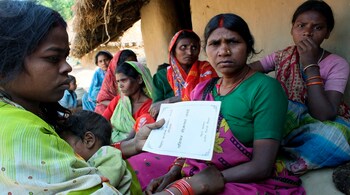
Women benefit the most from MGNREGA
Indian government implemented National Rural Employment Guarantee Act (later renamed Mahatma Gandhi NREGA) in 2005 to ensure enhancement of livelihood security of households in rural India.
The Act provides at least 100 days of wage employment to every household in rural India where adult members are engaged in volunteer manual labour work.
According to the Survey 2018, approximately 4.6 crore households were given employment under the scheme, of which 54 percent were taken up by women.
“As on 14th January, 2018, 54 percent (of the total employment generated) were generated by women, 22 percent by Schedule Castes and 17 percent by Schedule Tribes,” It said.
It said the trend regarding women taking up more than 50 percent of jobs offered through MGNREGA has been continuing since 2013-14.
Centre also brought some sweeping changes in the labour reforms for the benefit of women workers during 2017-18. These initiatives include establishing Mahila e-Haat and Maternity Benefit (Amendment) Act 2017.
While the former provides an online market place to approximately 3.75 lakh female sellers to market their products online, the latter enhanced maternity leaves up to 26 weeks (six months).
The Maternity Bill 2017, however, covers women labourers working with registered organisations, keeping a large number of female workers operating out of informal work environment out of the Act’s ambit.
Towards simpler Labour Acts
Apart from this, the Economic Survey highlighted that Modi government was progressing towards simpler rules and Acts governing labour market.
“The Government is in the process of rationalising 38 Central Labour Acts by framing relevant provisions of existing laws into four labour codes,” it said.
Centre plans to have only Wage Code, Code on Safety and Working Conditions, Code on Industrial Relations and Code on Social Security and Welfare to simply labour market rules and enhance social standing of workers.
“The codification of the labour laws is expected to remove the multiplicity of definitions and authorities leading to ease of compliance without compromising wage security and social security to the workers,” the survey said.
According to Centre for Monitoring Indian Economy, about 24.6 million persons (aged 15 years or above) were added to the labour force during 2017.
It was found that employment increased from 405.3 million in 2016 to 407.4 million (preliminary estimates) in 2017, implying an increase of 2 million jobs during the year.
“The 2 million increase in jobs in 2017 translates into a mere 0.5 percent growth. Urban employment grew by 2 percent while rural employment shrunk by 0.3 percent,” report by CMIE noted.
However, the number of persons who offered their services in the labour force shrunk by 15 million.
“The labour participation rate fell from 46.6 percent to 43.9 percent. Over 11 million (about 45 percent of the 24.6 million) should have joined the labour force but instead 15 million walked out of it. This is possibly a reflection of the stress on the jobs front. People have low hopes on finding jobs,” the report highlighted.
Discover the latest Business News, Sensex, and Nifty updates. Obtain Personal Finance insights, tax queries, and expert opinions on Moneycontrol or download the Moneycontrol App to stay updated!





