

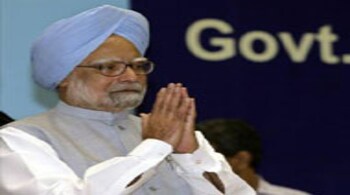
Describing the current economic situation as a difficult one, Prime Minister Manmohan Singh hinted at tough decisions like hike in energy prices and reduction of subsidies to achieve the growth target of 8 per cent in the 12th Five Year Plan. Inaugurating the National Development Council (NDC) meeting, Singh cautioned that "business as usual" policies will not be sufficient to achieve the scaled down growth target of 8 per cent, which he said was "ambitious".
The NDC, which comprises Cabinet Ministers and state Chief Ministers, is meeting here to approve the 12th Plan (2012-17) document. The Planning Commission for the second time proposed reduction in the average annual growth target for the 12th Plan. It was first scaled down from 9 per cent to 8.2 per cent and now to 8 per cent. Also Read: Tough to repeat '12 momentum; rate-cut impact low: ExpertsGovt mulls new taxes in Budget to boost revenue: Sources Noting that energy prices in India are "too low", Singh said, "some phased price adjustment is necessary". The central government and the states, he said, "must work together to create awareness in the public that we must limit the extent of energy subsidies". The Prime Minister further said that the 12th Plan has made a case for containing subsidy as failure to control them would mean that "other plan expenditures have to be cut or the fiscal deficit target exceeded". The Prime Minister said the current economic situation is "difficult" and steps needs to be taken to reverse the slowdown. "The continuing crisis in the global economy has reduced growth everywhere... Our first priority must be to reverse the slowdown. We cannot change the global economy, but we can do something about the domestic constraints which have contributed to downturn," Singh said. India's economic growth has declined to a nine-year low of 6.5 per cent in 2011-12. For the current fiscal, it is estimated at 5.7-5.9 per cent, which would be the lowest growth in the last decade. He termed scaling down of growth for 12th Plan to 8 per cent as a "reasonable modification". "I must emphasis that achieving an average of 8 per cent growth following less than 6 per cent in the first year is still an ambitious target... The high growth scenario will definitely not materialise if we follow 'a business as usual' policy," Singh added. Earlier, Planning Commission Deputy Chairman Montek Singh Ahluwalia said that in view of the domestic and global developments, the growth rate "associated with scenario one (most optimistic outlook) could be scaled down to 8 per cent". The Prime Minister emphasised that both the Centre and states should work towards increasing resources to finance programmes of inclusiveness. "If growth slows down, neither the states nor the Centre will have the resources needed to implement inclusiveness programmes. We will either be forced to cut these programmes or be pushed into tolerating a higher fiscal deficit, which will have other negative consequences," he said. _PAGEBREAK_ Seeking cooperation of the states to implement the GST regime, the Prime Minister said there is a need to increase the tax ratio as a percent of GDP through combination of tax reforms and better tax administration. "Early implementation of the Goods and Services Tax (GST) is critical in this context. I hope we will have the co-operation of the States to introduce the GST as quickly as possible," he said. Singh said growth rate of many states have improved in the recent years. "The average growth rate of the five poorest states exceeds the national average for the first time in any Plan. I think we may be reaching the stage when the term BIMARU states can be relegated to history," he said. During his address, the Prime Minister also made a reference to the recent gangrape of a 23-year old paramedic student in the capital. "The culprits have been apprehended, and the law will deal with them expeditiously. Government has decided to review the present laws and examine the levels of punishments in cases of aggravated sexual assault," he said. The issue of safety and security of women, Singh said, is of "highest concern ... There can be no meaningful development without the active participation of half the population and this participation simply cannot take place if their security is not assured". The government has already constituted a committee under former Supreme Court Chief Justice JS Verma and instituted a Commission of Inquiry to look into woman related issues. Referring to states' complaints regarding leakages and corruption in Central schemes, the Prime Minister said from January several subsidies would be transferred directly to the Aadhaar-linked banks accounts of beneficiaries. "In due course, a wide range of benefits like scholarships for students, pensions for the elderly, health benefits, MGNREGA wages and many other benefits will migrate to direct transfer into bank accounts," Singh said. This, he said, was also necessary to contain subsidies within the limits of fiscal sustainability. Elaborating on the urgency to deal with energy related issues, Singh said: "Unfortunately, energy is underpriced in our country. Our coal, petroleum products and natural gas are all priced well below international prices. "This also means that electricity is effectively underpriced, especially for some consumers. Immediate adjustment of prices to close the gap is not feasible, I realise this, but some phased price adjustment is necessary." Singh further said Centre and states must work together to create awareness about limiting the extent of energy subsidies. The experts, he said, are of unanimous opinion that the country cannot achieve rapid, inclusive and sustainable growth without adjusting the energy prices in line with world prices. Moreover, he added, there is also a need to moderate the demand of petroleum products as country is a net importer of this critical energy resource. India imports over 75 per cent of its crude oil requirement. Singh also said the recently created Cabinet Committee on Investment under his chairmanship will help in speeding up clearances to large projects which are stuck.
Discover the latest Business News, Sensex, and Nifty updates. Obtain Personal Finance insights, tax queries, and expert opinions on Moneycontrol or download the Moneycontrol App to stay updated!





