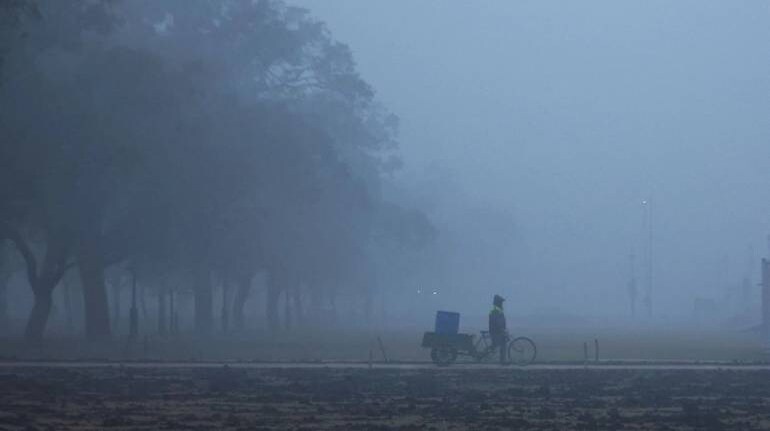
High amount of particulate pollution in Delhi during the winter nights in 2019 was caused by biomass burning, according to a study by two IITs and the Central Pollution Control Board (CPCB).
The study was conducted by Indian Institutes of Technology (IIT) Delhi and Kanpur along with researchers from Paul Scherrer Institut (PSI) Switzerland and University Helsinki, Finland.
The study has been published in Nature Geoscience journal.
"Delhi often experiences high amount of particulate pollution also termed as haze. However, exact reasons behind their formation was hitherto unknown.
"The exhaustive research unearthed the reason behind the severe haze events experienced during winters in Delhi which is one of the world's most-populated cities," said Sachchida Nand Tripathi, from IIT Kanpur who was the Principal Investigator in the study.
"The uncontrolled biomass burning for residential heating and cooking in the IndoGangetic plain gives rise to ultrafine particles, affecting the health of five per cent of the world's population and impacting the regional climate.
"Regulating the uncontrolled biomass-combustion emissions may help inhibit nocturnal haze formation and improve health. The study becomes important as air pollution is responsible for 18 per cent of the total annual premature deaths in India," he added.
The study was conducted in Delhi during the winter months of 2019 where aerosol size distribution and molecular composition of ambient aerosols and gases were measured.
The measurements helped calculate growth of aerosols during night time along with the sources of aerosols and also the sources of gases, it said.
"The study found that very high growth rates (tens of nano meter per hour) of aerosols especially for those smaller than 100 nano meters (nano particles) have been found in unfavourable new particle formation conditions compared to other places in the world, leading to haze formation in an span of few hours during extreme pollution events," it said.
It said the molecular information about aerosols clearly showed that organic vapours from biomass burning contributed to the growth of nano particles.
"It was also found that the composition of particles whose sizes were greater than 100 nano meter particles composition were dominated by ammonium and chloride species.
"Simultaneously, measurements of gases at molecular level showed that the biomass burning sources were their chief source which has preferential condensation on nano particles," he said.
Tripathi pointed out that thermodynamic modelling of gaseous partitioning confirmed the observational findings.
"The study points out that the reduction of uncontrolled combustion, especially during conducive weather conditions, may limit the amount of supersaturated vapours available for nanoparticle growth and hence may be an effective strategy for the mitigation of nocturnal particulate number during haze in Delhi," he said.
Discover the latest Business News, Sensex, and Nifty updates. Obtain Personal Finance insights, tax queries, and expert opinions on Moneycontrol or download the Moneycontrol App to stay updated!
Find the best of Al News in one place, specially curated for you every weekend.
Stay on top of the latest tech trends and biggest startup news.