Chances are you’d have heard of Abanindranath Tagore, Jamini Roy, SH Raza, FN Souza, MF Husain but not of Lalit Mohan Sen. The history of modern Indian art is a story of myriad art groups flourishing across India, at different points in time, in which each artist, while retaining their independent style, appeared publicly as part of a group’s voice. But there were outliers like Sen, who belonged to no such progressive art groups or movements.
In 1898, born into a textile-industry family in Shantipur, in Bengal’s Nadia, Sen shifted to Lucknow owing to a sudden outbreak of malaria in 1909. He studied at the British-established Government School of Arts and Crafts. After a London Royal College of Art fellowship in 1925, under the wings of artist-principal William Rothenstein, he returned to teach in India in 1945.
Kolkata’s Emami Art gallery has been trying to rescue this artist from obscurity, bringing his contribution — textile design, painting, printmaking, sculpture, photography — into the art historical discourse. In 2023, at “Lalit Mohan Sen: An Enduring Legacy”, it exhibited a small retrospective section of his vast photographic collection. The gallery has now brought Sen’s oeuvre to the fourth edition of the Chennai Photo Biennale (spread in three phases from December 20-March 16), and is themed ‘Why do we take photos?’, inspired by artist-photographer Dayanita Singh. The exhibition “An Enduring Legacy: Lalit Mohan Sen” opened on January 18 and will be on show till February 15 at Alliance Française of Madras.
It is the first major exhibition, with around 70 works, focusing entirely on Sen’s photographic practices — a hitherto unexplored trajectory of his artistic practice — and includes diverse genres of his photographic works: photographs of posed models, landscape and ethnographic portraiture, produced in the last two decades of his life. “His photography was never an isolated practice but rather closely connected to the other spheres of his artistic practice, exploring the ethos of naturalism,” says Ushmita Sahu, director and head curator at Emami Art.
 'Puff Your Blues Away' by Lalit Mohan Sen.
In Puff Your Blues Away, a 12x10-inch sepia-hued silver gelatin print of a photograph Lalit Mohan Sen shot in 1940s Garhwal, a Pahadi woman smiles with a cigarette in one hand and a metal pot on her head. Her nose ring touching her chin. Her visage, serene. Her head veil tied back, just the way Mother Mary did. In Boys Waiting at a Tea Shop, five boys in Gandhi topis (caps) sit on a bench, turning around to look at another boy as one of them looks straight at us, thus breaking the fourth wall. There are other images of agriculture, a file of bent women yanking crops in Harvest Season to men throwing haystacks onto trucks in Loading Hay. From a mid-length shot of a glum-looking, white-saree-clad tribal girl from the plains to a zoomed-in face of a Jaunsari tribe woman of Uttarakhand, the photographs are slices of daily life of village folks. The sepia tones, white scratches and torn corner are telling of their rescuing from the past and obsolescence.
 'Harvest Season' by Lalit Mohan Sen.
The exhibition connects the myriad genres of Sen’s photographs to the institutional, cultural, and political atmospheres of the day. Sen died young, aged 56, in 1954, “during the last decade of his life, when he was the principal of Lucknow School of Art, Sen created a vast body of photographs of the hill people of the Garhwal regions of the Himalayas. These photographs, which make up a significant part of his photographic oeuvre, reveal, on the one hand, his admiration for Gandhi and his preference for the rural people and culture of India and, on the other hand, his close friendship with renowned anthropologist DN Majumder,” adds Sahu.
 'Boys Waiting at a Tea Shop' by Lalit Mohan Sen.
In his photographs, there’s an unboxing of preconceived ideas that the viewer might come bearing. Like in Puff Your Blues Away, you’d imagine the woman to be holding a local beedi, not the more urban, expensive, commercially-produced cigarette the Britishers brought in their wake; was it then placed there by the photographer as he asked his subject to pose for him? The amused village hill woman seems to be in cahoots with Sen. In Boys Waiting at a Tea Shop, the pubescent boys are in Gandhi topi. Seems incongruous, unless these boys, huddled together for tea, were non-violent foot-soldiers of the Indian freedom movement or did Sen ask them to wear these and pose — certainly not to make a fashion statement but a political one. The performative and the play undercuts any objectification of the subject, in fact, it subverts the very trope deployed by the White man’s gaze in Orientalist photography — fervently criticised by literary critic Edward Said — even as some of these depict the “ethnic or occupational types”.
Sen, the British-educated Indian artist, might speak in the master’s language (British academic art) but, as a nationalist and Gandhian, spoke his own truth, blending academic realism with modern Indian artists’ search for alternative formal sources from Indian folk and indigenous cultures.
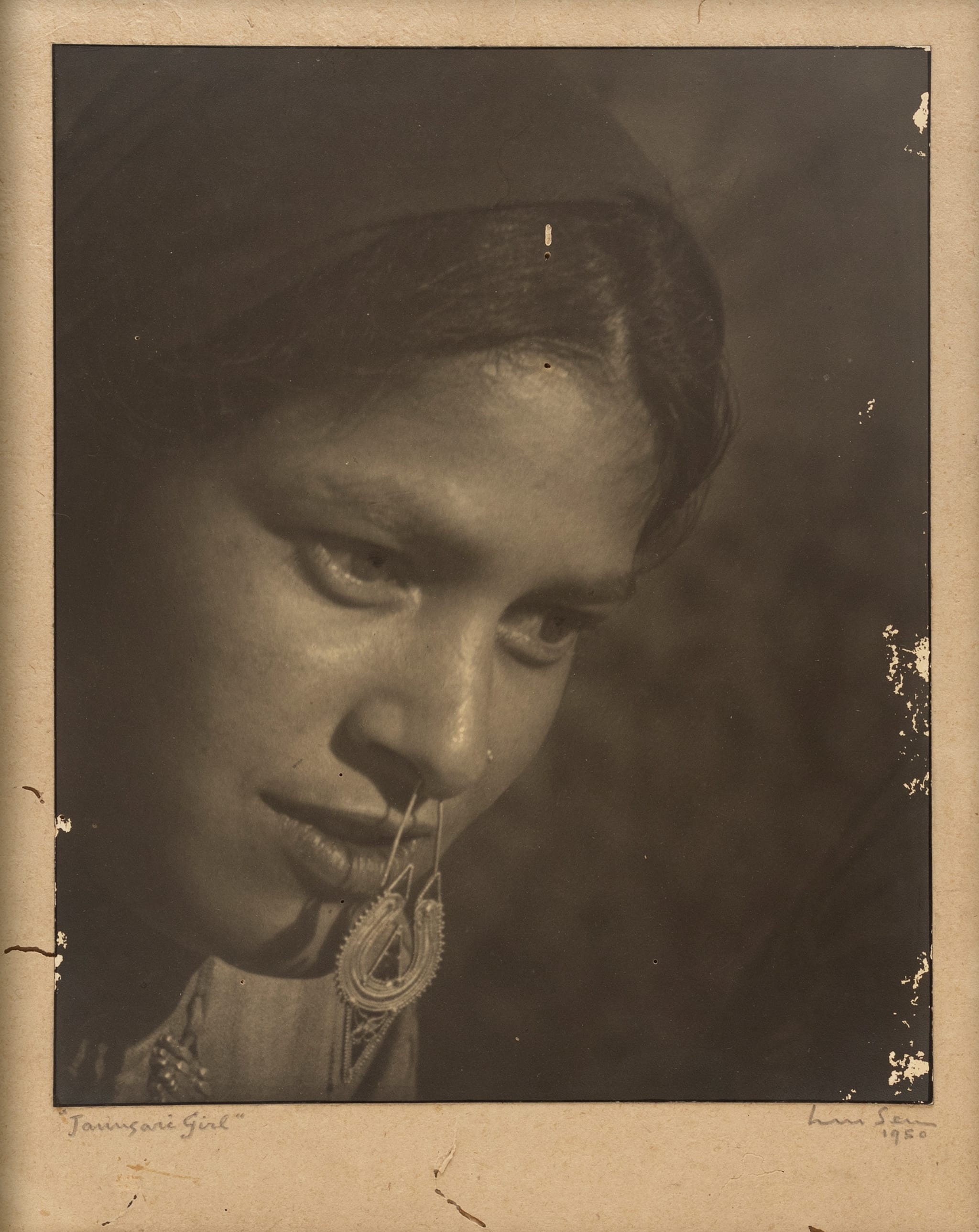 'Jaunsari Girl' by Lalit Mohan Sen.
Edited excerpts from an email interview with Ushmita Sahu:
Tell us about Lalit Mohan Sen’s enigma.
The most significant aspect of Sen’s artistic career is his syncretic nature of practice, which allows diverse mediums, genres and styles to co-exist and cohere. Despite his adherence to Indian nationalism, he let creativity express itself through many channels.
He was interested in depicting indigenous people and villagers. This has a deeper connection to Gandhi’s primitivism, as explained by Partha Mitter in his book on Indian modernism [The Triumph of Modernism: India’s Artists and the Avant-Garde 1922-1947]. Instead of exposing the suffering or resistance of the people, he mainly looked at the tribal villagers in the distant Himalayan forests as the true face of India. Many portraits and photographs in this show testify to this. Gandhi lay deep in his consciousness.
What has been a predominant or recurring subject/theme in Sen’s oeuvre?
Trained in the British academic style, the human body holds the central stage of his oeuvre.
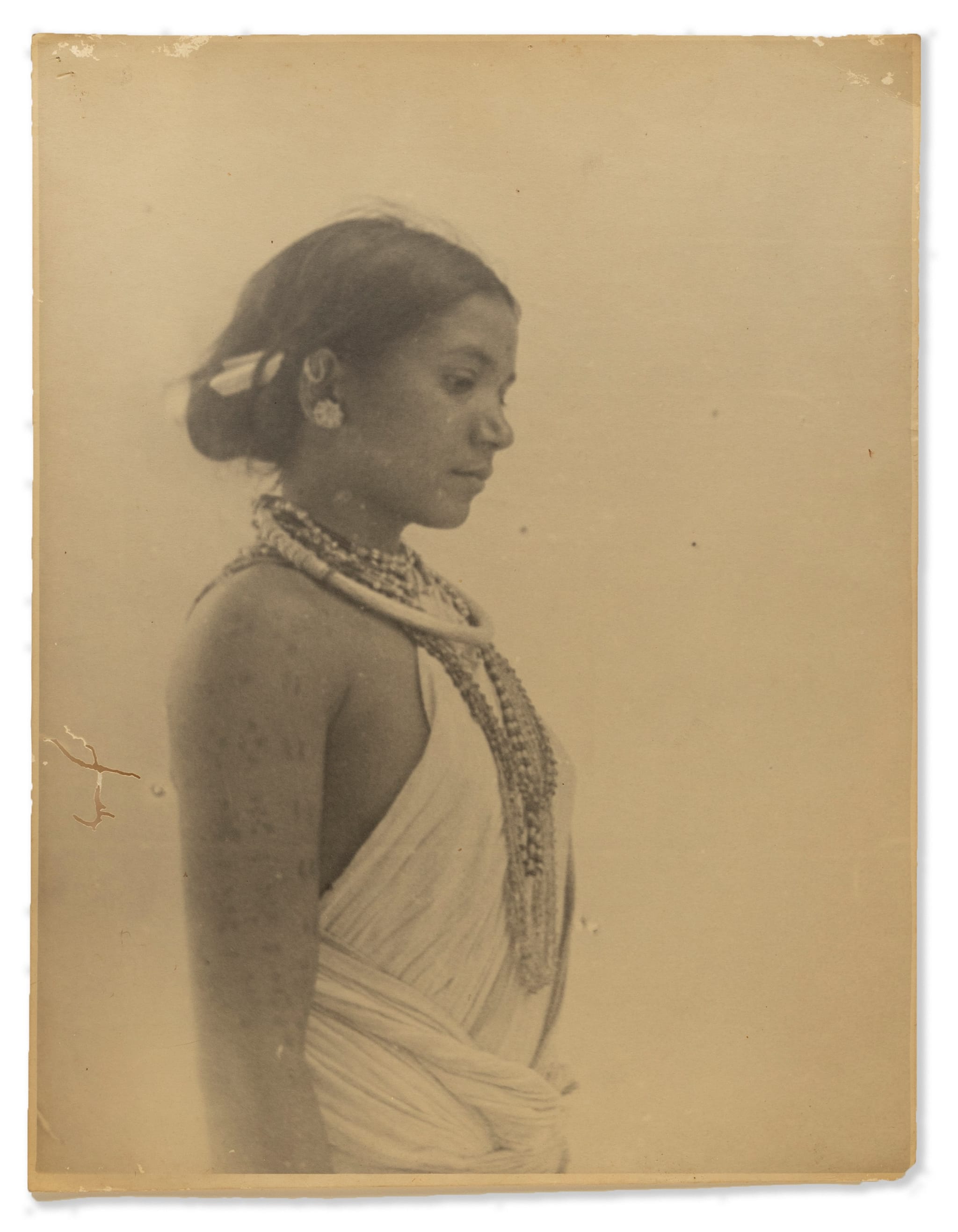 'Village Girl' by Lalit Mohan Sen.
Like painter Hemen Mazumdar, in what way was Sen going against popular art groups/movements like the Bengal School of Art, Santiniketan School, Calcutta Group, Bombay Progressives, Baroda Group and Madras Art Movement?
Based in Lucknow, he was away from the cultural centres of Bengal or Bombay. But he was never isolated, rather he was a good friend of some prominent artists associated with the groups you mentioned. He also participated in many exhibitions in Bengal, and Abanindranath [Tagore] is said to have admired his work. However, he loved independence and explored both academic realism and the Indian style of painting, craft and applied art.
He trained in various styles and mediums and never wanted to develop a trademark style or follow any manifesto in his artistic practices. He valued expression and believed every artistic style and medium — fine or functional — serve distinct purposes. Sen’s name does not bring any specific style to our minds. However, what holds his diverse work together is not his style but his unique attitude towards art and life.
Please throw some light on Lalit Mohan Sen’s photography and printmaking.
Sen, one of the pioneers of modern printmaking in India, showed incredible dexterity in black and white linocut and woodcut, his prime mediums. Although he focused on the naturalistic details, his graphic prints show the bold lines and precise distribution of dark and light areas, endowing the work with an emphatic graphic presence.
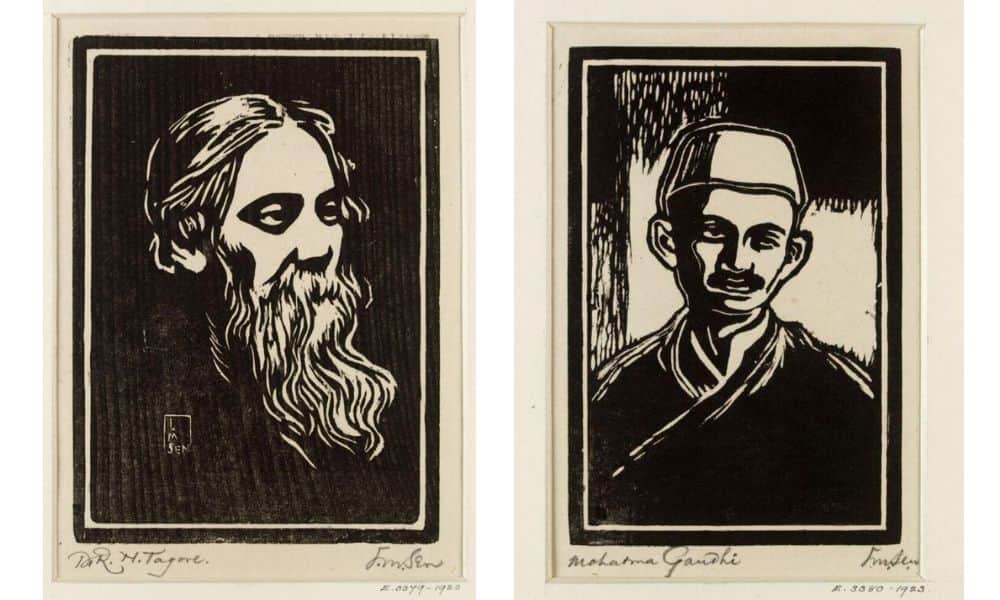 Rabindranath Tagore and Mahatma Gandhi woodcuts by Lalit Mohan Sen.
He was the first Indian artist whose woodcuts of Gandhi and Rabindranath [Tagore], done in 1922, were acquired by London’s Victoria and Albert Museum for permanent display. He joined the Royal College of Art’s Engraving School under Prof. Malcolm Osborne in 1925 and did his first etching there and earned a special certificate in wood engraving, besides a diploma in drawing and painting.
Sen is widely known for his woodcuts and linocuts. In the Emami Art collection, we have three albums: Woodcuts (1928; 15 woodcuts); Badrinath Sketches in Lino and Woodcuts (1940, 13 folios); and Amarabatir Rajkumarir Snan-Yatra (1941; 8 folios). Many of his woodcuts and linocuts, even those in the albums, were published in popular magazines like Aloka, Shilpi and The Hindoostan. He also created linocuts for books, such as Snowballs of Garhwal (1946) and Field Songs of Chattisgarh (1947).
He is more widely known as a printmaker than a photographer. Not many artists, art historians, and scholars know about his photographs. As a photographer, he enjoyed the medium and explored its beauty in monochromatic images. His pictures are mostly black and white, which he often used for creating his paintings, drawings and prints. He experimented extensively with the photographic medium, using various kinds of paper and techniques, such as Bromoil, to create different visual effects. He took pictures of the posed models, many of whom were indigenous people from Uttarakhand’s Garhwal regions.
Sen, while studying at London’s Royal College of Art became a member of the Royal Photographic Society of Great Britain in early 1925. However, his earliest photograph in our collection dates back to 1922, taken in Kashmir. In London, he regularly practised photography. He played a crucial role in spreading photographic culture in India through the UP Amateur Photographic Association (Est. c. 1933). He is said to have established a Commercial Art section at Lucknow Art School, where photography was taught.
 'Loading Hay' by Lalit Mohan Sen.
What has been Sen’s legacy?
Sen died in 1954, and people forgot him soon. The scholars also did not find his work easy to fit into their categories. He was a great teacher who inspired generations of students in the art school. His emphasis on medium-specificity and open outlook towards artistic practices and styles are relevant today.
Discover the latest Business News, Sensex, and Nifty updates. Obtain Personal Finance insights, tax queries, and expert opinions on Moneycontrol or download the Moneycontrol App to stay updated!

Find the best of Al News in one place, specially curated for you every weekend.
Stay on top of the latest tech trends and biggest startup news.